These Portland food workers see the bright side of the dark before the dawn

For those of us on standard day shifts, there’s a certain mystery and exoticism to people who work before dawn.
In the food world, bakers are known for starting their days in the dark, which is also famously when it’s time to make the doughnuts. We recently clocked in on the early shift to observe the routines of two other food producers: a barbecue pitmaster, and a small-batch coffee roaster.
They enjoy the solitude that affords them peaceful yet highly productive mornings. They’re partnered with their equipment, a customized, reverse-flow smoker and a RoasTronix S9X coffee roaster. They know the strengths and quirks of these quiet co-workers inside out.
When the clocks fall back to standard time on Sunday, they gain a little extra morning light for several weeks. But — except maybe during the deepest gloom of winter — it seems their passion for their work transcends the darkness altogether.

Ben Bellevue pulls a tray of meat from a rack in a walk-in cooler in the smokehouse at Terlingua in Portland. (Gregory Rec/Staff Photographer)
KEEPER OF THE FLAME
Low and slow is barbecue’s mantra. To render tough, primal cuts of meat into smoke-seasoned, juicy and meltingly tender treasures, you need to cook them at low temperatures, very slowly.
The beloved brisket at Terlingua in Portland spends at least 12 hours in the smoker, mostly at about 250 degrees, for instance. The restaurant has a gas-assisted, overnight smoker inside the kitchen to help augment its supply. But the bulk of their smoked meats — including pork shoulder, ribs, chicken, turkey and specialty cuts like beef cheeks — start cooking every day before dawn in the smokehouse, an attached shed just behind the kitchen.
Advertisement
Terlingua pitmaster Ben Bellevue starts his day there at 5 a.m. It helps that his commute is just 15 seconds, door-to-door; he lives with his wife and young son directly above the Washington Avenue restaurant’s dining room.
First order of business: Start the fire. Bellevue steps down into the smokehouse and makes for the custom-built, reverse-flow smoker. Terlingua co-owner Pliny Reynolds and his metalworker friend crafted the vaguely steampunk unit from a 500-gallon water tank and a Warner wood stove.
Bellevue lights grease-soaked butcher paper and kindling in the firebox. Its flat, cast-iron top gets so hot, he’ll sometimes cook his breakfast on it. Once the ember base is ready, he starts feeding the box with kiln-dried red oak. Reynolds and Bellevue swear by their Phippsburg-sourced hardwood, because it burns long, hot and clean.
In early summer, it’s light out at the start of Bellevue’s shift, which is nice. But he’s so used to starting in the dark, it makes him feel like he’s running behind, even at 5 a.m.
Turning the clocks back has that same disorienting effect, though the extra morning light slowly dwindles, then disappears in the dead of winter. “I like starting the day a little bit in the dark,” he said. “Don’t really like January, when it’s like 8:30 and it’s still kind of dark in here.”
‘ZEN AND THE ART OF BARBECUE’
This time of year, after peak season, Bellevue could start a little later, say 6 a.m. But that also makes him feel rushed. And there’s plenty to do still. Terlingua goes through as much as 200 pounds of brisket and 100 pounds of pork shoulder on a busy fall day.
Advertisement
Bellevue coats prime-grade, trimmed briskets first with a blend of mustard and pickle juice, then dry seasonings. He lets them sit for a few minutes so the rub can reliably stick and form the bark, barbecue’s prized, delectable dark crust. Then he sets the briskets and the day’s other meats on the smoker’s racks, arranging them strategically on and around the hot spots.

Terlingua pit master Ben Bellevue arranges meats in the smoker on a recent Thursday morning. Gregory Rec/Staff Photographer)
The smokehouse has no clock, and Bellevue doesn’t often check his phone for the time. “I’ve got a little bit of time blindness,” he said. “I go by the flow of the day.” He gauges the progress of the morning by the the staggered arrivals of day shift cooks, or the shafts of light that stream through cracks in the smokehouse roof.
There’s a distinctly meditative element to his early morning work. He’s focused, on task, but fully present and aware of his surroundings. “I’m trimming brisket by myself at 6 in the morning, and I’ll hear the first planes take off at the airport,” he said. Or he hears the sudden psssh of a truck’s airbrakes out on Washington Avenue, and the metal clang of its gate, and knows it’s time for a food or wood delivery.
Bellevue isn’t monkish about the quietude. The smokehouse has a TV screen, and he sometimes puts on a replay of an NFL game he missed over the weekend. Or he’ll listen to food or fantasy football podcasts. Or maybe some Sturgill Simpson or outlaw country, a taste he acquired about eight years ago in the smokehouse at Lewis Barbecue in Charleston, S.C., his barbecue boot camp.

Meats roasting in the overnight smoker inside the kitchen at Terlingua in Portland on Oct. 22. Bellevue starts his days at 5 a.m. Gregory Rec/Staff Photographer)
He worked the 3 a.m-1 p.m. shift at Lewis for 18 months, and his commute was 20 minutes without traffic. The smokehouse was in a separate building from the kitchen, and he estimates he walked about six miles during each 10-hour shift.
Temps inside the Lewis smokehouse averaged around 95 degrees, and grew much hotter in the summer, when it was already 85 degrees outside with 90 percent humidity at 3 a.m. Between work and his regular jogging routine, Bellevue thinks he lost 45 pounds in six months. Still, it was a chance to work under Texas-style barbecue guru John Lewis, and the experience was formative.
Advertisement
Bellevue has cooked in other types of restaurants — Duckfat, The East Ender and the former Grace, where he met his wife. But barbecue suits him best.
“With line cooking, you’re a machine. Making this dish for one minute, and then you’re done and on to the next thing,” he said. “In the smokehouse, I’ve got 30 minutes before I have to check the smoker again, so I’ve got 15 minutes to do this, 15 minutes to do that. And that’s a little better for the way my brain works.
“I tell everybody I have a perfect job. I don’t commute, I get to be outside. And as the guy I used to work with says, ‘I get paid to play with fire.'”
Reynolds worked the early morning shift himself for Terlingua’s first six years. He was happy to hand off the predawn pitmaster duty, but still vouches for its genuine pleasures.
“You get here first thing in the morning, you light up the smoker, make a pot of coffee, and you’re just in your own world and zone and pace for three to four hours. It’s a pretty great way to start every day,” Reynolds said. “Zen and the art of barbecue.”
ROASTING IN THE DARK
When you work at a small-batch coffee company, good coffee is a built-in perk.
Advertisement
Rwanda Bean head roaster Kyle Mitchell typically arrives at the Thompson’s Point roastery around 5 a.m., three hours before it opens, and makes himself a pour-over blonde roast while the roasting machine warms up.

Kyle Mitchell, head coffee roaster at Rwanda Bean on Thompson’s Point in Portland, starts work at 5 a.m., and his day is well underway by dawn’s first light. Here he feeds a batch of raw green Rwandan beans into the coffee roaster. (Derek Davis/Staff Photographer) Purchase this image
Mitchell roasts as many as 1,000 pounds of beans in a busy week, maybe 700 pounds a week in the off-season. In nearly two years since he’s been on the job, he’s roasted 78,676 pounds of Rwandan coffee — the equivalent of a fully loaded 18-wheeler, or 10 African elephants.
Small roasting companies need to start early in the day to stay on track with orders, and Mitchell is also Rwanda Bean’s head of production and order fulfillment. As a wholesaler, the company supplies beans and ground coffee to nearly every Whole Foods in New England, for example, along with about 10 cafés in Greater Portland. They also have retail and subscription customers both locally and around the country.
The roasted coffee Mitchell already has on hand on a given morning will be packaged and shipped out by the end of that day, so he needs a fresh supply. “What’s being roasted today might be bagged later today,” he said. On a recent Wednesday morning, he was roasting 300 pounds of beans, in roughly 17-pound batches.
Mitchell lives in Portland, and gets up for work around 4:15 or 4:30 a.m., depending when his cat wakes him up. He’s a naturally early riser.
“I was always the kid in school who wanted to get to school an hour early,” Mitchell said. “As a skier, I love the dawn patrol. You get the best tracks.”
Advertisement
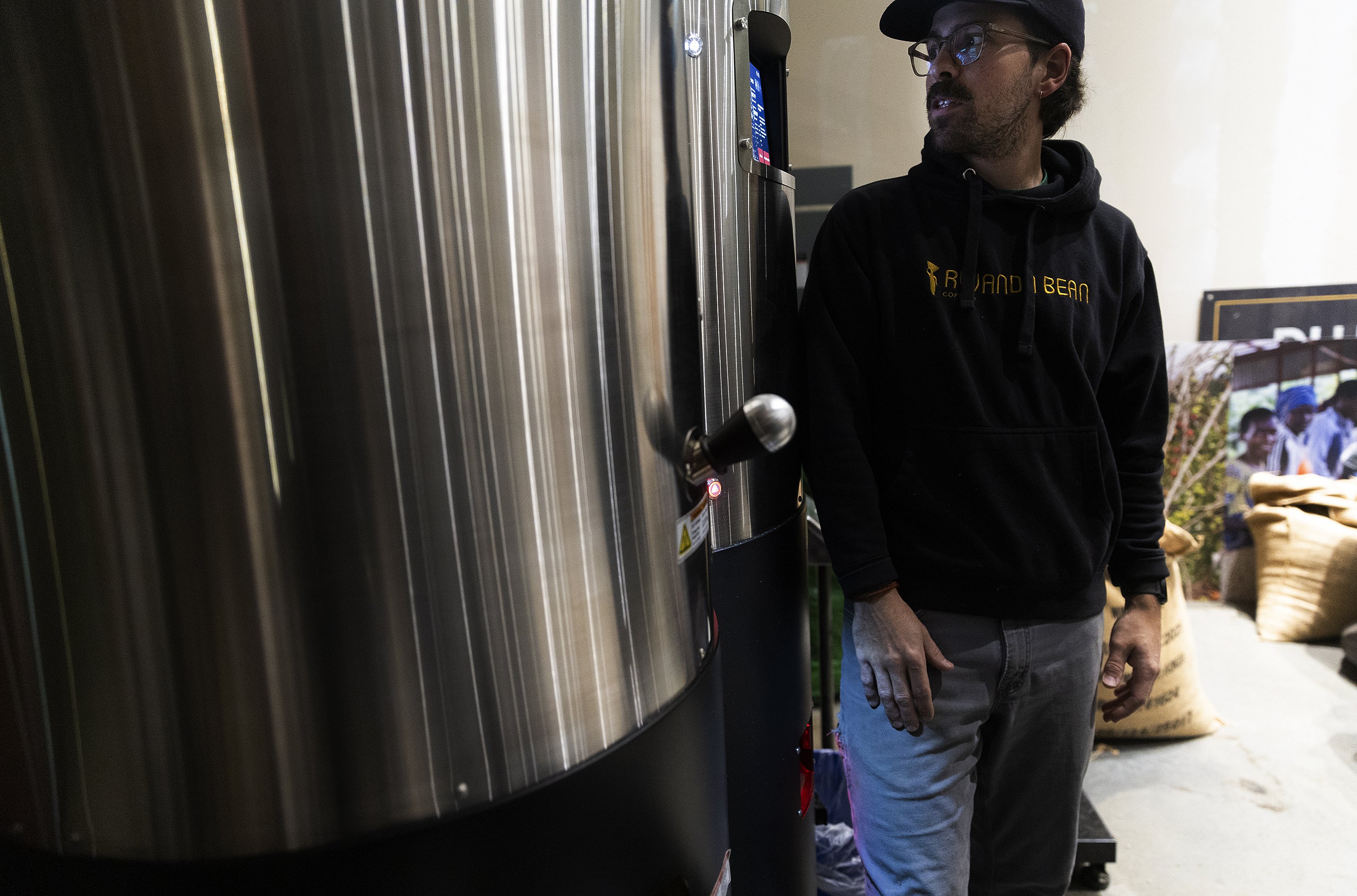
Kyle Mitchell checks temperatures on the roaster’s digital display at Rwanda Bean. (Derek Davis/Staff Photographer) Purchase this image
It’s still dark out when Mitchell begins scooping and weighing 17.7-pound batches of beans. He pours a batch into the hopper of the pre-programmed RoasTronix S9X roaster, which looks like a trio of shiny, conjoined water heaters. The roaster drum whirls and whooshes as it gently stirs and heats the beans. Mitchell monitors multiple temperatures on the unit’s digital display — radiant heat from a halogen bulb; conductive heat on the surface of the stainless steel drum; and convection airflow.
When Mitchell first started roasting at Rwanda Bean, they didn’t yet have the fancy electric RoasTronix.
“The gas roaster I learned on, I had to sit there all day, every day, to manually adjust throughout the roast,” he said. “I’m turning the gas knob to make micro-adjustments to the temperature. I had to give it my full attention. I still pay attention to it (now), and it still fluctuates a little bit, so I have to make sure it’s meeting our quality. But I can multitask.”
Around 6:15 a.m., he glances out one of the large front windows in the lofty space. The horizon glows with dawn’s first light.
“The sunlight here at the Point is really nice in the mornings. The sun comes up right over the highway. It’s a beautiful place to work. At one point in the day, it’s blinding, but besides that, it’s really nice.”

Decaf coffee roasted beans at Rwanda Bean in Portland. (Derek Davis/Staff Photographer) Purchase this image
FALLING BACK IS A MIXED BLESSING
All of Rwanda Bean’s raw green beans are single-origin, sourced from one farming cooperative in Rwanda. Rwandan coffee has a subtle inherent sweetness, with citrus and cherry notes. Blonde roast lets the light citrus flavor come through; dark roast delivers more robust, nutty chocolate flavor.
Advertisement
On this Wednesday, Mitchell is making medium roast beans, taking them past “first crack” stage where they shed their outer chaff layer. Each batch takes about 16 minutes, including a cooldown cycle. He’s careful to inspect the cooldown tray for any beans that might have stuck in the roaster and burned.
“One burned bean will ruin a cup of coffee, for sure,” he said.
The air in the roastery isn’t as thickly perfumed with coffee as you might imagine, but it wafts seductively from the freshly roasted beans as they twirl in the cooling tray. Open the lid of a 50-gallon barrel full of their dark roast beans, and the heady aroma envelops you.
Mitchell sees the fall clock change as a mixed blessing. “Having that sun come up a little earlier makes the day feel like it goes by a little faster,” he said, and helps him ward off any seasonal depression. But he also likes to go for long afternoon runs and bike rides, which are harder to pull off after work during standard time.
Regardless of when dawn breaks, Mitchell loves the serenity of early mornings at work. “The peace is the beauty of it,” he said. “I appreciate being able to come in and have things quiet.”
Mitchell has worked in the service industry, and likes interacting with people. Some customers will stop by the roastery after they open at 8 a.m. to buy a bag or two, and Mitchell still gets several people a day coming in for a cup of coffee, even though the space hasn’t been a café since 2023.
At the end of his workday, Mitchell tends to find himself as equally fulfilled as Rwanda’s orders.
“I enjoy coming in here every day knowing that what I’m doing is what a lot of people need to start their day.”
Copy the Story Link
Tagged: coffee, featured, maine food, maine restaurants

Tim Cebula has been a food writer and editor for more than two decades. He was most recently senior editor at Cooking Light magazine, where he worked for 13 years. His work has appeared in Time, Health,. More by Tim Cebula