Sprinchorn exhibit at Bates offers a freshly relevant take on the artist’s Maine work | Column

The great gift of a reappraisal of any artist’s work is to see it through new perspectives — derived from research into forgotten or newly discovered aspects of an artist’s work and life — and the retrospective intelligence (dare I say wisdom?) gained from historical distance. Last month, I wrote about the Carl Sprinchorn exhibition at the Ogunquit Museum of American Art, “All the World Is a Painting,” which closes Nov. 1 (clear your calendar if you must, but go see it; you won’t be sorry).
Now comes “Carl Sprinchorn: Points of View” (through Dec. 19) at Bates College Museum of Art, an exhibition curated by Samantha Sigmon and developed in conjunction with the Ogunquit, a relationship that has produced a handsome and thorough volume from University of Maine Press, “Carl Sprinchorn: A Rediscovery.”
“All the World” frankly discussed Sprinchorn’s homosexuality. This was something averted in polite society during his own time, yet so integral to the art that made him most famous: his portrayals of lumberjacks in Patten, Maine. Christopher Reed’s essay for the catalog establishes early on the precariousness of being out in the early 20th century, “when any articulation of homosexuality was risky, as Sprinchorn’s correspondence files document. A chummy letter from the artist John Blomshield — an extravagant figure sometimes cited as the inspiration for the promiscuous American, Clive, in Christpher Isherwood’s “Good-Bye to Berlin” — worried with facetious flair about a patron who was helping him find a studio in New York:

Related
Ogunquit Museum’s Sprinchorn exhibit is worth more than one visit | Column
“I do not know her well, at all, so do not quite know which way is north. There are still a number of sophisticated people (you must believe this) who consider homosexuality — a horrid word — an unusual and exciting phenomenon. Ah well…”
Curator Devon Zimmerman also recontextualized Sprinchorn’s art through the lens of the immigrant experience in America, which not only made the artist’s work feel freshly relevant, but illuminated just how radically that immigrant experience has changed since Sprinchorn’s day, implicitly admonishing viewers to consider why this is so.

Carl Sprinchorn, “Sunrise—1947,” 1947, watercolor on paper. (Image courtesy of Bates College Museum of Art, Gift of the Carl Sprinchorn Admiration Society)
Whereas the Ogunquit show was rich with paintings, “Points of View” concentrates on Bates College’s holdings of works on paper. To be sure, there are magnificent oils. Among them are “The Great Basin, Katahdin” (1940) and “Early Autumn” (1917), which corroborate Sprinchorn’s considerable skill as a landscape painter. Others, such as the watercolor “Sunrise — 1947,” reveal one of his singular techniques by quoting from Sprinchorn himself: “I used to make 5 or 6 quick, instant strokes and color notes on so many large sheets of water color [sic] paper within a matter of a few minutes…then hold on to the idea and finish them without looking at the sun again.”
Advertisement
What is more interesting to me about this watercolor, however, is the way it cements Sprinchorn’s position at the center of the many crosscurrents of modernism. The first allusion I made upon viewing “Sunrise—1947” was to Arthur Dove. It is impossible that Sprinchorn would not have known Dove’s work. Dove was one of the most highly acclaimed artists in Alfred Stieglitz’s stable at the legendary 291 Fifth Avenue gallery in New York, which also included Marsden Hartley and Georgia O’Keeffe, both of whom had connections (in O’Keeffe’s case, more tangentially) to Maine. Though he traveled widely during his career, the exhibition also confirms how Maine occupied a vital creative center of Sprinchorn’s life. Dove died the year before Sprinchorn painted “Sunrise—1947,” and his depiction of the sunrise seems inconceivable without the many versions of suns painted by Dove, among them: “Morning Sun,” “Sunset,” even “Moon” (all of 1935) and “Sun” of 1943.
This is speculation, of course. And having just seen the superb production of Tom Stoppard’s “Arcadia” at Portland Stage — one subplot of which revolves around the way historians tend to project their own assumptions on the subjects they are researching — I hesitate to put too fine a point on this. But both these exhibitions seem to me to make connections to the precedents and modernist trends Sprinchorn was absorbing into his own oeuvre, from van Gogh to Matisse to Dove to Hartley.

Carl Sprinchorn, “One of the Getchell Boys, Shin Pond, Maine,” 1937, charcoal and crayon on paper. (Image courtesy of Bates College Museum of Art, gift of the Carl Sprinchorn Admiration Society)
More intriguing still is how the many sketches and studies on view at Bates point up that Sprinchorn’s decision to de-emphasize facial features of his famous lumberjacks as a way of amplifying their homoerotic physicality was a deliberate one. Two self-portraits on hotel stationery from 1924 prove that Sprinchorn was most assuredly capable of rendering facial features and expressions with skill, which means that his choice to depict eyes, nose and mouth as simple slits in his paintings was intentional.
What is more, the drawings forced me to examine my own preferences for other subject matter Sprinchorn depicted outside of his lumber camp paintings (most specifically, the landscapes). This stylistic decision in his drawings certainly contributes to the immediacy of the drawings themselves. They are never meant to be finished works, but to capture an idea, a gesture, a pose (and so on) that can be further explored and refined in a finished work. So, in the drawings, we accept the lack of defined faces and expressions more easily. In finished paintings, however, I expected something more and could not help viewing his slitty features as in some way lacking or crude.
Was Sprinchorn’s judgement to obliterate facial features and expressions an effective move? Marsden Hartley, his friend and obvious influence, had at least made an effort at expressions and features, even though he was after the same beefcake effect of male bodies. Personally, it feels like Sprinchorn’s simplification of faces contributed to a kind of cartoonish effect in his paintings that diminishes them. Yes, we still intuit the eroticism of male bodies, but we might have perceived this more fully if eyes and looks were allowed to enhance that physical attraction by radiating a more smoldering sexuality.
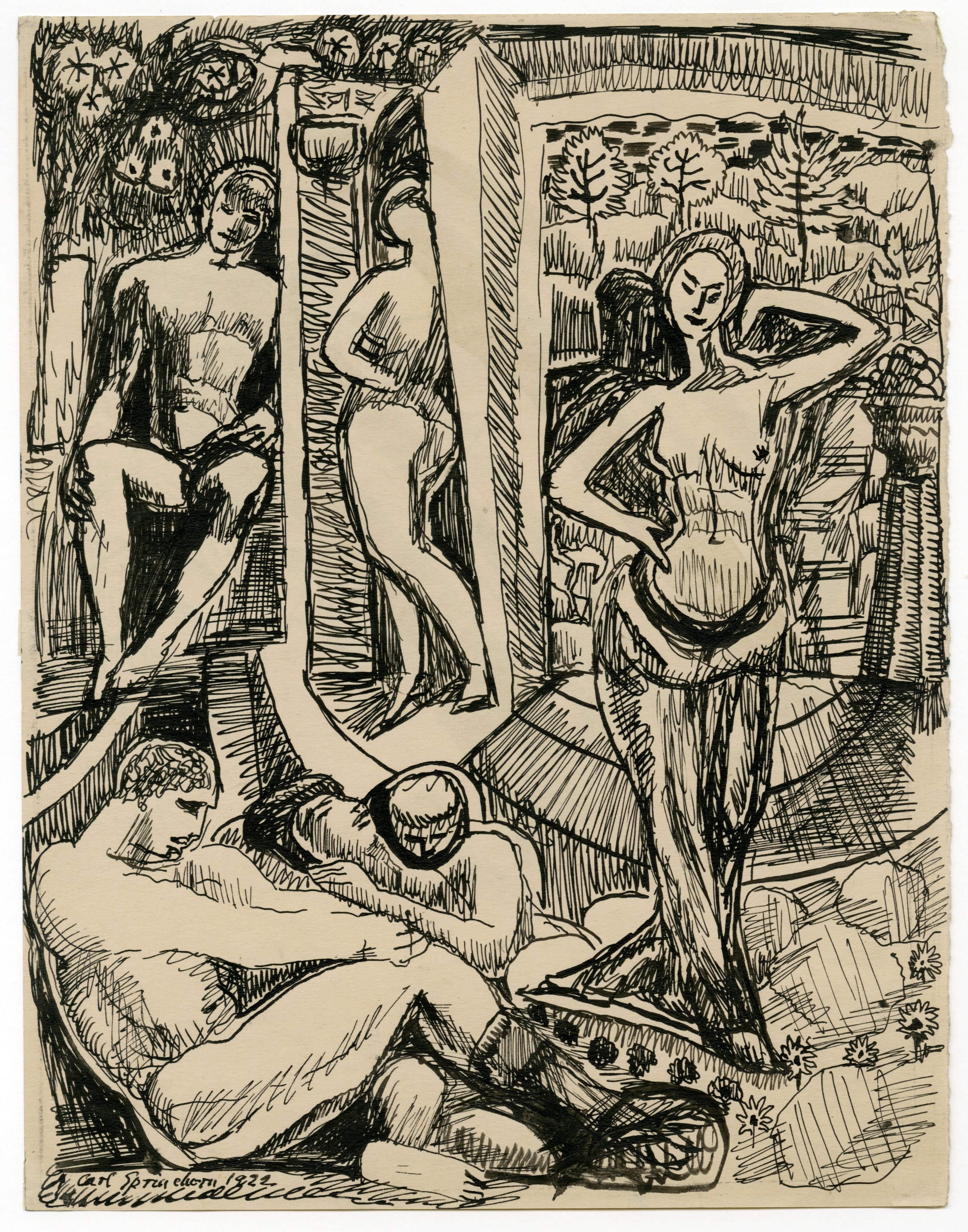
Carl Sprinchorn, “Dormant, Semi-Dormant, and Awake,” 1922, india ink on paper. (Image courtesy of Bates College Museum of Art, Marsden Hartley Memorial Collection, gift of the Marsden Hartley Estate)
On the other hand, a series of drawings Sprinchorn made in the late 1920s — most prominently “Dormant, Semi-dormant, and Awake” (1922) — display a wit and imagination that made me wish he had more fully explored in his figural paintings. The energy of its zigzag lines communicates tremendous sexual electricity. Bodies are concisely yet sensually articulated, carrying more charge in my mind than his lumberjacks.
Which is why it is worth seeing both shows. Maybe, in the end, it is just a difference between genres — the immediacy of sketching versus the more considered and refined process of painting. Artists have struggled with this for centuries. Eugène Delacroix was perhaps the most successful at bridging this divide. To this day I know artists who still struggle with preserving the urgency and energy of a drawing while making a painting. But without seeing both shows, it is hard to understand that conundrum. Each offers pleasures unique to its exhibition. But taken together, they form a holistic understanding and appreciation of Sprinchorn’s contributions to the modernist canon.
Jorge S. Arango has written about art, design and architecture for over 35 years. He lives in Portland and can be reached at [email protected]. This column is free to access through support by The Dorothea and Leo Rabkin Foundation.
‘Carl Sprinchorn: Points of View,‘ Bates College Museum of Art Olin Art Center, 75 Russell St., Lewiston. 10 a.m-7:30 p.m. Monday and Wednesday, and 10 a.m-5 p.m. Tuesday, Thursday and Friday through Dec. 19. For more, 207-786-6158 or bates.edu/museum

Carl Sprinchorn, “The Great Basin, Katahdin,” ca.1940, oil on canvas. (Image courtesy of Bates College Museum of Art, gift of the Carl Sprinchorn Admiration Society)
Copy the Story Link
Tagged: art exhibit, bates college museum of art