Once adrift, Graham Platner’s fleet of volunteers finds new purpose


Read all of our coverage of Maine's 2026 election or stay up to date with the latest developments through the Maine Political Report in your inbox or text messages from politics editor Kirby Wilson.
On a recent October evening, Kelly Millikan was among a half-dozen volunteers sitting on repurposed church pews inside a small storefront in Portland’s Arts District.
Hunched over a clipboard, Millikan dutifully scrawled a note on the back of a postcard.
“Last we spoke you told us of your plan to vote early at City Hall,” she writes. “Thank you for being an active participant in our Democracy + making your voice heard. Best, Kelly + PPM.”

Members of People Powered Maine write postcards to encourage people to vote. (Shawn Patrick Ouellette/Staff Photographer)
Each postcard is pre-printed with “People Powered Maine. Organized money always wins. Until organized people show up.” — the calling card of an organization founded by former volunteers for Graham Platner.
When Platner’s meteoric bid against Republican Sen. Susan Collins came crashing down in July, thousands of people inspired by the political newcomer and his progressive policy agenda were set adrift.
But many, like Millikan, are still engaged in the consequential election.
Advertisement
Related
Graham Platner wanted his movement to outlast him. Now comes the ‘ultimate test.’
Some have signed on to the Maine People Powered Movement, which rose from the ashes of Platner’s implosion. A few are working independently of any organized group. And others have joined up with the Maine Democratic Party.
Many of those disappointed by Platner’s exit say they have found a renewed purpose their organizing.
“I think it was difficult for a lot of people, not just me,” said Michelle Lesperance, a 69-year-old retired special education teacher from Portland who’s working independently for progressive causes. “We had so many reservations about the party itself, and I continued to have reservations.”
But in the short term, she and the party share the same goals.
“The bottom line is: We all are completely, completely and totally 100% around getting rid of Collins,” Lesperance said.
Volunteers with People Powered Maine are sending the postcards to residents their group has already met through canvassing efforts. Their notes don’t advocate for a specific candidate on the Nov. 3 ballot. That’s by design, said Bente Lundh, a lead organizer with the group.
Advertisement
“Most of the time, as you will see in the instructions, we’re not pushing people one way or another,” Lundh told the assembled volunteers. “We’re trying not to be obnoxious that way.”

Bente Lundh of Falmouth, left, organizes paperwork as members of People Powered Maine work together filling out cards to encourage people to vote. (Shawn Patrick Ouellette/Staff Photographer) Purchase this image
With less than two weeks before the midterm elections, People Powered Maine’s softer approach is distinct from other progressive organizing efforts in the state.
Democratic Party organizers are mustering canvassers to ask Mainers to vote for Democrat Troy Jackson over Collins. But People Powered Maine isn’t being quite so blunt. They’re betting that fostering relationships beyond the transactional nature of asking for a vote will lead to lasting change.
Those close to these efforts insist there is no tension between the voter outreach efforts of the Democratic Party and independent groups. But they’re undeniably approaching the campaign in different ways.
PEOPLE POWERED MAINE
Last fall, Platner’s campaign held a series of “Grahamcamps” that trained volunteers in relational organizing, which seeks to build relationships within a community and identify a common concern before trying to persuade someone to support a certain issue or candidate.
A core group of lead organizers attracted to Platner’s theory of politics decided to formalize his approach in August, incorporating People Powered Maine as a 501(c)(4), a type of nonprofit that allows for lobbying and public issue advocacy.
Advertisement
“Graham was much more focused on building that connection with the person you’re knocking at a door with,” said Gioachinno Brennan, a 26-year-old Cumberland resident and former Platner volunteer who now works with People Powered Maine. “The whole message was — the campaign is listening … this is a candidate that wants to address the concerns of the people.”
However, the group isn’t staying agnostic in the state’s biggest race. Last month, organizers created a federal political action committee, Maine People Powered Movement, to advocate for specific candidates who pledge to support the group’s platform and who pass muster with its members.
The group is backing Jackson, co-founder Crystale Lapham said, because he signed onto their policy platform and took questions from members.

Volunteers with People Powered Maine staff a table at a Sen. Elizabeth Warren’s rally in Deering Oaks on Oct. 17. (Shawn Patrick Ouellette/Staff Photographer)
Within the last couple of weeks, the group worked the crowds at rallies with Sens. Bernie Sanders, I-Vt., and Elizabeth Warren, D-Mass.
At the Warren rally in Portland’s Deering Oaks, Lapham said the group focused on “tripling.” That’s where volunteers ask attendees to call or text three friends urging them to vote and telling them what issues they find important.
Related
Crowd in Portland rallies around electing Maine Democrats on ‘No Kings Day’
Lapham said the group has a core of 250 or so volunteers and more than 2,000 others who have signed up on its website.
Advertisement
The 501(c)(4)’s canvassing approach is largely one of persuasion. Rather than knocking on the doors of Democrats, hoping to fire up the anti-Trump base, People Powered Maine is reaching out to people who are not enrolled in a political party ahead of the midterms. Unenrolled voters comprise nearly a third of the state’s registered voters, making them the second-largest voting bloc behind Democrats in Maine.
Lapham said nearly a third of those unenrolled voters are undecided about the U.S. Senate race, according data from the group’s canvassers. (Formal polls show a far lower share of undecided voters.)
“A lot of the people are saying, ‘This is the first time anybody’s knocked on my door to talk about Troy,'” said Lapham, a 44-year-old Falmouth resident. “So we know that we’re talking to the right doors.”

Crystale Lapham, a founding member of the nonprofit, People Powered Maine, speaks with Ronnie Cho, a political consultant and former community organizer for President Barack Obama, at the Beals-Jonesport Co-Op on Oct. 19. The group was there to highlight inflation and help lobstermen pay their diesel bills. (Randy Billings/Staff Writer)
The group is being assisted by Ronnie Cho, a former statewide organizer for Barack Obama’s 2008 campaign. Cho said Obama had a field operation that was separate from the Democratic Party — and it was key to his resounding victory in Maine.
“One of the biggest takeaways I got from that campaign was how important it was to talk to people beyond party affiliation,” Cho, 43, said.
“We had offices that were not co-located with the Maine Democratic Party, because we knew that we needed to make this place welcome and open for folks of all political stripes. … And I haven’t seen enough of that kind of intentionality when it comes to organizing.”
Advertisement
PARTY EFFORTS
The Maine Democratic Party says it has built the largest canvassing operation in state history.
On Tuesday, the party announced it has made more than a million attempted voter contacts, with canvassers knocking on more than 230,000 doors and making 790,000 phone calls. The party has opened 25 field offices in all 16 counties, trained more than 290 volunteer leaders and surpassed 18,000 volunteer shift sign-ups, it said.
The party said more than 2,200 former Platner volunteers have signed up for at least one volunteer shift.
That effort is geared toward electing Democrats up and down the ballot on Election Day. The party says 30% of their canvassing targets are unenrolled voters — meaning their efforts aren’t strictly partisan, either.

U.S. Senate candidates Troy Jackson, left, and Susan Collins. (Contributed and Press Herald file photos)
Collins’ campaign did not respond to specific questions about its canvassing operations. But spokesman Shawn Roderick said in a written statement that canvassing is being done by both campaign volunteers and the Maine Republican Party.
An outside group, Stronger Maine, has also been canvassing on Collins’ behalf for months.
Advertisement
SOME STILL ADRIFT
Some former Platner volunteers say they haven’t found a home since the campaign ended.
Among this group of expats is Erin Evans, who has offered her Portland house as a base for canvassing and making homemade campaign throughout the political season.
Evans wanted Nirav Shah to replace Platner on the Democratic ticket, but her candidate was out-organized by Jackson with the help of labor unions during the Democrats’ second, truncated mini-primary in July. But she’s still engaged in campaigning.
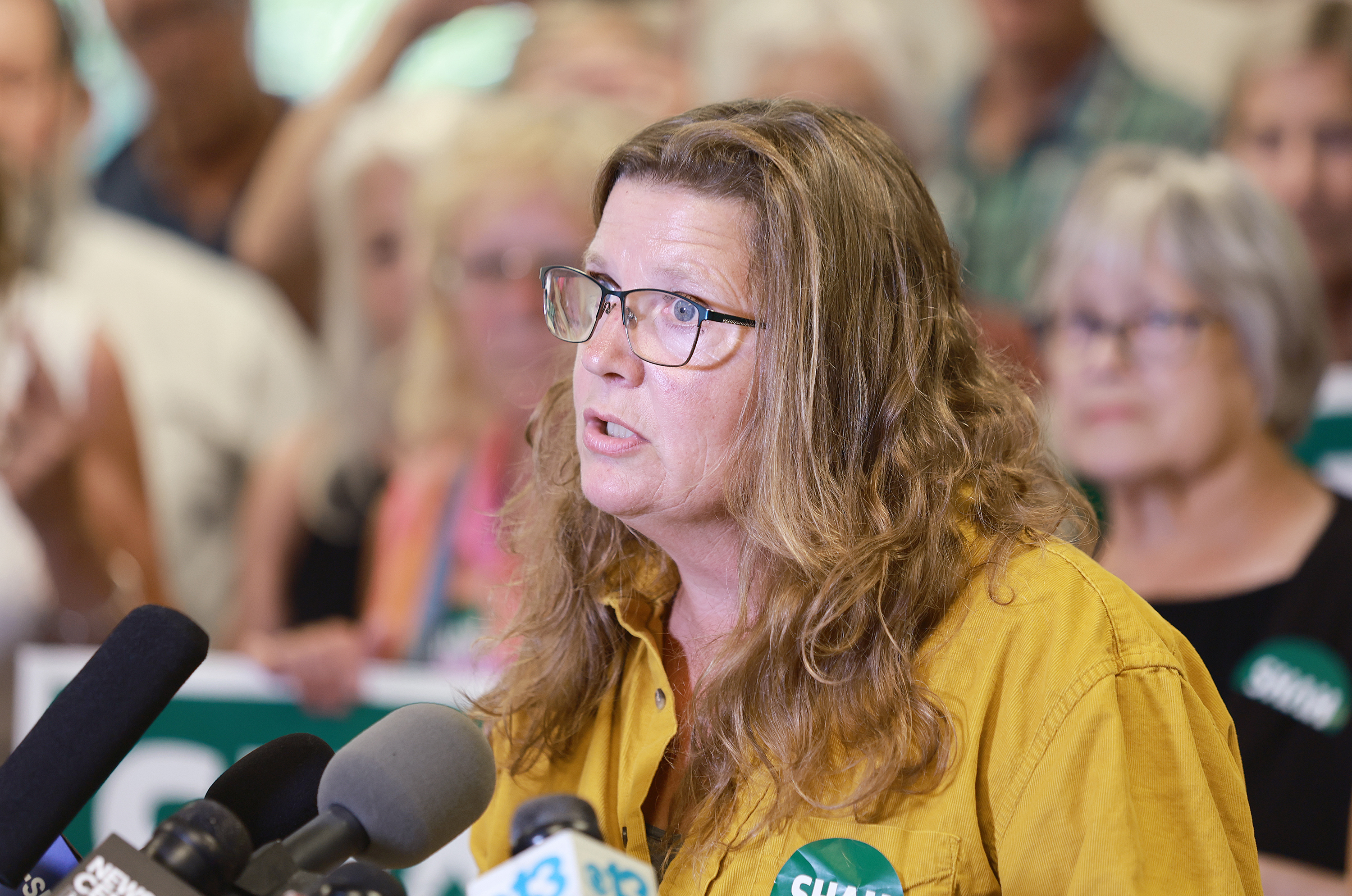
Erin Evans, a former volunteer on the Graham Platner campaign, speaks at a news conference for Nirav Shah last summer. She’s now supporting Troy Jackson for U.S. Senate. (Derek Davis/Staff Photographer)
“I am 50,000% onboard with Troy Jackson and Matt Dunlap,” Evans said, also referring to the Democrat running for the 2nd Congressional District seat. “And so are all of my Graham friends.”
Evans and some other like-minded former Platner volunteers said they didn’t like the top-down approach of the Maine Democratic Party’s campaign apparatus. Instead, they preferred the flexibility, creativity and community that infused Platner’s campaign.
“I’m not satisfied with either party,” said Jeanne McCliment, a 76-year-old independent who volunteered for Platner. “For me, the Democratic Party is the least worst.”
Advertisement
PLAYING THE LONG GAME
With so much at stake in November, it may seem strange to some how, in many ways, People Powered Maine is already looking beyond the midterms. But this outlook is part and parcel with the group’s theory of politics. They plan to stay active after the election so they can try to make inroads with people who don’t share their views.
“We have a huge resource,” said 24-year-old volunteer Lucy Climer-Kennedy, a Portland transportation planner. “People power.”
On a recent fall day, their unorthodox approach took them to Jonesport, a small Down East town more than 200 miles from Portland. There, Donald Trump and Collins each won their most recent elections with nearly 70% of the vote.
The group did not go there to talk politics or gin up support for Jackson or any other candidate. It was there to provide financial assistance to lobstermen at a local cooperative.

Fishermen sell their catch and fuel up at the Beals-Jonesport Co-Op on Oct. 19. Filling their tanks was made a little easier thanks to People Powered Maine, a nonprofit advocacy group that provided help to offset record high diesel prices. (Randy Billings/Staff Writer)
After a long morning of hauling lobster traps, Maurice Alley was greeted at the docks by Suzanne Carver, a fellow resident of nearby Beals and a People Powered Maine member.
As Alley’s crew sorted lobsters into crates and topped off his fuel tank, Carver told the 78-year-old skipper of the F/V Renegade that her group provided up to a couple hundred dollars for each member of the Beals-Jonesport Co-Op to help with the high cost of diesel.
Advertisement
For Alley, it was a pleasant surprise. Oftentimes, lobstermen arrive at the docks only to find that gas prices have gone up and the price of lobster has gone down.

Maurice Alley, 78, talks to fellow Beals resident Suzanne Carver at the Beals-Jonesport Co-Op after hauling traps on Oct. 19. Alley was one of several fishermen to receive help from People Powered Maine to offset record high diesel prices. (Randy Billings/Staff Writer)
Barely audible over the loud rumble of his diesel engine, Alley lamented that people in power are eager to help farmers affected by high prices, but lobstermen are often forgotten.
Nearby, the organizing group unfurled a banner reading “Working Mainers left holding a bill.” It detailed the increased costs of diesel, heating oil, gasoline and health insurance. Another volunteer offered Alley and his crew slices of pizza and cold drinks, which he accepted.

Suzanne Carver offers a slice of pizza to Maurice Alley, the captain of F/V Renegade, after providing him and other members of the Beals-Jonesport Co-Op with up to a couple hundred dollars each to help offset record high diesel prices. (Randy Billings/Staff Writer)
Before shoving off, Alley was asked about the assistance he received.
“Well, I like that,” he said. “It’s not that farmers’ aid, but at least it’s something.”
Carver, a former Platner volunteer, was careful not to talk politics or specific candidates on the docks. She said she’s only there to help her community.
Tensions rose when more reporters arrived with cameras. One reporter asked Carver about the upcoming elections and specific candidates. Within 30 minutes, journalists were asked to leave the docks by the manager.
Copy the Story Link
Tagged: election 2026, Graham Platner, senate 2026, Susan Collins, Troy Jackson

Randy Billings is a government watchdog and political reporter who has been the State House bureau chief since 2021. He was named the Maine Press Association’s Journalist of the Year in 2020. He joined. More by Randy Billings