On Halloween, front lawns play host to the most popular public art | Column

The nail in the coffin was a small plastic tombstone sticking out of a neighbor’s lawn which reads: “LET ME OUT” punctuated by a bat-like demon gargoyle. One is dying to know more about the speaker with his assorted ins and outs.
This piece, along with the classic hands reaching up from the grave, creaky hinges, fluttering ghosts and acrobatic skeletons – some nearly as big as a house – gives us an image of the non-living as quite active, opinionated, alert, and very much on the move. Death ducked once again.
Lawns near and far now become temporary sculpture gardens devoted to the riddle of being dead, and plastic tombstones are not cheap: this year, Americans were on target to spend upwards of $4.3 billion (!) on exterior Halloween decorations, up significantly from last year despite heaps of mournful economic news. This amount is a bit less than we spend on costumes, but a bit more than we spend on candy. By comparison, the total spending for art projects in this country by federal, state, local and non-profit sources totaled just $1.7 billion for all of 2025, less than half our Halloween budget.
This makes Halloween by far this nation’s single biggest, best investment in the plastic arts, and all in service of a single night. For this reason alone it is surely good and right to examine what all the money and effort are trying to say, and to whom.
The backstory is largely familiar, always linked to the time of year when crops are harvested, nights get longer, and humans feel a bit more vulnerable. A Roman festival (Lemuria, which shooed away pesky household spirits with black beans) gave way to a Celtic ritual (Samhain, which used bonfires to urge misguided ancestors, spirits, and fairies to go home), which in turn lent its atmosphere to a Catholic holiday (All Saints’ Day, which lights candles for the souls of Christian martyrs is and preceded by vespers on All Hallows’ Eve)
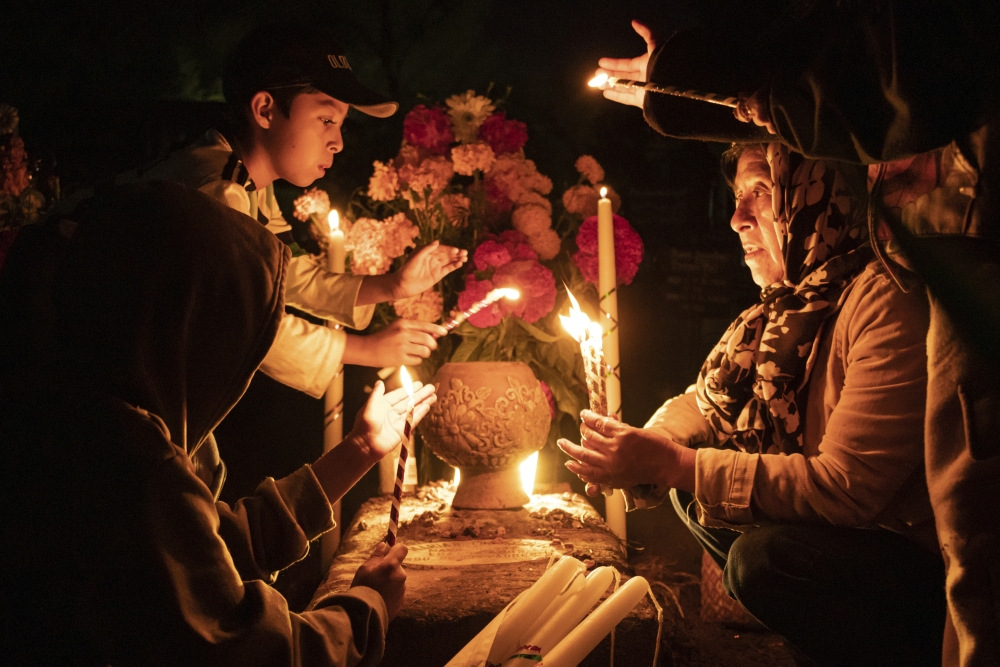
People hold candles over a tomb decorated with flowers at a cemetery in Atzompa, Mexico, on Oct. 31, 2023. In a tradition that coincides with All Saints Day on Nov. 1 and All Souls Day on Nov. 2, families decorate graves with flowers and candles and spend the night in the cemetery, eating and drinking as they keep company with their dearly departed. (AP Photo/Maria Alferez)
…which was (though alive and well in many countries) ultimately eclipsed in Protestant America by the much more recent, rather un-Christian, sugar-blasted evening celebration we know so well.
Advertisement
Since Protestants in Ireland, Scotland, and England (and later in North America) did not wish to promote the Catholic saints, they decided to reverse the night’s polarity. The souls floating around on their Oct. 31st did not belong to the hallowed ones wending their way heavenward, it was said, but belonged rather to those lost, dangerous, and thirsty ghosts who got trapped somewhere between Earth and the nether regions.
Though all these symbolic substitutions were a late amendment to an old holiday, they tap into deep roots. As far back as 2,000 BCE, art history records the use of scary objects – special geometries, deformed faces, gorgons’ heads – to ward off evil spirits, fighting fire with fire in the realm of appearance and behavior. This is an ongoing negotiation between the living and dead, the light and the dark, the constructive and the destructive forces of the world. Like most negotiations, bargaining and extortion are part of the process.
The ancient, inherited idea is that these spirits are sneaky and treacherous and resentful of we the living. On Halloween the boundaries thin and tremble. Masks are used to both blend in with them and scare them away.
One night, and one night only, rings a bell and opens a door to special kinds of blending, generosity and mischief. When else do Americans open their doors to strangers at night, with a smile no less? When else do we peer into each others’ living rooms, accepting every visitor?
Historically, this is the night to tempt fate, to invite human pranksters in close then bribe them into submission with fruit, nuts, cakes (before) and candy (now). Trick or treat? What will it cost to make the evil spirits leave us alone? A big bowl of Snickers seems like a small price to pay.
Yet naturally it is not so simple, psychologically speaking. We Americans seem pretty half-hearted in our efforts to expel the evil spirits. We seem to enjoy their company. Like many of our celebrities, they have some core qualities we firmly admire: bravado, irreverence, strength, confidence, recklessness, and various kinds of immunity from the usual humiliations of normal human frailty. We are in no great hurry, in the end, to see them disappear, and we enjoy the annual get-together with enthusiasm.
Advertisement
The result is a bit bewildering. Each Halloween, a great basket of hopelessly tangled and intertwined pop cultural quotations is dumped unceremoniously out onto the lawns and streets of American suburbia. Dying, death and decay mixes freely with vitality, vigor and valor. A strange and morbid pantheon!
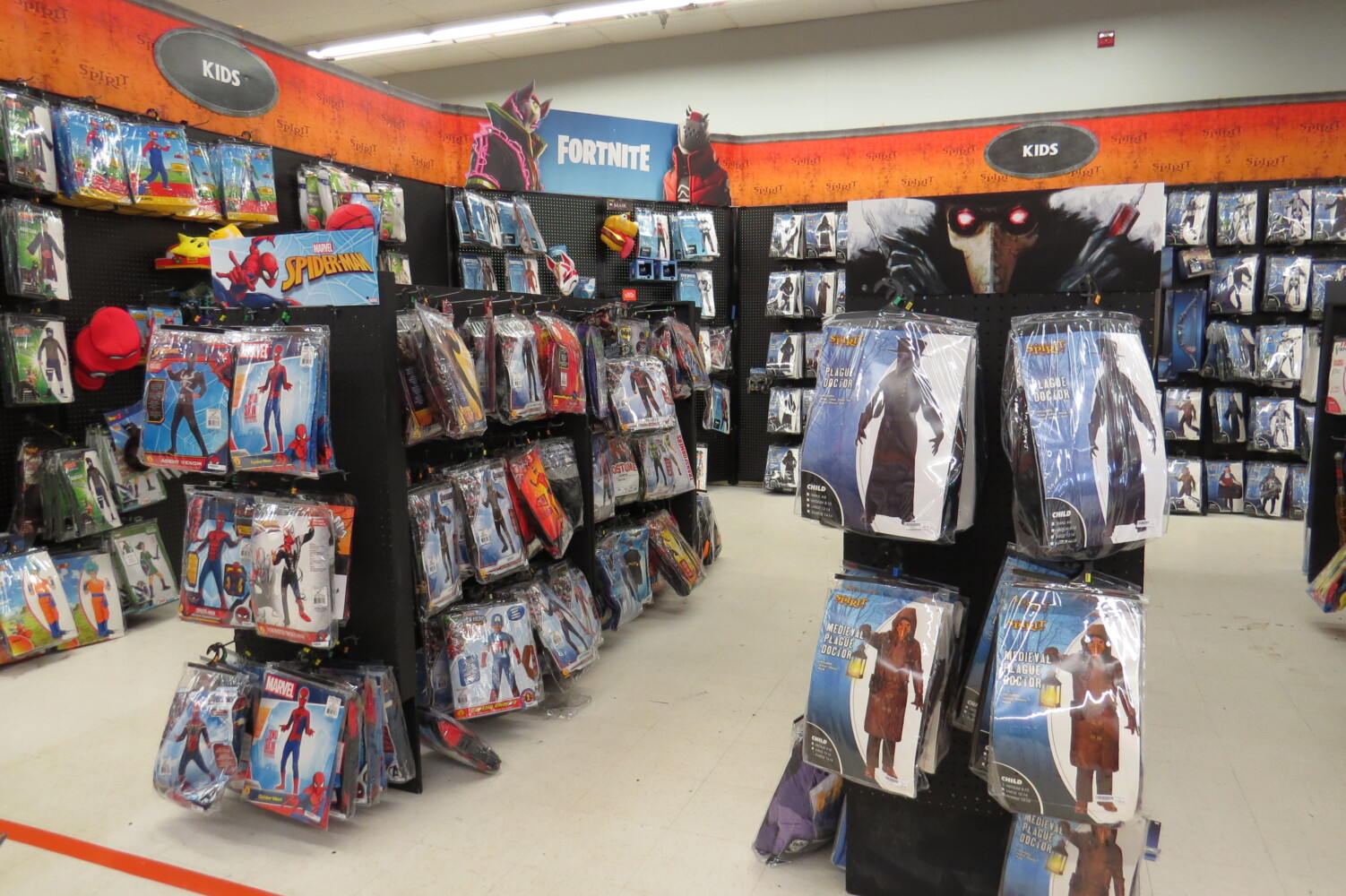
Popular costumes at Spirit Halloween in South Portland in 2020 include traditional options such a witches, vampires and pumpkins, as well as characters from Fortnite. (Michael Kelley / The Forecaster)
Whistling past the graveyards, American cheer and Batman meet a miniature Grim Reaper in service of Halloween commerce pulling in billions annually.
Pumpkins (harvest, nature, growth) glare at Deadpool (Hollywood, fantasy, immortality). Spiderman (savior) chats warmly with a serial killer (villain) about how much loot is in a pillow case. A Minecraft character (c. 2011) stumbles into Frankenstein’s monster (c. 1818) because it missed the steps and is helped up by a mother dressed up like a lethal, sarcastic psychiatrist (Harley Quinn, c. 2016) on loan from the Italian commedia dell’arte theater’s stock character Harlequin (c. 1585). Sugar is sprinkled on cemeteries.
In this way, each year at this time we take the temperature of the national mood. We carve out a core sample from the collective consciousness and get a nice, clean, spontaneous reading of what Americans wish to be. This year the blender whirs away with ever-increasing speed and franticness. So much for fencing out the evil spirits and protecting the harvest! Siphoning every creepy thing that captures our imagination, or clicks, we invoke the undead from video games, movies, television, and animation (high-budget media dominate, pushing real-life characters to the margins).
We gleefully churn together superheroes, ghouls, monsters, creeps, murderers, immortals, the strong, the famous, the extreme, the non-human, the inhuman, and the inhumane. Regarding these kinds of intimately familiar evil spirits, it is notoriously difficult to tell whether we want them to stay or to go.
Some of this season’s most popular costumes may look playful and charming, but many are associated with an extreme case of psychosis, trauma, or bloodshed. Nikki from the hit horror movie “Obsession,” for instance. Or Buddy the Unicorn, the terrifying orange mascot character and main antagonist of the dark comedy-horror film “Buddy.”
Advertisement
For those readers, like myself, born well before the year 2000, you will probably have to look them up. Even Agamemnon, whom I thought I recognized, is not really so much Agamemnon, brother-in-law of Helen, but rather a hunky cosplay character particular to the recent Christopher Nolan film, which departed shamelessly and often from Homer’s famous book.
If blending in seamlessly with the hungry ghosts is an intentional part of getting rid of them, we are doing an artful job of it this October. If this night is, and has always been, about giving some free play to the souls of the lost, then we seem to be honoring that tradition too.
Regarding the privately curated public art exhibitions which suddenly blossom in zillions of Maine front yards every year, it is easy to become confused and a little snarky. Why so big? Why the pumpkin head? Why is it up and stalking, when horror of death is usually tied to a fear of the stoppage of motion? Should one feel afraid or thrilled?

Draco the Amigo” stands over the home of Pete, Caron, Molly and Piper Morse in South Portland in 2025. (Daryn Slover/Staff Photographer) Purchase this image
An alternate reading is better, however. Also pictured above is a friendly, inviting living room and an illuminated vestibule. The sculpture, lights and decorations were pulled together with no small effort and expense for no reason other than human amusement and pleasure. This is art to be freely enjoyed by everyone in the community for its surprise, weirdness, and excitement. It conveys the useful message to passing children that some rules are momentarily suspended, that it is safe to approach, that the bell will ring, the door will open, and good things will follow.
If only every night were like this. The dead and the dark may be, after all, the least of our worries.
Jon Calame holds a master’s degree in historic preservation of architecture and is a Fellow of the American Academy in Rome. He currently teaches art history at the University of Southern Maine. This column is free to access through support by The Dorothea and Leo Rabkin Foundation.
Copy the Story Link
Tagged: art review