

Maine artists are exhibiting on a bigger stage: The world

In July 2022, as we emerged from the COVID pandemic, the art newspaper Artnews published a story with the headline: “Forget the Hamptons. Artists, Dealers, and Advisors Are Congregating in a New Bucolic Contemporary Art Hub: Maine.” Whether this still holds true, especially during the dead of Maine winter, is hard to verify. Statistics are not easy to come by. But certainly Maine art — which has a long and storied legacy as a mecca for artists — is looking particularly vital on the world stage at the moment.
Currently online through Oct. 29 is “A Look at ME: Paintings from Maine,” hosted by international art gallery Taymour Grahne Projects, which was first established in New York and now has locations in London and Dubai. The virtual exhibition features 29 painters, all but four of them alive and actively working in the state. In Arkansas, “Down East,” an exhibition of eight Maine contemporary women artists, just closed at Pond Gallery, an artist-run space in Fayetteville. On display from Oct. 29 through Dec. 17 at Concord Art in Concord, Massachusetts will be “Magnetic North,” which will showcase 17 Maine-based artists.

“Down East,” an exhibition of eight Maine contemporary women artists, recently closed at Pond Gallery, an artist-run space in Fayetteville, Arkansas. (Photo by Taylor Loftin, courtesy of Pond Gallery)
Creatives working in Maine have always individually sought representation in the larger urban art centers, particularly New York and Boston because of their proximity. But what is happening now feels different: national, international and online exhibitions that highlight groups of Maine artists as a collective rather than individuals, conveying the idea of Maine as particularly fecund ground for contemporary art.
It would be preposterous to suggest Maine art is any one thing, of course. As I write in my forthcoming book, Contemporary Maine Art (Monacelli, Spring 2027):
“I do not believe there is something remotely like a brand called ‘Maine art.’ This in itself prescribes confining boundaries for a phenomenon that is uncontainable and perpetually evolving and changing. That is why, when I talk about Maine art, I talk about ‘art in Maine’ rather than the ‘art of Maine.’ The difference in prepositions is an important one, for taken as a whole, art made here represents a staggering pluralism of styles, ideas, genres and media.”

Artist Gail Spaien in Dubai. (Photo by Boru O’Brien O’Connell)
What’s more, in all these exhibitions, the common narrative of the state as primarily a generator of painting of landscapes, seascapes, lighthouses and fishing scenes is almost nowhere in evidence. Instead, the artists featured are tackling current issues — politics, climate change, racism, sexuality and gender — as well as more universal themes such as time and memory, domesticity, loss and spirituality.
Advertisement
To what can this trend be attributed? Many artworld watchers point to a renewed interest in regional art. The website AmericanRegionalism.com, a “reference archive for study, preservation and celebration of American Regional art,” detected a shift that began in the 2020s with what it describes as “a renewed interest in authenticity, community and the emotional truth of local experience. As digital culture accelerates and global aesthetics become increasingly homogenized,” the site reads, “many artists and audiences are seeking work that feels grounded, human, and connected to real places.”
Lebanese-Finnish dealer Taymour Grahne has witnessed this on a global scale. “People are looking outside the centers — New York, Los Angeles, London — to networks and collectors in other cities,” he observes. “There are a lot of great artists in New York, but it’s interesting to see what is happening outside of that world.”
Marc Mitchell, the curator of the Fayetteville show, who is director of exhibitions at the School of Art, University of Arkansas, also points to social media. “There is a way that we can get information that has been very beneficial,” he says. “With social media and the internet, there really is no place we can call isolated any more.”
Another recent contributor to the enhanced consciousness about Maine artists, believes Falmouth and Portland art dealer Elizabeth Moss, is the Lynne Mapp Drexler syndrome. Though Drexler exhibited widely during her days in New York in the middle of the 20th century, she was largely eclipsed by her husband, the painter John Hultberg. After eschewing the New York art world and moving to Monhegan Island where she lived until her death, she could be found selling her work to tourists for $50.
“We’ve exhausted all the male abstract expressionists,” believes Moss. “People are looking at the art of women who were overshadowed in that time.” As part of this reappraisal, Drexler’s work has gained astonishing notoriety, collected by celebrities like John Legend and breaking auction records with prices in excess of $2 million.
MAINE, DUBAI AND THE WORLD

Meg Hahn. (Photo by Studio Headshots – Rachel Sperry / Nuuform)
When Grahne opened his new Dubai gallery this past May, the inaugural exhibition was “Arranging Flowers,” a solo show of paintings by Maine artist Gail Spaien, who the gallery has represented for years. When asked what led to this decision rather than concentrating on one of the many Middle East artists he has championed over the last 15 years, Grahne says, “Dubai is an international hub, one of the most cosmopolitan cities in the world. Opening with Gail was a signal that Dubai is a space where this art can be shown. She already had a following here. The show sold out.”
Advertisement
It might seem strange to hear that Spaien’s cozy paintings of Maine interiors overlooking the water — with their wood-burning stoves, curled up cats, braided rugs and floral arrangements — has such a powerful draw halfway across the globe. But Grahne knows why. “Domestic space is sacred and such a big part of our world in Arab culture,” he says. “While Gail’s art is Maine-specific, it also has a universal appeal.”
Spaien adds that “nature motifs and patterns are part of [Arab] reverence for the natural world.” The online exhibition, she says, “was Taymour’s idea. He asked me to organize a show of Maine artists.” The 29 painters Spaien selected were a mixture. Some are what she calls “old guard” artists such as Katherine Bradford, Mark Whetli and the late Carlo Pittore and Robert Hamilton (as well as Drexler). Another group is current “megastars” such as Tessa Greene O’Brien, Jarid del Deo and Anne Buckwalter. There are emerging artists such as Cody Castle-Stack, Grace Hager and Meg Hahn too. And others — the late Beverly Hallam (“totally unrecognized”) and Natasha Mayers — are little known outside Maine’s borders.

Cody Castle-Stack. (Photo by Kerry Constantino Photography)
“We’ve had nine or ten sales so far,” Grahne said. They include works by Castle-Stack, Spaien and Jay Stern, and they sold to collectors in Dubai, Jordan, Texas and Maine. There has also been considerable interest in paintings by Bradford and Drexler. Grahne doesn’t believe this trend is anywhere near ebbing. This past summer, he sent a team to Maine to scout artists for potential exhibition and representation. “I like that Maine is not market-centric, but artist-centric” Grahne says. “It’s created something very special.”
DOWNEAST, ARKANSAS
The “Down East” exhibition in Fayetteville came about through a vast network of personal connections. “I know a lot of artists in Maine because I went to graduate school at Boston University,” says Mitchell. While attending in the early 2000s, two of his classmates were Meghan Brady and Kayla Mohammadi. He also studied with John Walker, Mohammadi’s husband. “John used to make all his students go up to Maine and paint,” Mitchell recalls. “Ever since then, I try to get there,” which he did for a time through work with the Tides Institute in Eastport.
Before the pandemic, not long out of graduate school, Mitchell recalls, he was a fellow artist in residence with Eleanor Conover at the University of Tennessee in Knoxville. And when he got to Fayetteville, he met Samantha Sigmon, who ran an alternative artist-run space there called Backspace and has since become assistant curator at Bates Museum of Art in Lewiston. Significantly, Sigmon’s first curating foray at Bates after her arrival was a show she titled “Across Common Grounds: Contemporary Art Outside the Center” in 2024, which picked up on the regionalism trend.
“The more I thought about it, there was a common ethos between Arkansas and Maine,” Mitchell says, ticking off a list that includes, “resilience, an appreciation for nature and culture, a history of storytelling.”
Advertisement

“Down East,” an exhibition of eight Maine contemporary women artists, recently closed at Pond Gallery, an artist-run space in Fayetteville, Arkansas. (Photo by Taylor Loftin, courtesy of Pond Gallery)
Mitchell’s desire to do a woman-centric exhibition dovetailed with these synergies between Arkansas and Maine, so he contacted Brady and Conover to begin a conversation about who should be in the show. The nine women selected include Mohammadi, Conover and Brady, but also ceramist Ariela Nomi Kuh, sculptor Elizabeth Atterbury and fresco artist Barbara Sullivan.
Since the university’s Edward Durrell Stone-designed fine arts building was closed for renovations, Mitchell partnered with Pond Gallery for “Down East.” The show received several inquiries about buying the work, which were redirected to the artists’ galleries. And, says Mitchell, “The outpouring of compliments and support on social media was really nice.”
CONCORD BOUND
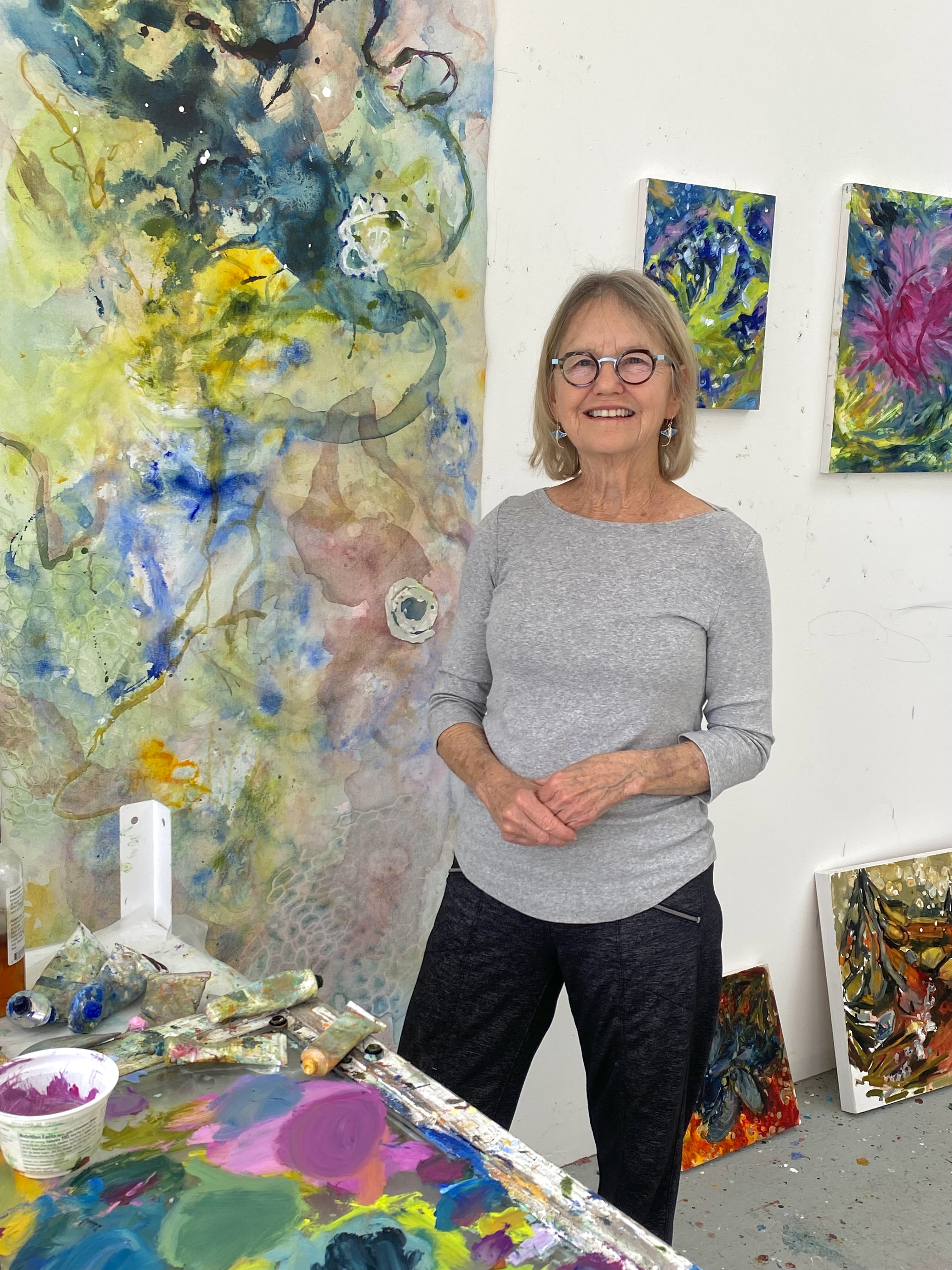
Elizabeth Awalt in her Swan’s Island studio. (Photo by Jack Ledbetter)
Painter Elizabeth Awalt has been coming to Swan’s Island from her Concord, Massachusetts home every summer for years. “I was seeing this kind of growth and strength of artists going on in Maine,” she says. “You can’t say that about New Hampshire or Cape Cod, at least not any longer. And they’re doing things that you wouldn’t expect. I wanted to share that in the Boston area because they’re doing wonderful work and you don’t see a lot of them down here.”
So Awalt leveraged her position on the exhibitions committee of Concord Art — an artist association incorporated in 1922 by painter Elizabeth Wentworth Roberts and located in the 18th-century John Ball House — to propose an exhibition of Maine artists. The institution agreed, so Awalt called environmental and installation artist Pamela “Posey” Moulton, who she had met some years before on Swan’s Island, to connect Awalt to Maine artists who were doing interesting work.

Pamela “Posey” Moulton. (Photo by Roy Fox)
The two have curated “Magnetic North,” a show that intentionally challenges the established identity of Maine art. Jocelyn Lee’s photographic, often nude, portraits of aging people. Dylan Hausthor’s subtly uncomfortable images of rituals conducted by hermetic religious communities. David Wilson’s beautiful yet spooky woodland scenes based on fables and myths. All of them, says Awalt, “have this weird, almost surreal quality to them.”
To Awalt, that felt in perfect congruence with Concord’s history as a nexus for Transcendentalist thinkers like Ralph Waldo Emerson, Sophia Ripley and Henry David Thoreau (who published his travel narrative “The Maine Woods” in 1864). The Transcendentalists, of course, were a fringe movement. But that, too, feels perfectly aligned with Maine’s history of attracting free thinkers and iconoclasts.
Advertisement
Interest in art produced in Maine will certainly get another national profile boost from former Portland gallery owner Peggy Greenhut Golden’s upcoming documentary, “Away from It All: Maine’s Place in American Art.” The film is scheduled to air this spring — locations to be determined — and chronicles the development of American art through a Maine lens. The film is narrated by actor Tony Shalhoub, an alumnus of University of Southern Maine.
For Maine artists themselves, believes Spaien, it is all about a pride of place and a desire to spread the enthusiasm far and wide. “The folks working in Maine right now want to share Maine,” she believes. “They want to be connected to those in the outer world but also want to remain Mainers and bring others into the picture.” The time for this, apparently, is now.
Jorge S. Arango has written about art, design and architecture for over 35 years. He lives in Portland and can be reached at [email protected]. This story is free to access through support by The Dorothea and Leo Rabkin Foundation.
Copy the Story Link


