

Jackson backs sovereignty, Collins delivers cash. Which matters to Wabanaki communities?


Read all of our coverage of Maine's 2026 election or stay up to date with the latest developments through the Maine Political Report in your inbox or text messages from politics editor Kirby Wilson.
Weeks after he was sworn in as president of the state Senate, Democrats Troy Jackson and House Speaker Sara Gideon called a meeting of the Wabanaki chiefs at the capitol. All five attended.
There, the lawmakers posed a question: “How do you want to fix this?”
By early 2019, there was a growing appetite to address the fraught relationship between the state and the Wabanaki Nations, which stems from a 1980 settlement that placed unique limits on the tribes’ jurisdiction. But Gov. Janet Mills was known to oppose sweeping changes to that agreement, and so the can of worms Jackson and Gideon were opening was a politically inconvenient one.
Tribal officials in the room were struck by the earnestness of the new leaders’ approach.
“That was refreshing to hear,” recalled Maulian Bryant, who attended as the ambassador for the Penobscot Nation. “I think for a long time the tribes were being told by the state what was good for us.”
Now locked in a furiously tight U.S. Senate race against Republican incumbent Susan Collins, Jackson’s past is serving him well in tribal communities.
Advertisement
“Troy is one of the leaders that we can credit with changing tribal-state relations in the state of Maine, and I am so honored to be his friend and supporter,” Bryant, who now serves on the Penobscot tribal council, told a crowd Saturday as she introduced Jackson at a campaign rally with Sen. Bernie Sanders.
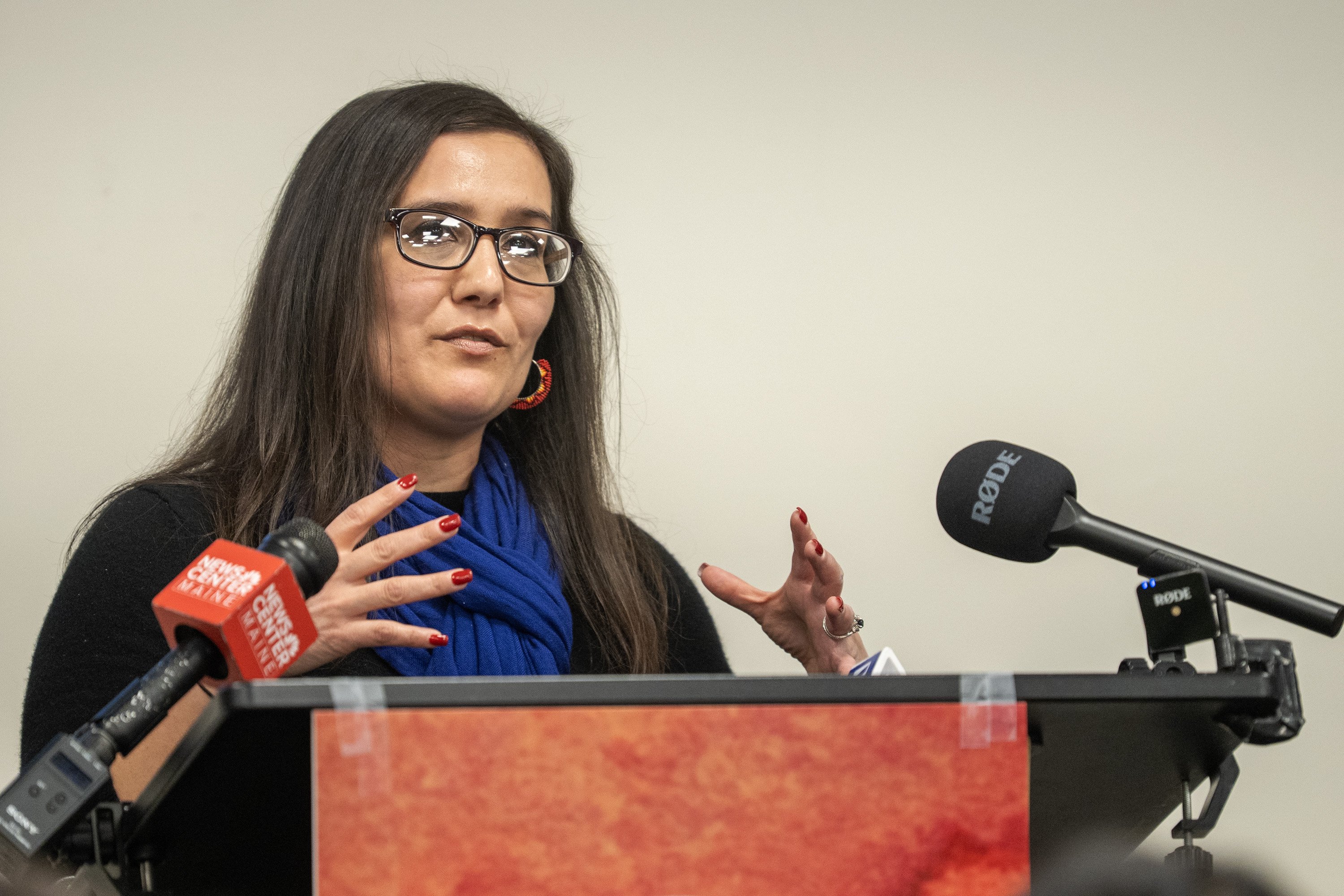
Wabanaki Alliance Executive Director Maulian Bryant said Troy Jackson’s approach to tribal sovereignty as senate president was refreshing. (Joe Phelan/Staff Photographer) Purchase this image
Collins has not championed tribal sovereignty — the notion that Wabanaki Nations’ authority over tribal lands should not be curtailed by state oversight — in Congress the way Jackson did in the State House, and she’s generally perceived to be at odds with tribal leaders on the issue. Congress adopted the settlement with the tribes and could consequently crack it open again.
For some Wabanaki voters, Collins has won support with the depth of her personal connections paired with millions in federal spending she’s directed to Indigenous communities.
In different ways, Collins and Jackson have both proven themselves to be worthy advocates of tribal issues.
Will it win over tribal members and their allies?
‘SHE DOESN’T FORGET’
The cornucopia of the Collins campaign is her power as the chair of the Senate Appropriations Committee.
Advertisement
She’s taken credit for nearly $6 million for housing improvements on the Passamaquoddy Reservation at Motahkomikuk (Indian Township); $5 million to improve the wastewater system on the Passamaquoddy Reservation at Sipayik (Pleasant Point); $530,000 to improve sidewalks in a Mi’kmaq affordable housing development; and several million more for programs run by Wabanaki Public Health and Wellness.

Related
What Susan Collins’ appropriations power means for Maine, and what happens if she loses
“She’s been instrumental in so much relating to our community,” said William Nicholas Sr., the long-serving chief of Motahkomikuk and a one-time Republican who is now an independent
When the Trump administration went on a slashing spree last year and halted payouts on federal grants, Sipayik found itself stuck, rather literally, in the water, when a $4 million grant to protect the wastewater treatment system from climate-related flooding was frozen.
Tribal officials met with Collins on the hill**,** and she swiftly persuaded the administration to release the funds.
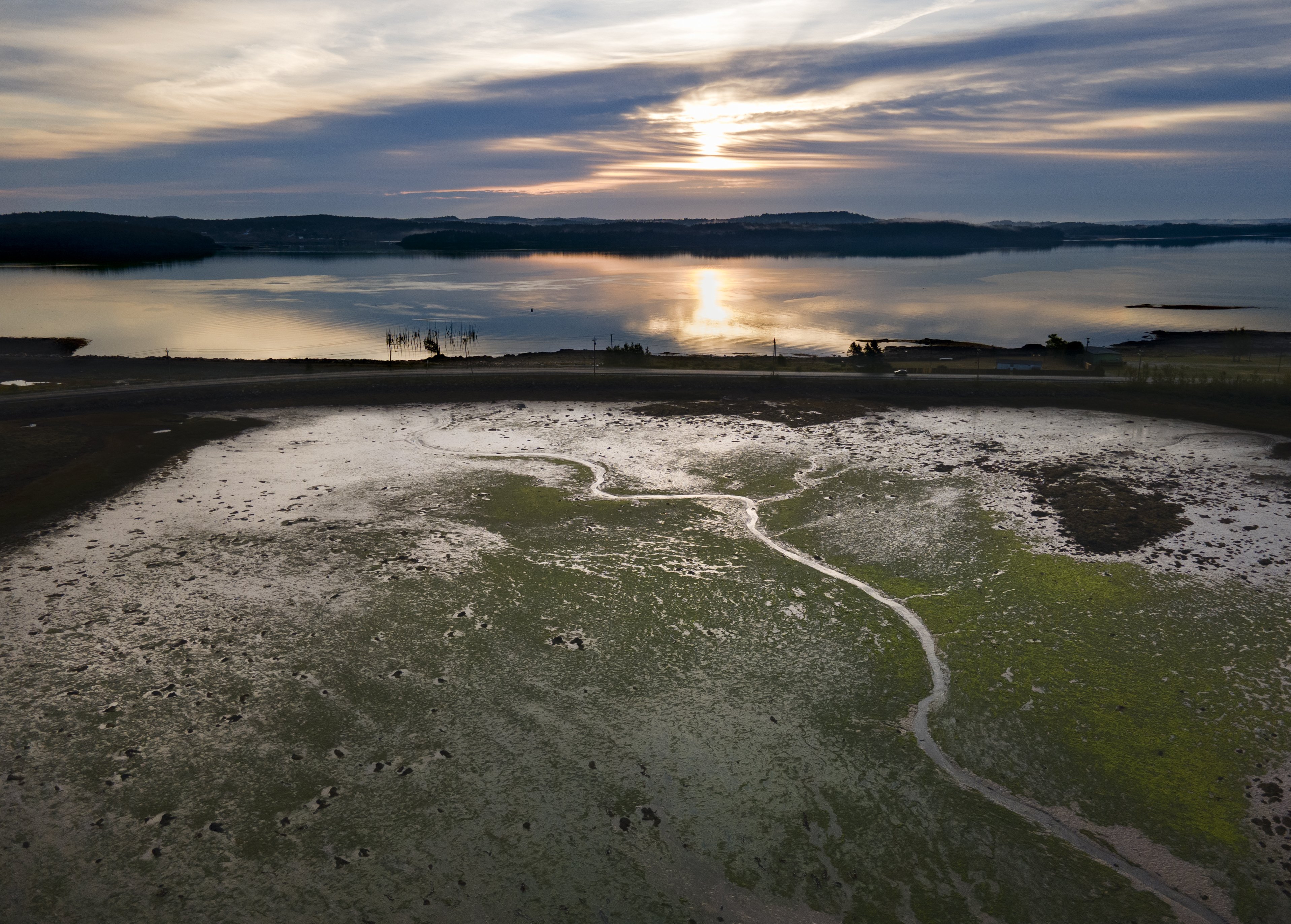
The Passamaquoddy Reservation at Sipayik received climate resilience funding that was frozen by the Trump administration in early 2025.(Gregory Rec/Staff Photographer)
Like her ability to wield congressional funding at home, Collins can effectively leverage strong interpersonal relationships in some tribal communities.
She attended the inauguration of former Sipayik Chief Fred Moore in 2015.
Advertisement
When Collins visits Motahkomikuk — the Wabanaki community she has directed the most money to — “it’s always about how she can help people and help the tribe,” said Chief Nicholas, who describes the senator as “a friend.”
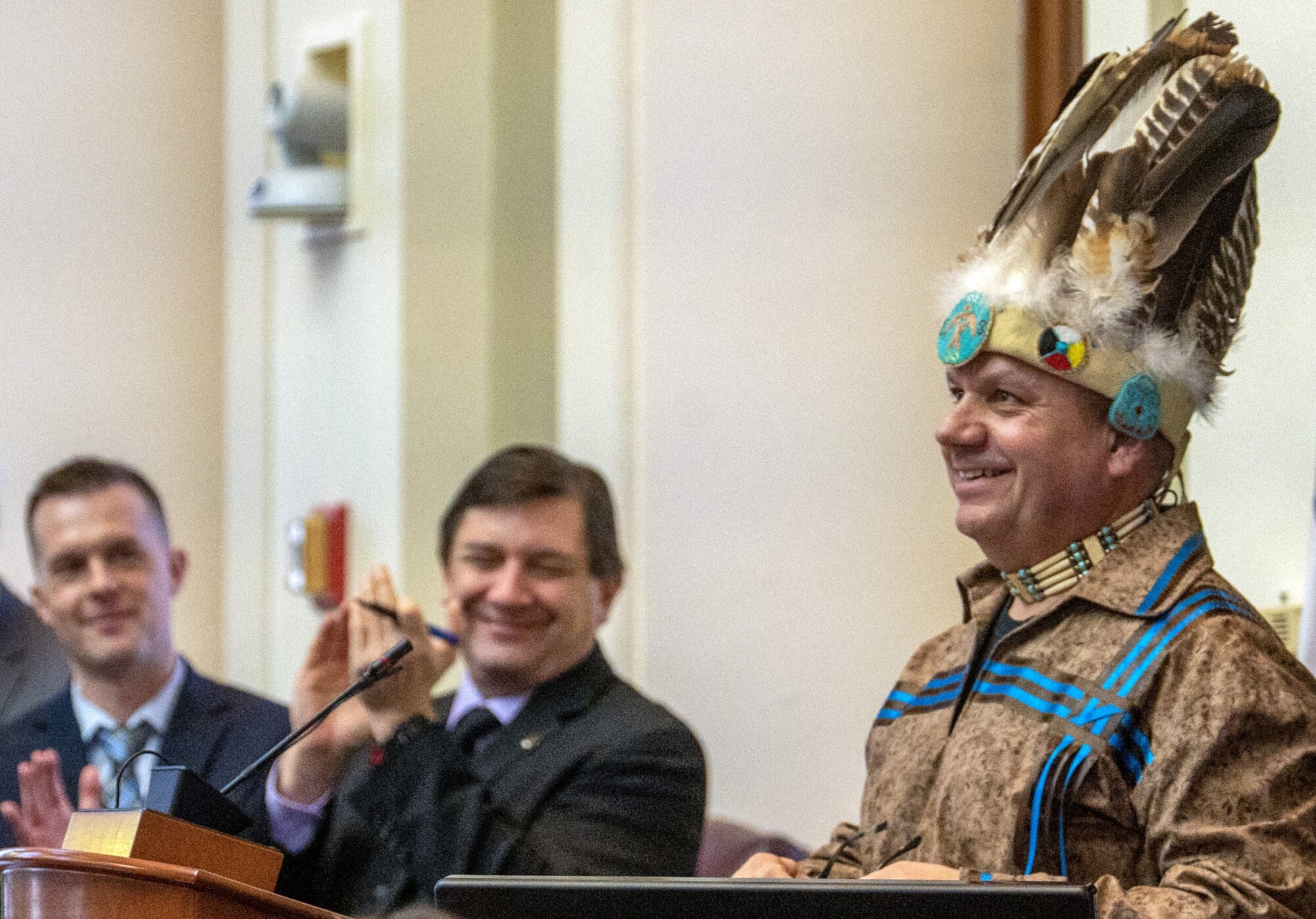
U.S. Rep. Jared Golden, D-2nd District, left, and then-Senate President Troy Jackson, D-Allagash, applaud after Chief William Nicholas Sr., chief of the Passamaquoddy Tribe at Motahkomikuk, spoke in February 2023. (Joe Phelan/Staff Photographer) Purchase this image
“What I hear when I’m around my elders is the fact that she doesn’t forget them,” he said.
Shane Hill, the director of transportation, realty and asset management for the Mi’kmaq Nation, is an anti-Trump Republican. He lives in Caribou, near Collins’ family farm, and his wife works for the family’s lumber supply company.
Hill ran into the senator at Tim Hortons several years ago, when he was the superintendent of the Northern Maine Veterans Memorial Cemetery, and mentioned an upcoming inspection by the Department of Veterans Affairs. He received a near-perfect score that year, and months later Collins called him up from the crowd at a ceremony to thank him, and later sent him a signed photograph of the two of them together.
“Maybe we wouldn’t agree politically on everything,” Hill said. “However, I think she’s done a great job with her high rank and being from the community that I’m from, you know, you’d be foolish to think that doesn’t have any pull.”
‘HE DIDN’T STAND DOWN’
In response to Jackson and Gideon’s question, “How do you want to fix this?” lawmakers established a task force.
Advertisement
The group published 300 pages of research, testimony and recommendations that have underpinned numerous bills and laws in the years since.
Although the most ambitious of those bills haven’t cleared Mills’ desk, Bryant — who now leads the Wabanaki Alliance, a coalition of tribes fighting for tribal sovereignty — said the work reframed tribal-state relations and forced Mills to wrestle with the issue.
“I think that was brave of (Jackson) and (Gideon) to take that on,” she said.
Jackson butted heads with the governor numerous times on the issue during his time leading the Senate, calling her veto of one sovereignty bill in 2023 “disappointing but unsurprising.”
The Mi’kmaq Nation endorsed Jackson in the gubernatorial primary, but has stayed silent since he entered the Senate race.
Teresita Hamel, the Mi’kmaq vice chief who spoke only for herself, said Jackson’s leadership and willingness to fight for tribal sovereignty have won her over.
Advertisement
“He didn’t stand down and turn his back on the Wabanaki Nations,” she said.
Even tribal leaders like Nicholas will praise Jackson’s affability and commitment to sovereignty, an issue that Collins has been mostly quiet about, or at times antagonistic.
There was a 2012 incident, when Collins confirmed with the Office of the Maine Attorney General that an amendment to federal disaster relief laws would usurp state authority and therefore not benefit the Wabanaki Nations. She elicited as much from the bill’s sponsor on the Senate floor: “This provision would not and should not apply within or to the State of Maine.”
Collins has maintained she was unaware of the chiefs’ objections at the time.
And in 2022, there was a bill sponsored by Rep. Jared Golden, D-2nd-District, that would’ve made all beneficial federal laws applicable to the Wabanaki Nations going forward. It wouldn’t have restored full tribal sovereignty, but it was a step toward righting what Wabanaki leaders say is one of the 1980 settlement’s most pernicious wrongs.
In the Democratically controlled Senate, it was a member of the majority caucus, Maine’s independent Sen. Angus King, who blocked the bill.
Advertisement
Collins earned no favors when she stayed silent.
“We were never in a position to flesh out her position, because there were other people in the Senate who caucused with Democrats who were standing in the way of it,” Golden said in an interview.
STATE VS. FEDERAL
Tribal sovereignty is one of those rare divisive issues that transcends party politics. Among non-tribal politicians, the dividing line appears generational, observed Golden.
“There’s a lot of people that are very dug in against tribal sovereignty in Maine politics, and they’re all, let’s just say, above a certain age,” he said.

Related
4 Wabanaki chiefs back Hannah Pingree in Maine governor’s race
After King killed Golden’s bill, lawmakers and tribal leaders alike are aligned in feeling that sovereignty has to start with support at the state level.
That’s why four chiefs, including Nicholas, endorsed Democrat Hannah Pingree for governor last week. Pingree has promised to pass and sign tribal sovereignty legislation in her first 100 days.
Advertisement
A working group in the Maine Legislature is currently developing a proposal for state-level changes that would allow the Wabanaki Nations to benefit from all or most federal laws that apply to other Indian tribes.
State and tribal officials are confident that they can make the change at the state level.

Democrat Hannah Pingree, center, was endorsed by, from left, Vice Chief Teresita Hamil (Mi’kmaq Nation), Chief Sheila McCormack, (Mi’kmaq Nation), and Chief Kirk Francis (Penobscot Nation) and Chief Clarissa Sabattis (Houlton Band of Maliseet Indians) on Indian Island on Friday. (Courtesy Hannah Pingree for Governor)
A Collins spokesperson in a statement Tuesday reiterated the senator’s support for the applicability of individual federal laws, but declined to take a position on the matter at the federal level. A spokesperson for Jackson said “Troy believes the Wabanaki Nations deserve the same respect, rights and opportunities as other federally recognized tribes,” but did not take a stance on this specific issue.
People like Nicholas and Hill will overlook Collins’ past silence on sovereignty and take the wins — all $6 million of them — that are attainable until the issue is settled at the state level.
“When we get there, I think we’re going to have that discussion, but it’s not right now,” Nicholas said.
Hamel, the Mi’kmaq vice chief, looks at it differently.
Advertisement
“Having a champion for sovereignty at this time in our growth, I think that’s extremely important,” she said. “I think that that’s the fight we need to take on.”
Jackson and Collins both have their shortcomings: Jackson his lack of power and experience, and Collins her unwillingness to lead the charge.
Their supporters are not willing to let these imperfections be the enemy of their good.
Reuben M. Schafir is a Report for America corps member who writes about Indigenous and rural communities for the Portland Press Herald.
Copy the Story Link
Tagged: election 2026, senate 2026, Susan Collins, Troy Jackson, wabanaki nations

Reuben, a Bowdoin College graduate and former Press Herald intern, returned to our newsroom in July 2025 to cover Indigenous communities in Maine as part of a Report for America partnership. Reuben was. More by Reuben M. Schafir


