

In Rockland, artists now have an innovative, creative space to live and work

Some might say that what it takes to create a thriving community of artists is funding. Others might argue it’s housing, or spaces for creatives to do their work in. Still others would say it takes inspiration. Architect Matthew Baird, the vision behind the newly reimagined mini-campus of Rockland’s Ellis-Beauregard Foundation, says it takes all of the above — plus a dinner party.
“We would always meet with the trustees on Thursdays at 4 o’clock, and [Foundation executive director Donna McNeil] would always stop the meeting at 5:30 and say, ‘Okay, all of you please come to my house for dinner.’”
There, he and members of his New York-based firm would sit down and eat with everyone from curators at the Center for Maine Contemporary Art and the Farnsworth Art Museum to the Camden Film Festival and local artists.
“Those conversations meant that by the time we got halfway through the design, we really had an understanding of the local community and what was meaningful to them,” he says. “Donna knew that if she threw a great dinner party and brought all of these interesting people together, that it would inevitably inspire a great process.”
The result of that five-year process is Rockland’s latest addition to its cultural institutions, intended to further cement the area as an arts destination. The Ellis-Beauregard Foundation provides resources and support for artists and sustains the legacy of its founding artists, Joan Beauregard and David Ellis. Two innovative, net-zero energy structures have been built adjacent to the original building where Beauregard and Ellis once lived. The new buildings, built by Mussel Ridge Builders in Rockland, include residence and studio units for four visiting artists, plus performance and exhibition spaces, at a total cost of about $6.2 million.
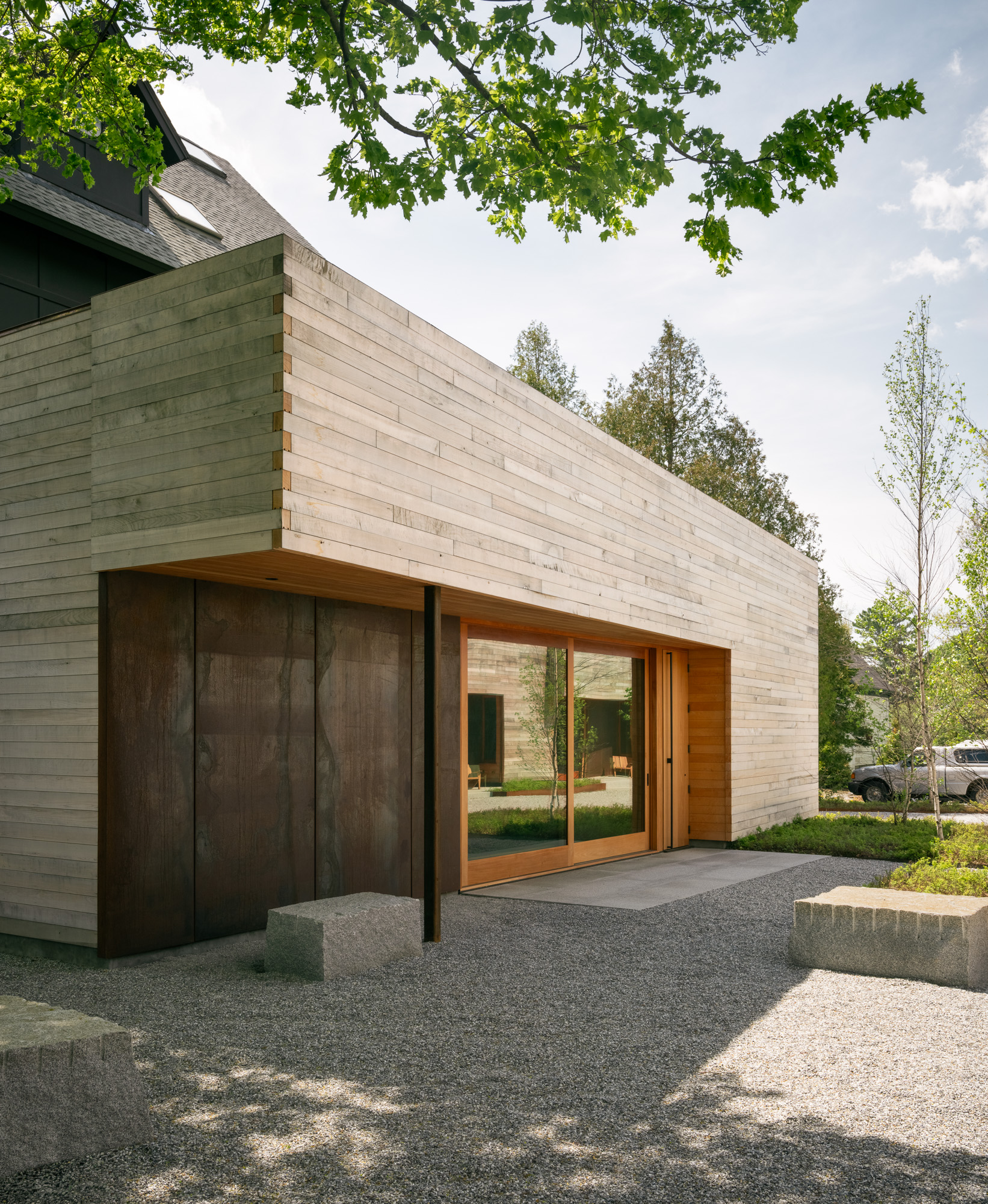
The new buildings, built by Mussel Ridge Builders in Rockland, include residence and studio units for four visiting artists, plus performance and exhibition spaces. This is a view of the Foundation’s new multipurpose exhibition and performance space, with the original home of artists Joan Beauregard and David Ellis visible behind it. The house now serves as the Foundation’s administrative offices and archives. (Photo by Trent Bell)
In June, the new campus was inaugurated after the Foundation’s preexisting visiting artists program was reignited in January. (Alumni include the Reggie Burrows Hodges, whose residency there is credited with first getting his work noticed; painter Anne Buckwalter; and photographer Dylan Hausthor.)
CONVERSATIONS WITH ARTISTS
Those visiting artists introduce new perspectives and voices to Rockland, says McNeil. “One thing we provide that neither the Farnsworth nor the CMCA do is we bring in a national group of artists to engage in the conversations,” she says. “It brings an outside voice to the community that residents seem to enjoy, and certainly the other institutions respect and value.”

“We wanted to make a building that’s ultimately utilitarian, and that finds beauty in its utility,” says Foundation Executive Director Donna McNeil. A rear view of the residency building shows the shared corridor that connects the four artists’ studios to the communal living and dining space. Translucent polycarbonate glazing lines the exterior of the corridor, allowing natural light to filter through. (Photo by Trent Bell)
And while Baird’s design for the new campus could easily have been a throwdown meant to match the creative works it houses and exhibits — his roster of high-profile projects, after all, includes the likes of the Woodmere Art Museum in Philadelphia and the New York Studio School — he’s quick to explain that he wanted just the opposite.

Natural light fills one of the artists’ studios through clerestory windows and a north-facing pyramidal skylight, illuminating the workspace below. (Photo by Trent Bell)
“A lot of times, I think architects brought onto arts projects feel the need to make something artistic themselves,” he explains. “But this is not a moment for the design to take center stage. What you want to do is create a neutral backdrop for art, so anyone can bring their vision and not find the architecture is in the way.”
Advertisement
Instead, he focused on those conversations he was having with artists in the community including many who’d already been through the program. “We spoke with 30 or more,” says McNeil, who accepted the post of executive editor after coming out of retirement from an illustrious career that included helming the Maine Arts Commission. The artists’ requests ranged from wanting lots of natural light (northern light — prized for its indirectness and consistency — pervades the buildings) to high ceilings. “And they definitely didn’t want to sleep in the studios,” recalls Baird. “If you were painting with oil paints, [you’d be] sleeping with that smell.”
ARTISTIC SPIRIT AND SUSTAINABILITY
Aesthetically, he aimed to turn the buildings’ minimalism and functionality into something familiar to the artists — to echo “the gritty loft living and the kind of places where people were making art in lower Manhattan and Brooklyn,” he says, and to “capture that spirit in Rockland.” That’s also reminiscent of the New York lofts where artist founders Joan Beauregard and David Ellis lived and worked before moving to Maine. “We wanted to make a building that’s ultimately utilitarian, and that finds beauty in its utility.”
And then there was the sustainability effort, which was about “making a building that the artists would be proud to be a part of because it was so responsible environmentally,” he says. That’s manifested in elements like the green roof, which has a reservoir that can retain rainwater. “It’s like a sponge up on the roof, so we protect the harbor from all the runoff that some buildings can create,” he says. It’s equally evident in other groundbreaking systems — several of which were the product of a $100,000 grant from the Helen Frankenthaler Foundation. “It was the first project where we’ve taken solar power, used it to run heat pumps, and have those produce hot water that we’ve run in a slab to create radiant heat. So in the wintertime, the artists are in bare feet in the studios and they love it.”

A closer aerial view highlights the residency building’s pyramidal skylights, with north-facing glazing designed to bring abundant natural light into the studios and solar panels integrated into their south-facing sides. (Photo by Trent Bell)
Other innovations extend to the new second building. “We built an exhibition and performance space, and they can use that space to hang an exhibit, invite a curator, to have a performance, or screen a film,” says McNeil. “We put in a sprung floor for dance because we love choreography here, and it’s attracted a lot of applications.”
“It can be a choreographer, a composer, a theater person, a novelist, an essayist, a visual artist, a sculptor. The overarching concept was sort of Bauhousian omni conversations across genres,” she says. It highlights “different ways of knowing and looking and working. and tackling informative for everybody, and it expands the work. The artists love having those conversations across genres.”

Performance artist Sandy Tugwood performs in the Foundation’s multipurpose exhibition and performance space, located across the courtyard from the residency studios. The flexible space accommodates a range of artistic disciplines and creative activities. (Photo by Trent Bell)
And the community is also brought in, via regular public events at local bars. “It’s so much better because everybody’s relaxed,” she reflects. “They’re having a drink. It’s dark. They’re commingling. If you create the proper setting, the barriers come down. And the exchange of ideas is more fluid and informal, and people become friends, not just colleague-to-colleague or workmate-to-workmate. It just becomes a conversation among people.”
Which has echoes of the dinner parties McNeil threw for the design team. “I think it’s more fruitful that way. Something happens around a dinner table that doesn’t happen in a meeting,” she says. “So yeah, I believe in the dinner table.”
Alexandra Hall is a longtime New England lifestyle writer who lives in Maine.
Copy the Story Link
Tagged: artists, featured, maine artists


