

Greater Portland restaurants embrace Scandinavian cuisine — and habits

To spend a day eating around Scandinavia, one could enjoy a slice of malty sauna bread, fill up on a plate of Finnish meatballs and end with a Bagsværd Lakrids caramel licorice, all while barely leaving Portland’s East End.
Scandinavian-inspired pastries, stores and experiences are available throughout southern Maine, from Swedish cardamom buns to Nordic candy fish. And that’s not to mention the embrace of sauna culture, or the pursuit of Scandinavian design available at long-standing downtown imports store Simply Scandinavian, or the new home goods spot Hei Hey on Congress Street.
Could it be the comparable climates, the similarly dramatic coastlines, the propensity for comfort? Or American political escapists dreaming of a life of socialized healthcare and less wealth disparity?
“It seemed like an outdoorsy place, it seemed like a very community-oriented state and culture, it seemed like a place where people took care of each other, it seemed like a place where people embrace winter,” said Kristina Alving, co-owner of Swedish-inspired Saco bakery Fika, who moved to Maine from Massachusetts years ago. “It’s a little slice of Scandinavia just over on this coast.”

Kristina Alving takes an order from a customer at Fika, a walk-up Scandinavian-style cafe and bakery, in Saco on Oct. 22. (Brianna Soukup/Staff Photographer)
(Scandinavia is made up of Norway, Sweden and Denmark, although in the United States it’s often used interchangeably with the term Nordic, which also includes Finland and Iceland.)
Alving, and other chefs and owners behind some of these businesses, say that even more than the cuisine itself, Nordic customs of slowing down, finding comfort and being in the moment — embodied in traditions like the cozy Danish idea of hygge – are what they’re trying to bring to Maine.
Advertisement
‘THE WHOLE THING IS AN EXPERIENCE’
For Nikoline Østergaard, owner of Sødt Nordic Candy Shop, opening the store was about bringing a piece of her childhood outside of Copenhagen to Maine.
When Østergaard, 33, and her sister, Signe — children of a Danish father and American mother who met while he was an exchange student in Maine — started to see the pick-and-mix candy shops of their Danish youth crop up in major American cities, they worried someone might beat them to it. In May 2025, they opened their first shop in Portland. It was so successful that they ran out of stock on opening day, and this summer they expanded with a second, larger location in Freeport.

Sødt Nordic Candy Shop owners, sisters Nikoline, right, and Signe Østergaard, at their store on Cumberland Avenue in Portland on Oct. 13. (Brianna Soukup/Staff Photographer)
Østergaard said the tradition of fredagsslik, or Friday candy, is just a part of life in Denmark. After school at the end of the week, parents take their children for a bland selv-slik, or a bag of candy from a ubiquitous kiosk, and they work together to pick their favorite candies before going home to watch a movie or play board games. As kids grow up, they carry on the tradition with their friends or partners.
“The whole thing is an experience,” she said. And that’s what the people of Portland are appreciating about it too. In the years after the pandemic, Østergaard said, Americans seem to have reembraced opportunities to do things together, rather than, say, just going to a convenience store to grab a bag of candy.
“Activities have become fun again,” she said. “Experiences have become more of a thing again.”

Sødt Nordic Candy Shop in Portland on Oct. 13. (Brianna Soukup/Staff Photographer)
View 4 photos
She has another theory about why Americans, and Mainers, are loving Scandinavia right now: politics.
Advertisement
“When you’re uncertain about times in your life — like how the United States is in a very weird situation right now — I think you look elsewhere and see what’s working,” she said. “Scandinavian countries, for many years now, have had a very steady economy and steady well-being, and they’ve figured out the whole work-life balance.”
‘NOT JUST ABOUT THE DAILY GRIND’
For Alving, 41, and Samuel Wiese, 33, the team behind Saco’s Fika, named for the practice of taking a break to have coffee and a pastry, it was that tradition, more than a particular type of baking, that sparked them to open the popular walk-up microbakery in 2023.
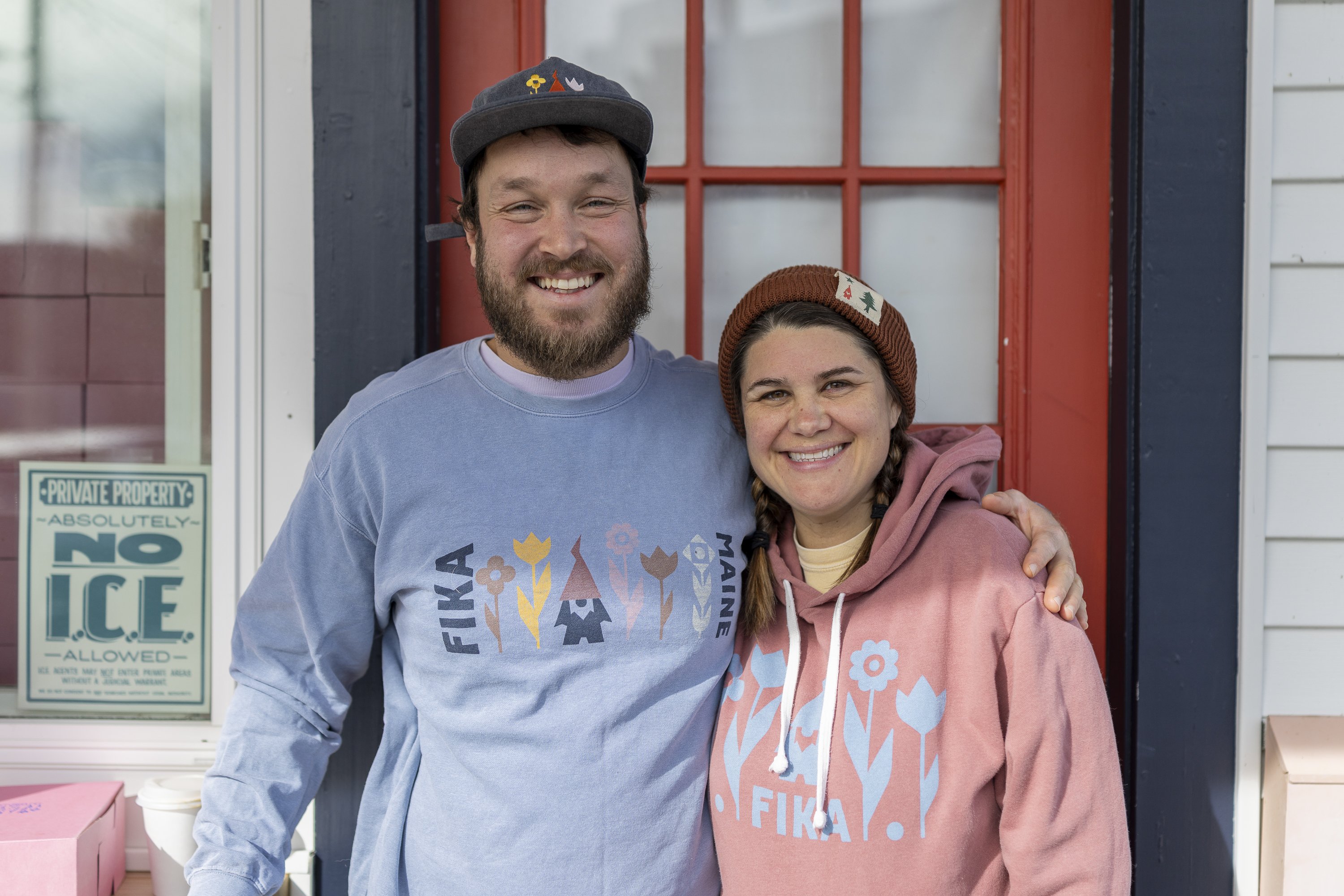
Co-owners Kristina Alving and Samuel Wiese at Fika. (Brianna Soukup/Staff Photographer)
Like Sødt, the shop was designed as an antidote to America’s fast food and hustle cultures. “Fika is kind of antithetical to that,” Wiese explained. “It’s very much about making intentional breaks in your day, stopping and remembering that life is not just about your daily grind, and it’s about enjoying the little things in life.”
Both Alving and Wiese have Scandinavian ancestry, and the bakery does have glimmers of Nordic baking in its deeply seasonal menu, which changes monthly. October’s pastries showcased the best of Maine’s fall bounty: apples, pears and quinces cropped up across the buns, tarts and cakes, which range from $3 to $9.
In each menu, they return to familiar forms with different flavor combinations. October’s artful apple knot, or appelbullar, was a doughy bun contrasting with a bright cider glaze and a tart baked half-apple in the center. One of Alving and Wiese’s favorite shapes is the crumb bar, available last month with a well-balanced cranberry apple filling atop a buttery base with flecks of oats and cardamom, the staple spice of Nordic baking.

Customers line up to order at Fika, a walk-up Scandinavian-style cafe and bakery in Saco on Oct. 22. (Brianna Soukup/Staff Photographer)
View 4 photos
And the cardamom bun, or kardemummabullar, their only consistent item month-to-month, is sticky and floral, crispy on the outside and twistier than the traditional version, but pillowy toward its center.
Advertisement
Fika is good at reminding its patrons to slow down. I waited more than 30 minutes to order (Alving and Wiese warned this was likely because of the first day of their new October menu), and the two of them still took time to chat with every customer. I had a cup of the daily drip roast, from Massachusetts-based George Howell Coffee — the obligatory other half of fika — which delivered on promised notes of chocolate and tangerine.
‘EVERYONE IN THE SAME PLACE’
For Portlanders seeking a sauna experience, Washington Baths in the East End is a go-to spot. But those in the know also go for the food.
Izabel Nielsen, 34, a co-owner and founder, said her focus for the cafe (which patrons can visit without saunaing) was more about creating a gathering space around food than the food itself. It was influenced in part by her year of college abroad in Denmark, where she saw families come together at straightforward lunch cafes.
“The idea of everyone eating together around a similar time with something very simple and multi-generational and very accessible, was something that I found extremely appealing,” Nielsen said. “It put everyone in the same place.”

Izabel Nielsen and Asher Woodworth, owners of Washington Baths, pose for a portrait next to the cold pool in January 2025. (Ben McCanna/Staff Photographer)
In contrast to Fika, the menu at the cafe doesn’t change, and it’s anchored by staples like sauna bread, a recipe of Nielsen’s own creation that pays homage to the hearty, earthy, slightly sweet offerings she sampled while doing sauna research in Finland.
Her version is square and made of rye, intensely toothsome with nut-like inclusions of malt and served with an insurmountable cloud-like pile of whipped saltless butter (although the employees told me most people finish all of it, and some ask for more, so I’m apparently an outlier.)
Advertisement
The cafe also offers a range of beverages to counter dehydration that can happen during the sauna experience, including three mineral waters from bathing towns in Romania, Georgia and Iceland. The naturally carbonated Georgian Borjomi, the funkiest of the three, tastes like dipping beneath the surface of the pool and accidentally getting a mouthful of salty water, but in a good, nostalgic way.
Nielsen notes that Washington Baths is an American bathhouse, pulling ideas from bathhouses in Finland and Japan, and from global bathing styles. The cafe is cosmopolitan too. Other menu staples include ever-popular daal, dates, a lemon poppyseed almond cake and pickles.
Bathing culture differs from U.S. spa culture in its focus on taking care of oneself, rather than treating oneself, Nielsen said. “It’s not a restaurant,” she said. “This is something I could eat every day.”
At the twice James Beard-nominated craft cocktail bar Hunt + Alpine, owner Andrew Volk said the Scandinavian influence was half-gastronomical, half-practical.
“There’s a kinship between New England and a lot of those countries that have similar latitudes, similar weather, similar flora, similar fauna,” Volk said. “A lot of the food that you would find here, you can find there.”

Hunt & Alpine owner Andrew Volk makes the Inspector Clouseau mocktail at the Market Street bar in Portland in October 2025. (Daryn Slover/Staff Photographer)
But in creating the menu, he was also thinking about resources. The space on Market Street in Portland doesn’t have a stove hood, a live flame or a fryer, so Volk said they found a solution in offering bar bites: cured meats and fishes, pickles and other staples of Nordic cuisine.
Advertisement
Andrew and then-co-owner Briana Bononcini released a cookbook in 2018 called “Northern Hospitality,” combining their craft cocktail prowess and recipes from Briana’s Finnish grandmother, like riisipuuro, a rice pudding, and pulla, a cardamom bread.
Volk said Scandinavian cuisine was part of Hunt’s original DNA, and although the bar has “let some of that go” through rebrands, time and Bononcini’s departure, Finnish meatballs are still on the menu.
Southern Maine doesn’t have a particularly large Scandinavian community, but these businesses have become a destination for the ones who do exist, or inspired others to visit.
Volk said Hunt + Alpine has often served as a gathering place for employees of Eimskip, the Icelandic shipping company headquartered in Portland, who are always delighted to find pickled herring on the menu. For years, the bar catered Eimskip’s Scandinavian charity Christmas parties.

Pastries at Fika on Oct. 22. (Brianna Soukup/Staff Photographer)
The team at Fika said people come from as far away as Swedish communities in the Midwest, or even Sweden itself, because they’ve heard it’s a good spot to get familiar treats. Likewise, Østergaard at the candy store had no idea how many people with Nordic ancestry lived in the area until it became a hot spot for them.
“I’ve spent 33 years traveling back and forth and never met someone from Denmark,” Østergaard said. “Now, we open the store, and there are so many.”
Copy the Story Link
Tagged: featured, maine restaurants, restaurant industry, Restaurants

Riley covers education for the Press Herald. Before moving to Portland, she spent two years in Kenai, Alaska, reporting on local government, schools and natural resources for the public radio station KDLL. More by Riley Board


