Wildfire in White Mountain National Forest more than 50% contained


Firefighters mop an area of the Wild River Fire where logs and tree litter continue to smolder. (Photo courtesy U.S. Forest Service)
The Wild River Fire just over the Maine border in New Hampshire now encompasses 821 acres and is 53% contained, the U.S. Forest Service said on Tuesday.
The Forest Service first responded to the fire in an area of the White Mountain National Forest about 7 miles southeast of Gorham, New Hampshire, on Nov. 1. It’s on the northwest side of the Wild River, just west of Mount Hastings in Maine’s Oxford County.
Early last week, the Forest Service estimated that the fire had grown from a few hundred acres to nearly 1,000 acres. At that point, it was just 11% contained.
As firefighters shifted to the offensive late last week, they narrowed their estimate of the Wild River Fire to about 856 acres. Over the weekend, they pegged it at about 821 acres, where it still stood Tuesday.
Related
Wildfire response enters new phase in White Mountain National Forest
While the fire’s footprint has been slow to shrink, firefighters’ containment of the blaze has grown exponentially over the weekend and into early this week.
The Forest Service estimated the fire was roughly 20% contained by Friday, 29% by Sunday and, on Tuesday, they said the Wild River Fire was approximately 53% contained.
Advertisement
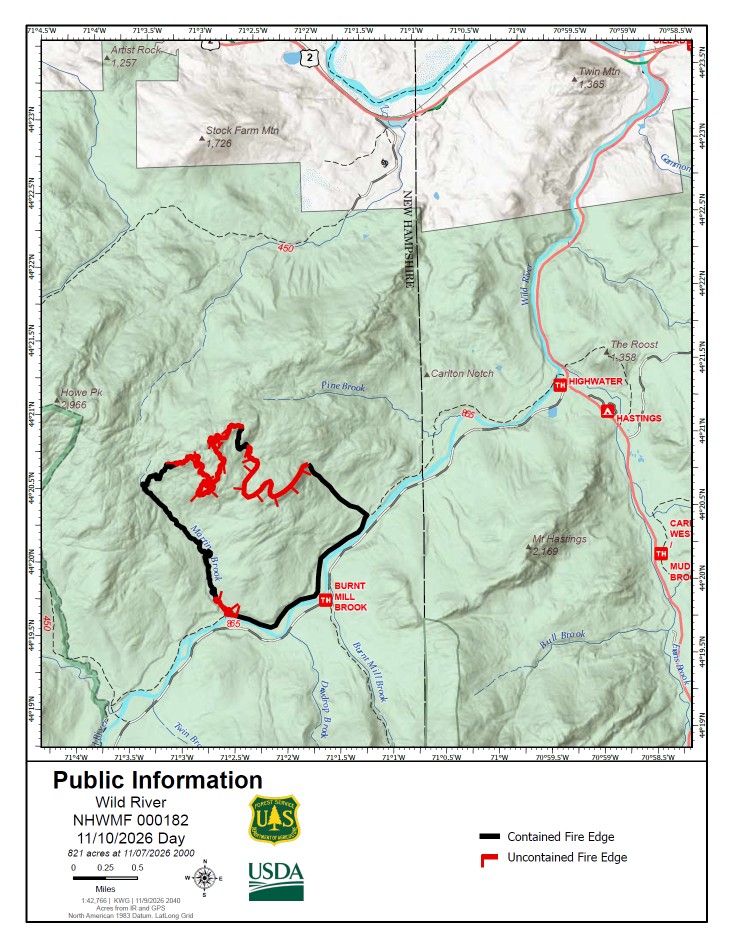
Officials estimated the Wild River Fire was 53% contained as of Tuesday. (Courtesy of the U.S. Forest Service)
The portion of the perimeter contained in the first full week of fighting was largely limited to the banks of the Wild River and a stretch of the blaze’s northeast border, which is roughly a half-mile from the state line.
However, Tuesday’s update showed progress in other areas, including along a brook on the west side of the fire, and segments of the fire’s jagged northern edge.
The size of the response — which peaked at 140 assigned personnel on Friday — dwindled over the weekend and was down to 88 assigned personnel as of Tuesday.
“As fire behavior has moderated, and the potential for the fire to spread continues to be reduced, incident managers have begun adjusting resources to better align with operational needs,” the Forest Service said in its update Monday.
As they did last week, officials detailed the large-scale response at a public meeting in Shelburne, New Hampshire, on Tuesday night.
Ben Wagner, an operations section chief assigned to the wildfire, said they have divided the fire into three sectors: One encompasses nearly the entire south side of the blaze, along the Wild River, while the northeast and northwest edges make up the other two. A division of firefighters is assigned to each of the three sectors.
Advertisement
Wagner said much of the area that has yet to be contained is in mountainous terrain, which can be especially hazardous for firefighters to navigate.
“If you can imagine hiking 2,500 vertical feet carrying chainsaws and leaf blowers and everything you need, and then breaking your leg on that mountain,” Wagner said, “the arduous work would then be to take that person and hike them down the mountain and cross over a river — and trying to do that within daylight.”
No firefighters have been injured during the response, due in large part to only attacking the fire where and when it’s safe to do so, officials said Tuesday.
But some conditions have gone the Forest Service’s way. For instance, Wagner explained that the spread of the fire, which has been thriving off felled hardwood, has naturally slowed or halted in areas with conifer fuels. Water sources, like brooks and creeks, have also served as natural means of controlling the spread.
And the icing on the cake has come in the form of sorely needed precipitation.
“The rain, the snow, the increase in moisture that’s permeating down into the ground, has really helped us a great deal in holding this fire where it’s at,” Wagner said.
He later added: “For as difficult a ground it is to work, we do have some things that are working in our favor.”
Copy the Story Link
Tagged: new hampshire, White Mountain National Forest, wildfires

Drew is the night reporter for the Portland Press Herald. He previously covered South Portland, Scarborough and Cape Elizabeth for the Sentry, Leader and Southern Forecaster. Though he is from Massachusetts,. More by Drew Johnson