

Why investment profit is at the center of CMP’s rate hike


Richy Ainsworth of the Center For an Ecology Based Economy holds a sign Tuesday during a "Fight the Hike" protest outside of the Lewiston Public Library in June. The protest was a coalition of organizations who are opposing proposed rate hikes by Central Maine Power. (Libby Kamrowski Kenny/Staff Photographer)
Central Maine Power Co. is asking state regulators to raise the cap on revenue it can make back from its investments in Maine’s electrical infrastructure.
That has become a sticking point in the monthslong debate as CMP is asking the Maine Public Utilities Commission to approve an $18 per month increase in the average household’s distribution bills.
That would give the company $189 million in new revenue to pay for grid upgrades, added staff and storm recovery. Raising revenue on CMP’s past investments accounts for about a third of that increase, according to the Office of the Public Advocate.
Groups representing consumers in the case, which will extend well into next year, have argued that CMP doesn’t need more profit — not while Mainers struggle with the rising cost of living. CMP says the jump keeps the utility’s returns below industry standard, and that it’s necessary to compete for investment.
For Maine’s largest utility, the new revenue is paramount for repairing an aging grid and maintaining its reliability. CMP’s financial status is already strained, and its cash flows have stagnated after a previous five-year rate proposal was rejected last year.
“Delaying projects that benefit customers and communities today only increases costs tomorrow,” CMP said in a written statement.
Advertisement
CMP serves about 670,000 homes and businesses in central and southern Maine. For them, it’s about affordability.

Related
CMP rate hike hearing draws protesters, fierce testimony to Lewiston
“There does have to be some rate of return, and it will always come from ratepayers,” Heather Sanborn, the Maine Public Advocate, said. “We have to think about affordability, and that Mainers are breaking under the weight of how much costs are going up in every facet of their lives.”
Here’s why investment revenue — or return on equity, as the regulators and utility experts call it — has become a focal point, and why it could make a big difference on power bills next spring.
WHAT’S RETURN ON EQUITY?
Return on equity, simply, is the money utilities are allowed to make on their built infrastructure, like poles and transformers. The PUC regulates that revenue as part of rate cases for CMP and other utilities.
It’s the only way utilities can make profit, since CMP can’t mark up the actual delivery of electricity.
State regulators set return on equity as a percentage, usually somewhere between 8-10%. That number is then multiplied by the “rate base” — the total amount of CMP’s built infrastructure, like poles and transformers, as long as regulators deem it was “prudent” to build it in the first place. That equation determines how much CMP can bill ratepayers for its investments.
Advertisement
For example: If CMP had $100 million worth of capital investments and Maine regulators approved a 10% return, CMP would bill ratepayers a total of $10 million for its investment return.
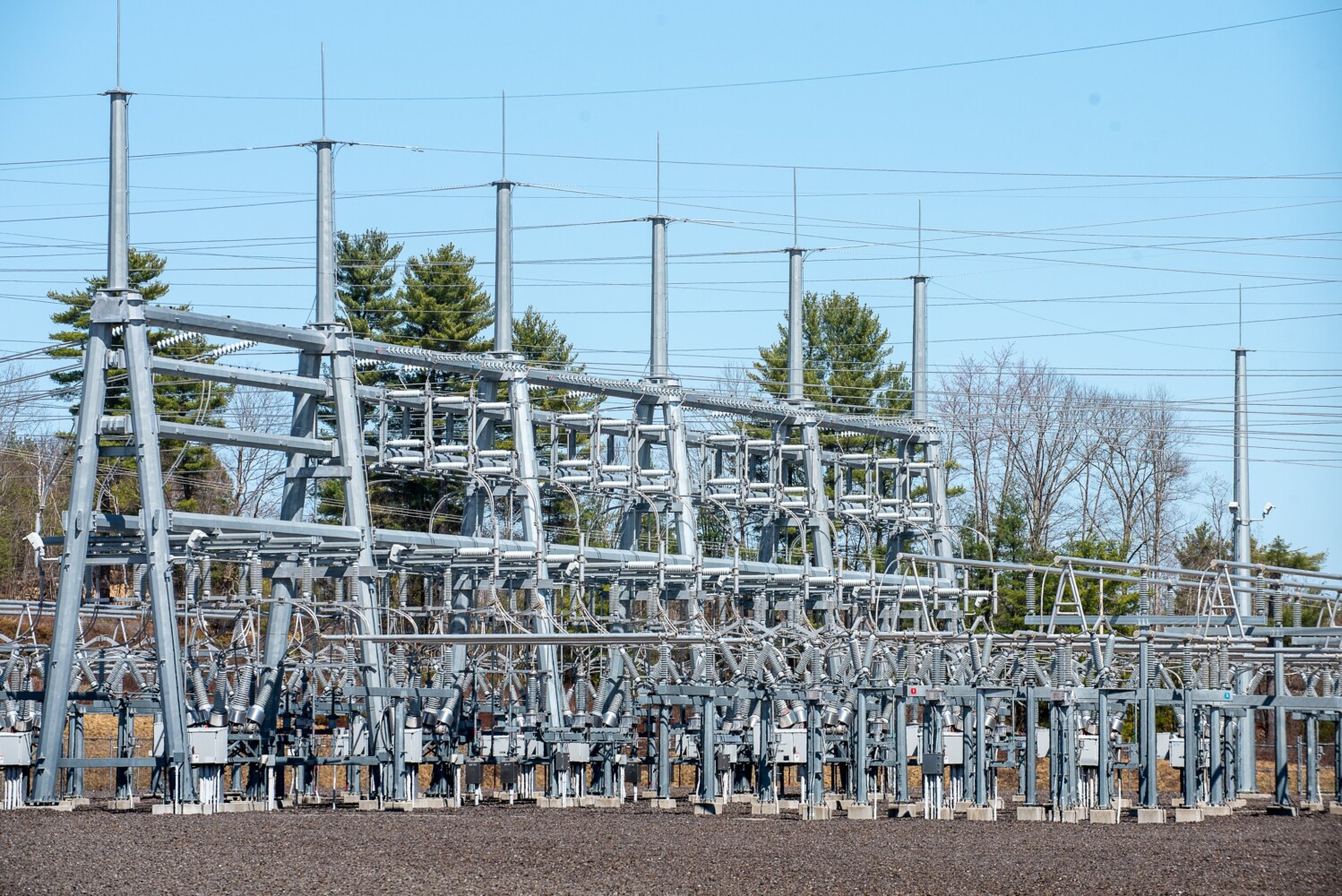
Central Maine Power’s Larrabee Road Substation in Lewiston, the southern terminus of the utility’s 145-mile NECEC transmission line project. CMP’s return on equity is based on investments like this one. (Russ Dillingham/Staff Photographer) Purchase this image
SO WHAT’S CMP ASKING FOR?
CMP’s current return, set in 2023, is 9.35%. It’s now hoping to raise that to 9.8%.
But the utility has also spent millions on building infrastructure, which could mean it and its parent companies earn tens of millions more.
Related
From 2023: CMP rate hike approved by regulators, will increase home bills nearly $2 next month
CMP’s 9.35% return is built on a rate base of $1.67 billion. Jumping 9.8% on that same base would mean CMP’s return would go up by about $7.5 million.
But CMP says its new base rate, with all the infrastructure it’s built in the past several decades, is now $2.23 billion. Jumping to 9.8% means $61 million more in revenue.
If regulators determine all of CMP’s recent infrastructure investments were sensible, that rate base could be as large as $2.27 billion, up 32% from the current $1.69 billion, the Office of the Public Advocate said. Sanborn said CMP has built much more than it told regulators it would in its 2022 rate case, leading to the increased rate base.
Advertisement
A half-percent return increase, with a $2.27 billion rate base, would equal a jump in revenue of more than $60 million.
CMP and its witnesses have said that the increase to 9.8% is not just fair — it’s slightly below the 10-11% standard set nationwide, and was based on a group of similar utilities — it’s necessary for the future of the company.
CMP’s financial outlook was downgraded last month by S&P Global Ratings to “negative” because of lag in this rate case and a $100 million cash flow deficit.
CMP’s expert return on equity witness Ann Bulkley wrote in an April filing that CMP will face potential pressure on its credit ratings and assume financial risks if regulators don’t allow the utility to recover the costs of its investments in Maine’s grid.
The company’s ask is also consistent, Bulkley wrote, with U.S. Supreme Court decisions that allow utilities to recover their capital costs, as long as it leads to “just and reasonable” rates for customers.
IS CMP ASKING FOR MORE THAN IT NEEDS?
If you ask advocacy organizations opposed to CMP’s hike — yes.
Advertisement
And the evidence to back it up is public, Seth Berry, the executive director of Our Power and an intervenor in the rate case, said.
CMP’s own parent company, he said, isn’t expecting CMP to make 9.8% return on equity. It’s not even expecting the 9.3% it’s authorized to make now.
“It’s more than three percentage points lower,” Berry said, referring to a section of the 2025 earnings report from Iberdrola, CMP’s corporate owner, that estimated investor return for its U.S. electric subsidiaries at 6.26%.
Iberdrola, the Spanish energy conglomerate, bought CMP parent Avangrid in 2024, and its biggest shareholders are Qatar and the private equity firm BlackRock.

Our Power Director Seth Berry, dressed in a bear costume, leads a chant during a “Fight the Hike” protest outside of the Lewiston Public Library in June. The protest was a coalition of organizations who are opposing proposed rate hikes by Central Maine Power. (Libby Kamrowski Kenny/Staff Photographer)
Expert witness and national utility case consultant Mark Ellis found the 6.26% expected rate of return in the Spanish company’s books. He filed his own testimony to the PUC last week, arguing that lower percentage is enough to balance CMP’s financial concerns and ratepayers’ affordability concerns.
Regulators forced CMP earlier this month to open its books to show where that 6.26% number came from — a move that advocacy groups believe could prove CMP is asking for more than it needs.
Advertisement
Ellis — a former utility executive — has made the argument in several other states for lower return on equity for utilities, and has so far failed to get regulators to adopt his approach.
“While some continue to promote theories that have been repeatedly rejected by regulators across the country, our focus is on the practical realities facing Maine: maintaining reliability, preparing for future growth, and making the investments needed to keep the lights on in a way that is affordable and sustainable for the customers we serve,” CMP said in the written statement.
But Berry said he believes using the parent company’s own numbers against them is a novel tactic worth the PUC’s attention.
“Customarily, their argument has been, ‘Oh no, we need much, much more,'” Berry said. “‘And if we don’t get what we want, then the sky will fall.’ So far, the sky hasn’t fallen, and I think it’s time that we hold the utilities to their own figures when they are in fact required to be accurate.”
In a hearing earlier this month, an attorney for CMP said the 6.26% number applies broadly to all of Avangrid’s U.S. electricity subsidiaries, not just CMP — and that it was calculated using an unrelated accounting exercise.
And Bulkley, the company’s expert return on equity witness, wrote that CMP’s financial status could suffer if regulators divert from the industry norm.
Advertisement
“If higher returns are available for other investments of comparable risk, including from other utilities, investors have an incentive to direct their capital to those investments,” she wrote.
HOW WOULD IT IMPACT ME?
CMP indicated in its initial filings that about $61 million of the $189 million revenue increase was tied to its increased return on equity, according to the Office of the Public Advocate.
So, if CMP’s proposal were approved as-is by the PUC, the average customer would pay about $70 more annually for CMP’s investment return, out of a total $216 increase.
But, again, the case is still in its toddler stages, and final numbers are yet to be determined.
Testimony, filings and hearings are scheduled for the next several months, and a final decision from the PUC isn’t expected until next spring. New rates would go into effect in May 2027 at the earliest.
Copy the Story Link
Tagged: Central Maine Power Co., CMP, cost of living, electric bills, electric utilities, electricity costs, infrastructure, Public Utilities Commission

Ethan reports on cost of living for the Portland Press Herald. Before he joined in mid-2026, he covered local news in Augusta and surrounding areas and ran a weekly newsletter for the Kennebec Journal. More by Ethan Horton