

Troy Jackson once blockaded Canadians. How does it shape his Trump-era politics?


Troy Jackson, then president of the Maine Senate, is seen through the beveled glass of the Senate chamber door in 2022. (Joe Phelan/Staff Photographer)
HAUT-MADAWASKA, New Brunswick — It drove his anti-establishment political awakening. It peppered his yearslong state legislative record. It figures prominently in his month-old Democratic U.S. Senate campaign.
While moving left on social issues, Troy Jackson has remained consistent — and singularly persistent — on at least one goal: restricting the hiring of Canadians in northern Maine’s lumber industry.
That focus dates to 1998. As a logger from the far-northern town of Allagash, Jackson helped blockade U.S-Canada border crossings when companies “tried to replace us with foreign labor,” as he put it in his campaign’s first TV ad.
His often-told political origin story brings a different kind of roadblock to the forefront of Maine’s high-profile Senate race a decade after President Donald Trump rose on a promise to wall off the U.S-Mexico boundary. As Trump has aggressively curtailed migration and iterated new barriers to trade in his second term, Democrats have yet to cohesively recalibrate their approaches to those issues.
Jackson has shown long-standing impulses to restrain the movement of workers and goods across borders, which could shape his stances on immigration and trade. Or they might take a back seat since Trump has taken the similar impulses of his working-class supporters to new extremes.
To be sure, Jackson — who comes from a region where French heritage and families like his straddle the border — has not expressed animus toward Canadians, as Trump has done. His 1998 blockade was a weeklong protest, not a government policy, and it concerned nonimmigrant visas. Like many progressive Democrats, Jackson says he wants to abolish Immigration and Customs Enforcement.
Advertisement
But he no doubt represents a departure from the recent liberal mainstream. Stephen Meardon, a trade economist at Bowdoin College, said Jackson’s backstory harks further back, as Trump has, to a late-19th-century era when tariffs prevailed as “protection against pauper labor,” which could undercut U.S. workers when done by foreigners either at home or in the United States.
“Democrats in the present day, nowadays, they think of themselves kind of in this cosmopolitan way that is more skeptical of borders and their relevance,” Meardon said. “And the funny thing about Troy Jackson is that he’s at odds with that, as far as I can tell.”
Voters in Aroostook County, where Jackson and his Republican opponent, Sen. Susan Collins, both grew up, favored Trump in the past three presidential elections. Jackson, who in 2016 said he could understand why Trump’s broadsides against trade deals resonated, continued to win state legislative races as a Democrat even as Trump pulled the county, and especially his native St. John Valley, right.
The area is no stranger to trade tensions. Asked about Jackson’s demonstration in 1998, locals often recalled a different one: a 1980 potato blockade in which Aroostook County farmers used their product to stop cheaper Canadian competitors from entering the U.S. market.
But neither Jackson nor Collins, a Republican in the pre-Trump, pro-trade tradition, supports Trump’s ongoing trade war with Canada or his suggestions that it become a 51st state. Maine businesses have shuddered at the president’s latest plan for 50% tariffs on certain products from Canada, scheduled to take effect on Aug. 19, and critics say he uses the levies as a haphazard cudgel more than an effective economic tool.
Jackson, who until June was a candidate for governor, has not announced specific prescriptions for federal trade or immigration policy. In a statement, his adviser, BJ McCollister, drew a sharp distinction between Jackson and Trump.
Advertisement
“Trump scapegoats immigrants while handing more power to corporations,” McCollister said. “Troy believes immigration and trade policy should protect workers, strengthen wages and hold abusive employers accountable — not terrorize families, reward corporations or impose reckless tariffs that raise costs for Maine people.”
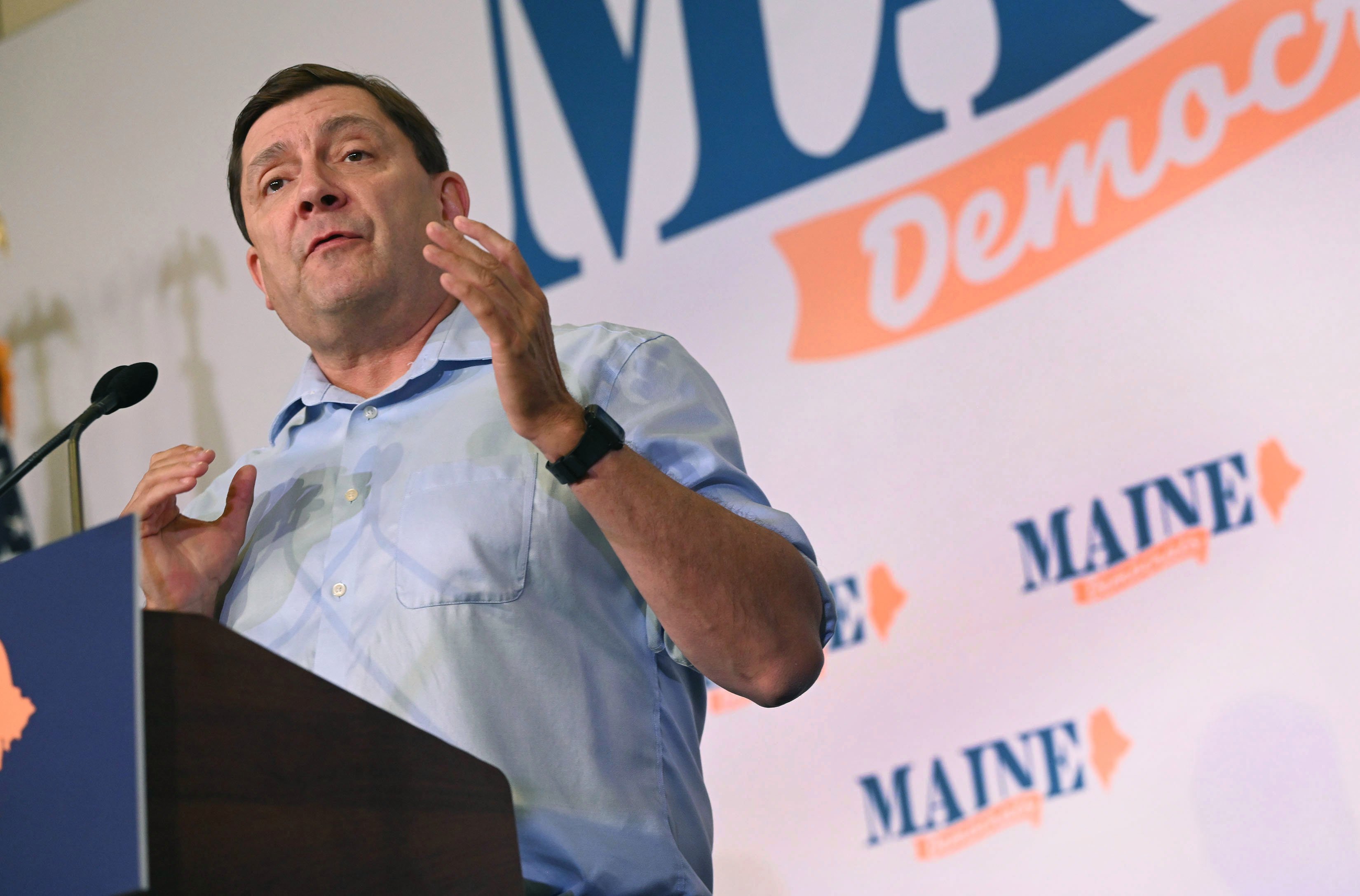
U.S. Senate candidate Troy Jackson speaks during the Maine Democrats’ U.S. Senate Nominating Convention at the Cross Insurance Center in Bangor last month. (Rich Abrahamson/Staff Photographer)
A WEEK IN 1998
On Monday, Oct. 19, 1998, a 30-year-old Jackson awoke before dawn and drove to Maine’s St. Pamphile border crossing with Quebec, southwest of Allagash. He felt nervous, he would later recall.
“We just parked our vehicles across the road and said, you know, that no wood is going into Canada and no workers are coming back into Maine,” he said in a video posted on his social media in 2019. The group, he added, “tried very hard, and I still try very hard today, to try and make this not us against the Canadians. Our focus always was on the American landowners.”
In fact, Jackson has ancestral ties to Canada. And he has first cousins there now, said his mother, Colleen McBreairty.
“Back when I was growing up, Canada didn’t seem like a different country,” McBreairty, 74, said last month at her Allagash home, where she hangs a fusion of the U.S. and Canadian flags. (In the 19th century, the St. John Valley was briefly home to a single, unrecognized Republic of Madawaska.) Before post-9/11 security measures, one could cross the border without a passport.
Five years before the blockade, President Bill Clinton had signed the North American Free Trade Agreement, a deal with Canada and Mexico meant to boost the continent’s economic growth. Labor unions and most Democrats in Congress had opposed it, saying it would hurt American workers.
Advertisement
The deal carried a symbolic weight in the logging dispute. “We have a global economy and both our countries agreed to NAFTA,” a Quebec lumber mill manager said in one news report on Jackson’s blockade. “It shouldn’t be just one little tip of Maine that’s allowed to be apart.”
Maine loggers had long been concerned about lumber companies’ hiring Canadians who would work for lower pay that could go further back home, said Hilton Hafford, 68, another Allagash resident and blockade organizer. The currency exchange rate climbed throughout the 1990s, reaching what the blockaders described as a breaking point.
They alleged that the companies were not following the requirements of the H-2A visa program — namely, that Americans get first dibs on the jobs. The program lets employers sponsor seasonal foreign laborers, the vast majority of whom are Mexican farmworkers, according to government data.
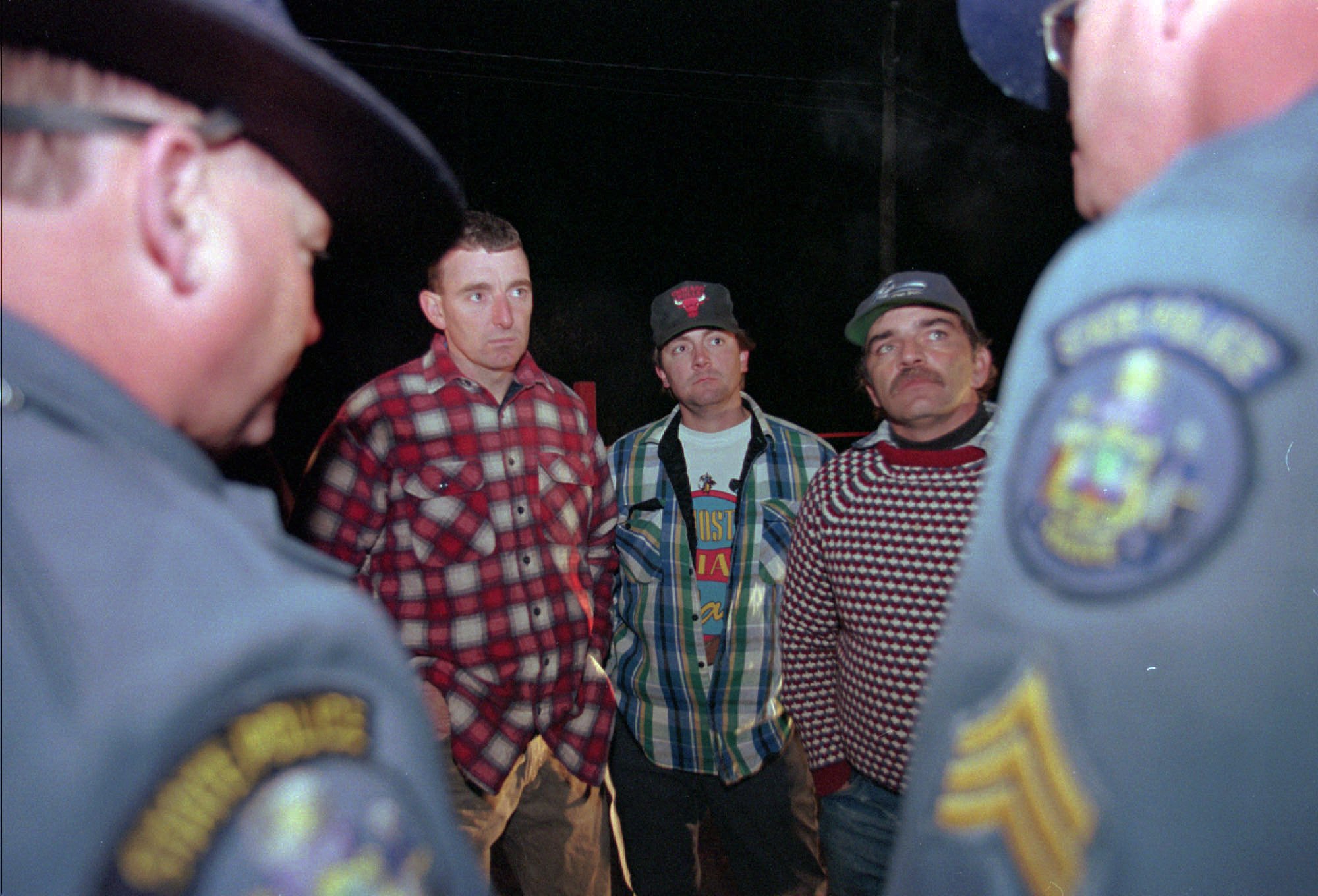
Maine loggers Stacey Kelly, second from left, Troy Jackson, and Hilton Hafford are threatened with arrest by Maine State Police if they continue to block access to Canadian woodsmen at the border at St. Pamphile on Oct. 26, 1998. (Robert F. Bukaty/Associated Press)
The blockade ended after a week, when state troopers threatened arrest. The most Jackson and his compatriots had to show for their efforts, by their account, was more attention to their cause and renewed feelings of disenchantment with politicians, who dispatched representatives.
Jackson said in a recent TV interview that Collins — then in her first Senate term — and then-Gov. Angus King were among the elected leaders who “wanted to, you know, work for the billionaires and the big landowners.”
Campaign spokesperson Blake Kernen said in a statement that Collins “has been a champion for loggers throughout her Senate service.” She added: “Troy is bending himself like a pretzel trying to have it both ways — he wants to talk like he opposes President Trump at every turn, but on the other hand he brags about blocking Canadians with legal work permits from entering the country.”
Advertisement
A spokesperson for King, now an independent U.S. senator with whom Jackson would caucus in the Senate, declined to comment.
Hafford said he could not find work in Maine in the blockade’s aftermath due to retaliation, so he spent most of the next decade traveling to work in the Vermont woods.
Jackson, meanwhile, soon entered an occupation where no Canadian could replace him: politics.
‘CANADIANS FOR LePAGE’
After a failed 2000 run as a Republican, Jackson served from 2002-08 in the state House of Representatives — first as an independent, then as a Democrat — and a total of 14 years in the state Senate.
He brought the blockade fight to Augusta.
During his early years in the Legislature, Jackson worked to boost state oversight of the use of H-2A visas in logging, according to Dana Doran, the executive director of the Professional Logging Contractors of the Northeast, an Augusta-based organization that until recently advocated for the industry only in Maine. (The group gave Collins an impact award in 2021.)
Advertisement
“A lot of the problems that he was shedding light on were real,” said Doran, who has followed Jackson’s career. He credited Jackson with championing reforms that helped “bring about that level playing field.”
But in the 2000s, the industry rapidly transformed to use more machines and require fewer workers felling trees, making Jackson’s focus on Canadian labor less relevant, Doran said. “The issue has not been there because the industry has changed so much.”
In his statement, McCollister, Jackson’s adviser, explained the candidate’s “concerns” about H-2A visas.
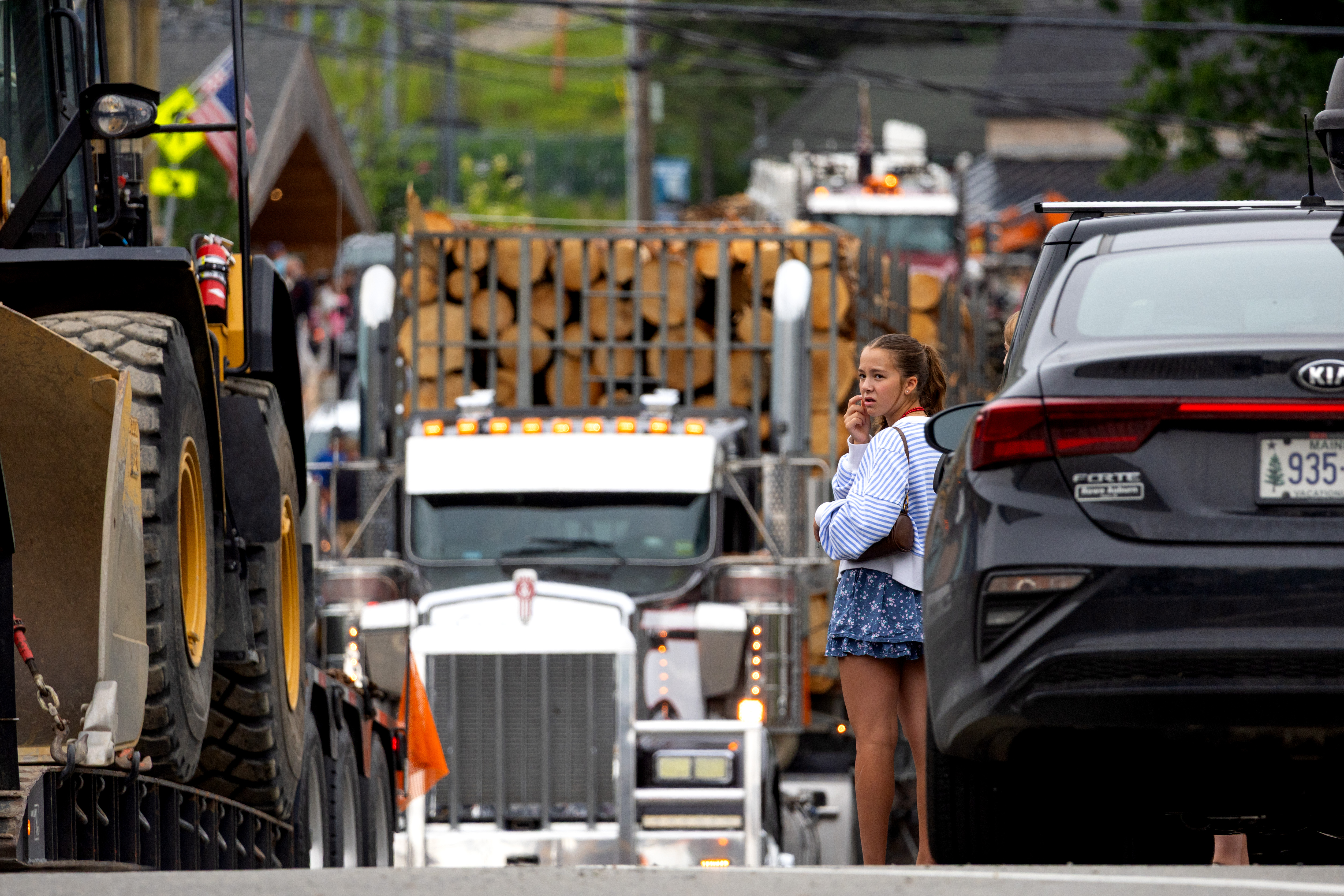
A girl watches logging trucks drive by during a July 18 parade celebrating the logging industry, part of the Rangeley Logging Festival. (Quentin Blais/Staff Writer)
“Guest-worker programs should not be used to undercut wages, evade labor standards, or displace workers who are already here,” McCollister said. “The answer is not to demonize immigrant workers, who are often being exploited themselves, but to hold employers accountable and ensure strong labor protections apply to everyone.”
Jackson kept at it.
In 2011, a bill he spearheaded to ban foreign loggers from working in state-owned woods failed to become law due to a veto by then-Gov. Paul LePage, a Republican, who cited constitutional reasons. Jackson took his frustration to the Bangor Daily News’ online comments section under the anonymous handle “Canadians for LePage,” as CNN first reported last month and Jackson confirmed.
Advertisement
In 2019, Democratic Gov. Janet Mills signed into law a bill that Jackson, by then the Senate president, sponsored to extend collective bargaining rights for logging workers.
And in 2021, Mills let a Jackson-led measure to prohibit foreign truckers from hauling wood between points within Maine become law without her signature. But it never went into effect, because federal courts ruled that it was preempted by federal law. Jackson dismissed the outcome as a predictable move by the powers that be.
If elected to the Senate, Jackson would finally have a say in the law governing foreign laborers that stymied him before.
“With respect to Democratic politics, it certainly is a little abnormal. But I think it comes from his roots,” Doran, the industry advocate, said. “If you use the past as a guide, I would say that he will bring that perspective and attempt to bring policies related to logging if he were to become a U.S. senator.”
SAME BORDER, NEW ISSUES
At the Fort Kent border crossing, a bridge curves over the St. John River into Canada. A sign advertises the northern terminus of Route 1: “AMERICA’S FIRST MILE.” As Trump insults Canada — this month, he railed against its “nasty leadership” — U.S. Customs and Border Protection agents check incoming drivers for a shifting set of products affected by his tariffs.
Such is the daily scene in Jackson’s backyard, and the likely context in which he would legislate on issues related to Canada and trade. So far, Jackson has criticized Trump’s tariffs — and not emphasized any other protectionist preferences, either.
Advertisement
At an annual Canadian-American sled dog race in Fort Kent in March, while running for governor, Jackson pushed back on Trump’s import taxes without qualification.
“Canadians have always been a big part of our economy here. That’s actually slowed down a lot. You know, they’re not coming over, so we’re losing that,” Jackson told an online news outlet, noting that tariffs raised costs for imported logging equipment. He suggested that incentives for the industry in Maine would be better than tariffs.
He did not mention his crusades against Canadian labor.
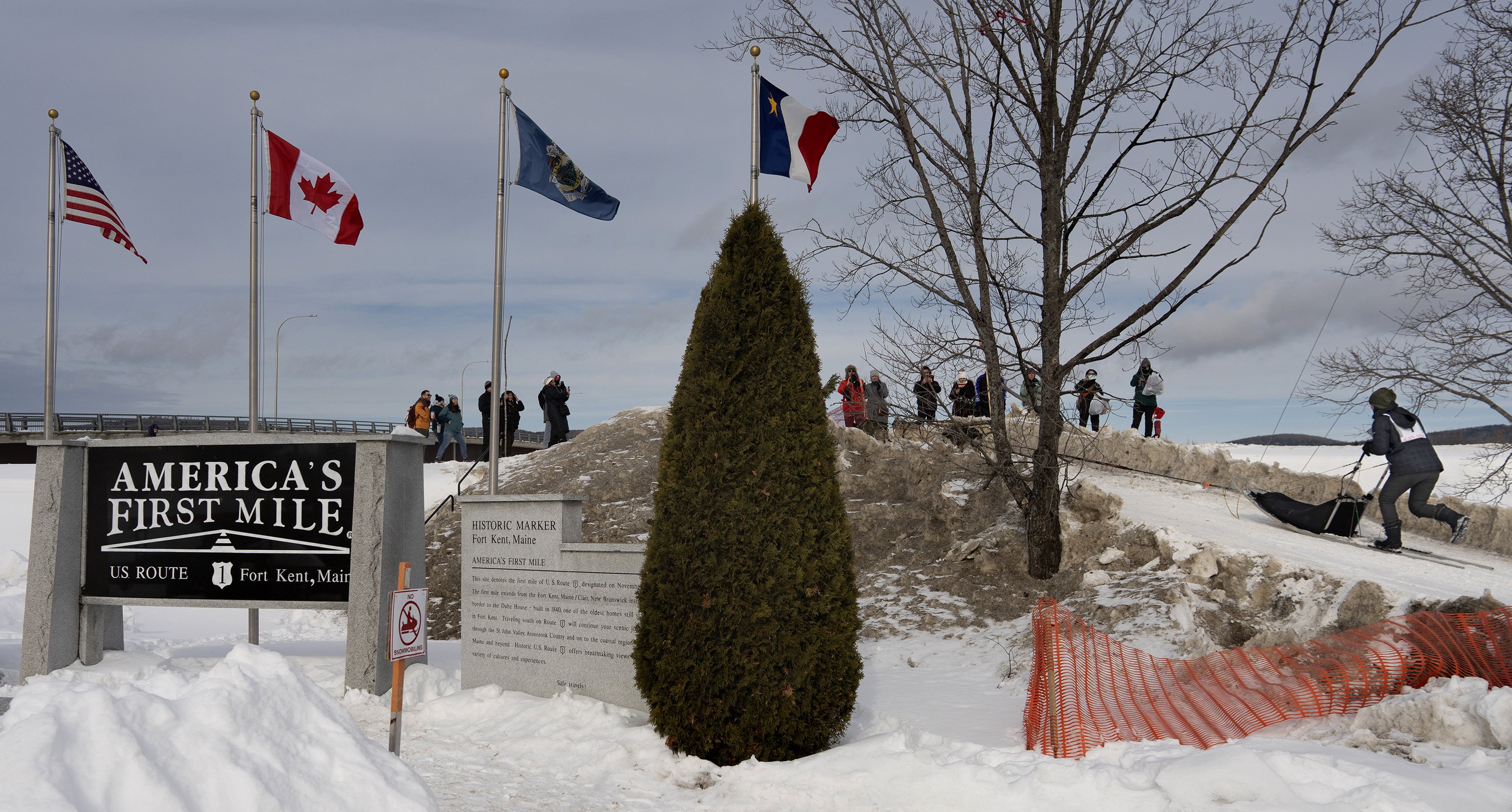
Musher Emily Thomas-Kelly of New Hampshire heads up a hill near the First Mile marker in this year’s 30-mile Can-Am Crown International Sled Dog Races in Fort Kent. (Gregory Rec/Staff Photographer)
But the basic economic logic that Jackson has shared with Trump — correcting unfair imbalances that put Americans at a disadvantage — has a long history in northern Maine and the lumber industry. The Canadian and U.S. governments have tussled for decades over Canada’s allegedly subsidized softwood lumber exports.
It has a Democratic proponent in Rep. Jared Golden, a moderate from Maine’s 2nd Congressional District, which Trump has consistently won. Golden has proposed tariff legislation and said free trade policies “decimated domestic manufacturing and Maine’s heritage industries.”
Even on the Canadian side of the border, it’s possible to find some sympathy for the rationale behind U.S. tariffs.
Advertisement
In her house overlooking the St. John River last month, Ethel Lozier, a 72-year-old dual citizen who grew up in Canada and once lived in Maine, brought up Canada’s preexisting limits on how much one could bring in from the United States as an explanation for Trump’s import taxes.
“It sucked for the Canadians, but I understood in a way why he did it,” Lozier said. “It wasn’t really free trade.”
But Lozier does not appreciate Trump’s pugnacious posture toward the country. Some other residents of Haut-Madawaska, the New Brunswick town closest to Allagash on the other end of the Fort Kent bridge, now refuse to cross at all, denying Mainers their business in protest.
“We call it boycotting. They’re boycotting U.S. because of Trump,” Nancy Ann Landry, the town’s mayor, said in her office, switching from the local French dialect into English with a word the languages share.
It’s another reason, on top of the logging industry’s mechanization, why Jackson’s blockade would be inconceivable today.
It remains unclear how exactly the instincts from that 1998 episode would map onto Jackson’s Senate service in Trump’s shadow, but his campaign’s emphasis on the specific moment reaches for a more universal working-class appeal.
“Probably not so much the issues of the Canadian labor, but the issues of labor itself, I think everybody could almost find themselves in the same position as that,” Hafford, the other blockade organizer, said.
Copy the Story Link
Tagged: election 2026, senate 2026

Ethan Wolin from Washington, D.C., is a rising senior at Yale University where he served as the print managing editor for the Yale Daily News. He is assisting the Press Herald's politics team with election. More by Ethan Wolin