

Thousands use AI trip planner to generate Maine travel itineraries


Visitors at Thunder Hole in Acadia National Park during the federal government shutdown in October 2025. (Brianna Soukup/Staff Photographer)
“Let’s make it personal.”
That’s the heading on the new trip planner powered by artificial intelligence on the Maine Office of Tourism’s website.
The office launched the tool in January in partnership with a company called Mindtrip. Since then, the tourism office reported that more than 27,000 people have used the function and generated more than 3,000 custom travel itineraries.
Data from market researchers in the tourism sector show that travelers are increasingly relying on AI.
Future Partners found this spring that 30% of Americans were using these tools to plan their trips, up from 24% the previous year. Another recent study from Phocuswright found an even higher percentage — 56% — used AI for at least one trip in the past 12 months, according to an article by TravelPulse, an industry publication for travel advisors.
That trend was part of the inspiration for the Maine tourism office to hire Mindtrip, an AI trip planner that works with more than 70 destinations worldwide, including eight states, such as California and Florida.
Advertisement
“It was also really recognizing the opportunity for a unique way to really dig deeper into providing personalized information,” said Carolann Ouellette, the state’s tourism director.
Nationally and in Maine, the tourism sector is trying to figure out how to balance the growth of AI with the demand for authentic experiences.
“Technology definitely transforms personalized service, there’s no question about it,” Ajay Aluri, an associate professor at West Virginia University who researches AI and tourism. “But humanity is what defines true hospitality.”

A visitor takes a photo of Sand Beach at Acadia National Park in 2025. (Brianna Soukup/Staff Photographer)
‘ONE MORE TOOL’
Users can enter the trip planner on VisitMaine.com by posing questions to the chatbot or selecting from a menu of interests and priorities. People can save their itineraries, set budget parameters, upload receipts to confirm bookings and plan multiple trips at once.
Aluri said people are gravitating to AI in part because of information overload.
“For somebody to really make a decision to go to a hotel or go to a restaurant, they have to go to five to seven different websites,” Aluri said. “That is one reason why AI is becoming more about personalizing digital experiences.”
Advertisement
Searches by the Portland Press Herald showed the trip planner generates recommendations across the state and hones itineraries based on answers to its questions. However, searches with more parameters don’t always return what the user is looking for. For example, the tool offers the option to prioritize businesses that are owned by women or people of color, but sometimes indicated it didn’t have enough information to make recommendations in those categories.
Ouellette said that the tool prioritizes content on the state’s tourism website, so it might be limited where there are gaps in content, but she’s confident that it’s accurate and vetted. The office hasn’t had complaints about errors, she said, although they have received some feedback that users didn’t find what they wanted. She said the tourism office isn’t using AI to generate articles or images for its website.
Users can’t book hotel rooms or flights or tables through the platform, so the state can’t say whether someone who builds an itinerary actually follows through on it.
The state hasn’t widely marketed the tool yet and is still figuring out how to do so, Ouellette said. The contract with Mindtrip, she said, is for three years with a cost of $113,000.
Related
Travel like a local with our guide to summer in Maine
Mindtrip started in 2024 as a travel planner for consumers but quickly expanded to work directly destinations.
“There’s all of these destinations and tourism boards that have amazing content and are local experts in their own right that could really move the needle from inspiration only into actual taking action from that inspiration and helping the consumer plan their personalized trip to their destination,” Chief Marketing Officer Michelle Denogean said.
Advertisement
Ouellette said the state was already using data about Google searches and web traffic to guide marketing decisions. The trip planner will give state officials more information to understand what potential visitors are looking for, she and Denogean said.
Ouellette emphasized survey data shows that 2 in 5 visitors also rely on advice from family and friends for their trips.
“It’s those genuine connections that people forge with Mainers that keep them coming back,” she said. “This is just one more tool.”
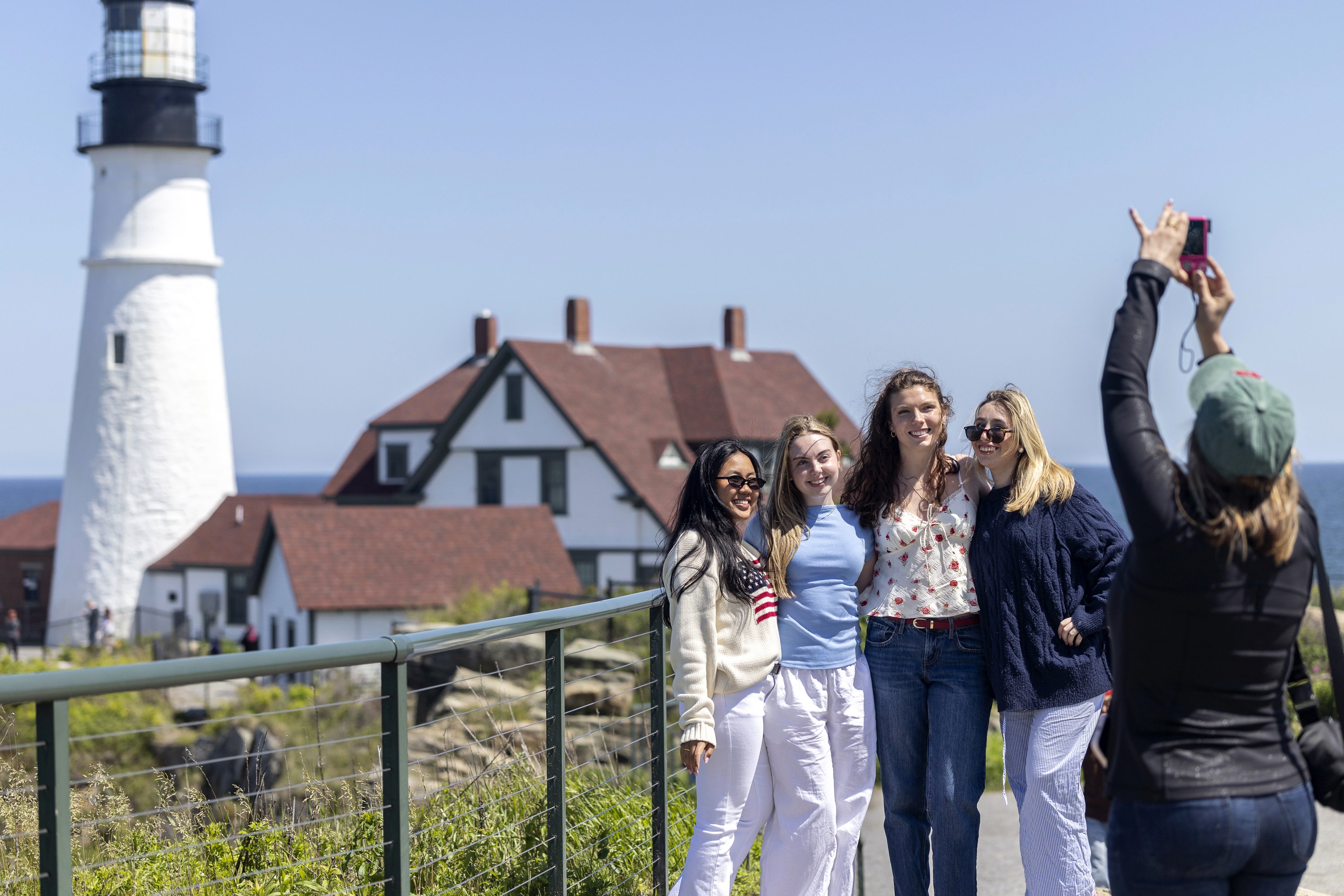
Tourists pose for a photo in front of Portland Head Light in June. (Brianna Soukup/Staff Photographer) Purchase this image
‘A GAME OF WHACK-A-MOLE’
Many in the tourism sector are wrestling with new questions raised by the increasing use of AI.
At the Craignair Inn by the Sea in Spruce Head, owners Lauren and Greg Soutiea considered using an AI service to answer the phones when people call to make reservations but ultimately decided against it.
“It doesn’t feel quite authentic,” Lauren Soutiea said. “I just don’t know that our guests are ready for it, especially our older guests. There’s a reason they’re calling and not making their reservation online.”
Advertisement
Related
Why the Maine Atlas and Gazetteer is still a page-turner
Still, Lauren Soutiea said she knows from her own surveys and personal conversations with guests that some people are finding her coastal inn and restaurant through queries on ChatGPT and other platforms. She and her husband decided to test it out while planning a June getaway in Maine. He asked ChatGPT for suggestions for an outdoorsy couple traveling with dogs.
“It was a good starting point,” Lauren Soutiea said.
Businesses and destinations said they are beefing up their websites knowing that even those patrons who aren’t using specific platforms, such as Claude, encounter AI summaries on simple Google searches. They said misinformation online isn’t a new problem — people don’t always double check business websites to confirm that a pet policy has changed or a promo has ended, for example — but it can be amplified when AI mines old data from the depths of the internet.
“It feels like a game of Whack-A-Mole,” said Amanda Pleau, marketing and communications manager at the Maine Maritime Museum in Bath.
Katie Hey, director of marketing and communications at the Coastal Maine Botanical Gardens in Boothbay, said one of her greatest concerns is that AI might supplant artists, photographers and graphic designers. She hires creatives instead of generating AI images, she said, because she values their work.
“There’s nothing we can do about AI,” Hey said. “But if we can ensure that we are leaning in and that we are supporting our community, that, to me, is how we survive.”
Pleau said she’s concerned about what the growing use of AI means for a state where part of the charm is that some businesses don’t even have websites.
“The AI-ification of everything endangers some of what’s so special about living here, working here and visiting here,” she said. “We hear from a lot of people who came to Maine on vacation and were so blown away that they were like, ‘Oh, I want to move here.’ I hope that continues to be the case even if they come here and have bad AI intel.”
Copy the Story Link
Tagged: artificial intelligence, hospitality industry, tourism

Megan Gray covers the outdoors and tourism at the Portland Press Herald. A Midwest native, she moved to Maine in 2016. She has written about presidential politics and local government, jury trials and. More by Megan Gray