They lived in a hotel when their baby was born at 22 weeks. Now they’re homeowners.


Winner, 4, at her family’s home in Portland on Oct. 12. Born at 22 weeks and weighing just over a pound, she is thought to be the youngest baby born in Maine to survive. (Brianna Soukup/Staff Photographer)
PORTLAND — Four-year-old Winner walked down the stairs of her family’s home, dressed to the nines.
Each piece of her outfit was carefully selected and color-coordinated. The pink tights perfectly matched her glasses and the beads in her hair.
The black ruffled skirt and shoes brought everything together with a statement-making fuzzy jacket.
She crept into the living room and in a quiet, almost raspy voice, asked her father, Francisco, if she could watch “Cocomelon.”
The answer was no, but she climbed up on the couch and snuggled into him anyway, occasionally sticking a thumb in her mouth.
Winner sat while her parents detailed, in French, how just a few years ago, so much of what they have now — a three-bedroom, salmon-colored home they own, a healthy, fashion-loving daughter stuffing empty cheese ball packages in the couch cushions — seemed out of reach.
The family asked the Portland Press Herald/Maine Sunday Telegram not to publish their last name because of concerns about safety related to their immigration status.
Advertisement
Her mother, Linda, looked at the girl, who was quietly practicing counting to 10 in English and licking cheese dust off her fingers.
Holding up one hand, Linda gently traced its outline with her finger, remembering how little her daughter was on the day she was born — small enough to fit in the palm of her mother’s hand.
‘I WANT MY BABY TO LIVE’
That day, the pain started at 2 a.m.
Linda couldn’t call 911 — she and Francisco didn’t speak English. They had recently immigrated from Angola and were living in a hotel in southern Maine. She was only 5-months pregnant. Surely, she couldn’t be having the baby now.
Then, she started bleeding.
At 5 a.m., Linda and Francisco took a taxi to Barbara Bush Children’s Hospital in Portland.
Advertisement
Up until then, Linda’s pregnancy had gone smoothly. She hadn’t had any issues or any reason to expect she’d go into labor prematurely and certainly not before 24 weeks, typically the earliest gestational age when a baby can survive outside of the womb.
A full-term pregnancy lasts 39 to 40 weeks, and babies born before 37 weeks are considered premature, according to the American College of Obstetricians and Gynecologists.
At 22 weeks, barely more than halfway through the pregnancy, their major organs are still underdeveloped. Survival rates for infants that young range from 11% to about 25%, the latter with intensive care, according to reports from the American Academy of Pediatrics and the National Institutes of Health.
At that point, no baby in Maine had been born at 22 weeks and lived, according to Maine Medical Center.

Winner’s parents are immigrants, and when she was born the family was struggling with housing insecurity. They connected with Project Home for help. Eventually, they got on their feet and later purchased a home in Portland. (Brianna Soukup/Staff Photographer)
Linda couldn’t even imagine what a baby born that early would look like.
At the hospital, doctors told her, “No, you can’t give birth, the baby will die,” she recalled.
Advertisement
“Don’t lose faith,” Francisco responded.
“I want my baby to live,” she told the doctors. “I want my baby.”
Somehow, she held firm in her faith. In most other countries, her baby wouldn’t survive, but they were in the United States, a country with advanced medical care, Linda said.
“I had hope that even I couldn’t explain,” she said.
Their baby girl was born on a Saturday in July, weighing just 1 pound, 2 ounces. They named her Winner.
“(The doctors) told my husband to touch her, but he was scared,” Linda remembered.
Advertisement
She was so small, doctors didn’t know if she’d survive the trip to the third floor of the hospital, where they put her in an incubator, Linda said.
“Every day I asked the doctor to be patient,” Linda said. “Be patient with my baby. Be patient with my baby.”
A PLACE TO CALL HOME
Behind the scenes, hospital employees were trying to connect Winner’s family with stable housing.
Against all odds, Winner survived, but she was still incredibly fragile. She could not go home to a hotel room.
A nurse sent a plea to Project Home, a Portland-based organization that partners with local landlords to find housing for families experiencing housing instability.
The family had already reached out to the organization for help a few months before, but because of Winner’s medical needs, they were moved to the top of the line.
Advertisement
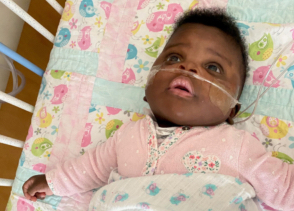
Winner, at eight months old, when she was finally able to go home from the hospital. (Courtesy of Maine Medical Center)
Project Home found them a two-bedroom apartment in Portland for $1,470 a month, paid for by General Assistance, a state-mandated, locally-administered emergency program that helps families meet basic needs.
They signed the lease in March, just days before Winner was finally able to go home. She had been in the hospital, including two months-long stays in Boston, for eight months.
They didn’t know what awaited them at this next stage. Winner was healthy enough to go home, but she’d be hooked up to machines to keep her alive. She weighed 13 pounds, 5 ounces, putting her around the second percentile for girls her age.
Doctors told Linda that Winner had a greater chance of having disabilities. She didn’t know what the word meant. When they explained it, she cried. Raising her would be a lot of work, they told her.
Linda didn’t care.
“I am her mother,” she said. “If God decided to give me a disabled child, I accept it.”
Advertisement
MUCH ON THE LINE
Lucas Schrage remembers the first time he walked into the apartment.
Schrage, director of housing initiatives for Project Home, was delivering a crib that had been donated. The entire apartment, he said, had been built around Winner.
“It wasn’t like when you see families with newborns and there’s a lot of baby stuff,” he said. “This was like walking into a hospital room.”
The family was living in a bubble, trying desperately to keep any germs away from the baby girl’s delicate lungs.
So they were alarmed when they learned their unit was scheduled for routine pest control spraying.
Linda and Francisco tried to relay their concerns to the property manager, but they struggled with the language barrier.
Advertisement
There was a lot on the line.
In many cases, Schrage said, “the perception is going to be that a family is being obstinate and refusing pest control.” That could put them in violation of their lease and risk eviction. Even if they were to fight it, the damage would have already been done, because the pest control would happen regardless.
Project Home was able to help translate the gravity of the situation to the landlord — that spraying for bugs seems small, but in this case, it could be life or death, Schrage remembered.
They were able to come to an agreement, though Schrage couldn’t remember if they skipped the treatment or held off spraying the family’s floor.
KEEP MOVING
Eventually, they moved on from that apartment into another one.
Months, then years passed. Winner continued to grow stronger. The disabilities the doctors warned Linda of never materialized.
Advertisement
Winner had ocular surgery, and the thick lenses on her pink glasses magnify her eyes, but other than than, she’s grown like most other kids, her mother said.
Winner is smart. She’s a fast learner and speaks both English and Portuguese. She loves to watch TV, make jokes and take walks with her big brother, whom she idolizes.
“When I give him food, she also asks to eat. When he goes to bed, she also goes to bed,” Linda said.

Winner, 4, hugs her father at their home in Portland on Oct. 12. Winner is thought to be the most prematurely born baby to survive in Maine, but she is now healthy. (Brianna Soukup/Staff Photographer)
While Winner grew, her parents also squirreled away a little money each month, saving for a home of their own.
They had worked so hard to get to this point, endured so much heartbreak.
They had fled Angola, where authorities had threatened to put them in jail or kill them for protesting the government.
Advertisement
They moved to Brazil, but there, they were still at risk. People could easily follow them there to kill or hurt them, Francisco said.
Over two months in 2022, they said they traveled through nine countries, crossing big rivers and spending four days walking through a dangerous rainforest in Colombia and Panama before finally reaching the United States.
Their eldest son, who is now 15, stayed behind in Angola.
“It was too difficult to escape with two children,” Linda said.
They haven’t seen him in five years.
Linda and Francisco, along with their younger son, were granted asylum in the U.S. and finally, after years of living on the run, of shuffling between a hotel and a hospital, of battling to keep Winner safe, they purchased their own home in early 2025.
Advertisement
THE COST OF FREEDOM
The Cape-style home is embedded in a quiet Portland neighborhood.
There’s a lot the family loves about their home — like its central location and the small backyard where Winner and her brother like to play — but to Linda, its true value is intangible: “the freedom, the peace.”
“We saved our money to find a house here to be free with our children,” she said.
Still, it wasn’t easy to find a house they could afford.
The Portland housing market is competitive, and homes in their budget sold quickly, often for over the asking price.
Daniel Meuse, the family’s real estate agent, said they struck out several times before finding the Cape with the blue-green door.
Advertisement
The asking price was high, around $560,000, but it had been sitting on the market for a while. After an initial “lowball” offer that got rejected, Meuse said they resubmitted and met in the middle.
The owner, an investor and real estate agent, had been using the home as a furnished rental property and offered to leave some of the items, like a kitchen table, some bed frames and living room chairs.
The family was determined, he said, and knew what they wanted. They had a sense of “urgency,” about them, he remembered, and showed up “in earnest” to open houses with a large group of friends and extended family in tow.
“I’m so glad we found it,” Meuse said. “It’s your classic American dream home.”
It has been hard to make ends meet.
Linda works in food manufacturing and Francisco is a custodian. They work long hours to cover their housing costs, which they said amount to a whopping $4,800 a month.
Advertisement
“Maybe the house is a bit expensive, but it’s worth it,” Linda said. “We want to live free. Even if we can’t eat, we’re free.”

Winner, 4, plays with a soccer ball in the backyard of her home in Portland. Her family purchased their home last year after struggling with housing insecurity. (Brianna Soukup/Staff Photographer)
It’s a big responsibility, but there’s no landlord bothering them, no medical issues to deal with, just long days. “We hope that God continues to give us the ability to get up every morning, to make money, to pay for the house,” she said.
They’re focused on the future. Francisco hopes to finish a workforce training program in the construction industry. They want to get their green cards to they can finally bring their oldest son to Maine, to live in the home they own and meet his little sister. They want to see all three children go to school and get the education they couldn’t.
It’s all expensive.
“God will give us the strength and the money we are looking for,” Linda said.
So they keep working.
Advertisement
A ‘STAGGERING’ SUCCESS
It’s rare that Project Home employees get the kind of closure that Winner’s family offered. The organization houses between 400 and 450 families a year, so the focus is always on whoever needs help next.
Francisco reached out to Project Home last month about some workforce development opportunities and updated the team on the family’s progress. He shared a photo of Winner, smiling in all-pink ensemble, her eyes large behind her matching glasses. The entire organization celebrated the win.
“This is a staggering one,” said Schrage, at Project Home. “It had along so many points in the journey the opportunity to be catastrophic.”
The case was critical for Schrage. It solidified for him the idea that housing advocacy doesn’t have to happen at arms length, in response to the court system or an emergency, he said. It can be preventive.
And while he’s proud of the work they did and all their case symbolizes, Francisco and Linda are the ones who poured their blood, sweat and tears into relentlessly advocating for their daughter.
Project Home is a tool, Schrage said, and tools only work if there are determined people using them.
“I can’t think of two more determined people than the parents of the smallest newborn to survive in Maine.”
Copy the Story Link
Tagged: Health, housing, immigrants

Hannah is the housing reporter at the Portland Press Herald, covering all aspects of Maine’s housing crisis - real estate and development, home ownership and rental issues and the lack of both affordability. More by Hannah LaClaire

Salomé Cloteaux is a community reporter covering Scarborough and Westbrook. She was born in France but lived in Indiana for most of her life before moving to Portland in November 2025. Salomé has a degree. More by Salomé Cloteaux