

South Portland’s tank farm has been linked to chronic health risks. Now what?


Tanks at the end of Forest Avenue in South Portland early in October. A report released by the Maine Department of Environmental Protection says air quality in South Portland has higher than recommended levels of benzene, a known carcinogen. (Derek Davis/Staff photographer)
Carolyn Hurwitz feels stuck in South Portland.
When she bought her house — her first — less than half a mile from the Citgo terminal a couple of years ago, she said she didn’t know her new neighborhood would smell like a crew was doing constant road work right outside the house.
She notices it first thing in the morning. An avid runner, she said she sometimes pulls her shirt up over her face when she jogs on the Greenbelt.
A report recently released by the Maine Center for Disease Control and Prevention found that South Portland residents living near the more than 100 petroleum tanks in the city owned by six companies could be at a higher risk of cancer and other chronic health issues as a result of long-term exposure to carcinogenic emissions detected there.
Related
Exposure to South Portland tank emissions increases cancer, chronic illness risks, report says
It found that monitors along the fence line of some of the tank farms regularly logged long-term average benzene concentrations in ambient air that exceeded state guidelines, according to one and half years of data collected by the Department of Environmental Protection.
Benzene is a known carcinogen, and acute exposure can cause fatigue, dizziness, irregular heartbeat and headaches. High long-term exposure can cause cancers, including leukemia. There is no safe level of exposure to benzene, according to the World Health Organization.
Advertisement
A day after the CDC and DEP presented their findings to the City Council, Citgo announced that it will cover its share of additional fenceline testing and invest in technology to reduce emissions. A spokesperson for Global Partners did not say whether the company has specific plans in light of the report findings.
Related
Citgo plans to reduce emissions at South Portland tanks
The four other oil companies with holdings in the city did not respond to requests for comments about whether they have plans to reduce emissions.

A cyclist passes Sunoco LP’s petroleum tank field in South Portland in October. (Brianna Soukup/Staff Photographer)
The South Portland City Council will host a workshop on Dec. 1 to discuss avenues to reduce toxic air emissions from the petroleum tanks, such as licensing fees for oil companies, mandating better emissions control technology and collaborating with state legislators on statewide policy.
“There’s no magic answer for how to protect these people in the short term while they’re waiting for action and waiting for something that would reduce these levels in their communities,” said Gail Carlson, an environmental science professor at Colby College. “I don’t want to sugarcoat it.”
What can the Maine DEP do?
The Maine DEP, the regulating body over these petroleum tank farms, issues air quality emissions licenses and is responsible for evaluating compliance with state and federal regulations. It’s also in charge of enforcing federal regulations.
Beyond requesting additional testing, it’s not intervening at this point. And it legally doesn’t have to.
Advertisement
“Health guidelines are just that,” Carlson said. “They’re just a recommendation.”

Oil tanks seen from Elm Street on Turner Island in South Portland. (Derek Davis/Staff Photographer) Purchase this image
The Clean Air Act, through national ambient air quality standards, sets legally binding limits for a handful of dangerous chemicals like carbon monoxide and lead, but not benzene, acrolein and about 100 other chemicals that are monitored by state guidelines. It’s ultimately up to the DEP to decide whether to take further action.
The DEP recommended another year of data collection along the fence lines of the South Portland Terminal and Citgo and nearby homes to understand how quickly the benzene concentrations dissipate.
The DEP is planning to use optical gas imaging to see if it can figure out which activities in the storage facilities contribute to emissions, said Eric Kennedy, bureau director of the air quality division of the DEP. After that, there might be a more concrete plan, he said.
“We can’t solve the problem when we don’t know exactly what the problem is,” he said.
Carlson is not surprised that the DEP isn’t taking more proactive steps. It’s a government agency with limited capacity and resources to take on a large pollution control project, she said.
Advertisement
Some residents aren’t surprised, either, noting that the agency was unwilling to take enforcement action when petroleum companies violated emissions limits nearly 10 years ago.
Related
State admits it was wrong to resist federal crackdown on oil tank pollution
“The agency hasn’t taken this as seriously as the residents who have to live next to these tank farms do,” said Chelsea Byun, a nearby resident and former Portland Press Herald editor.
Three petroleum companies operating in South Portland — Sprague, Global and Gulf Oil — were sued by the EPA in the past 10 years for violating emissions caps for volatile organic compounds dating back decades. The companies had to pay damages and were ordered to reduce emissions.
What could the Legislature do?
In 2021, the Maine Legislature mandated that petroleum companies take steps to reduce evaporation and emissions, such as installing floating roofs in tanks. It required fence line monitoring (including of volatile organic compounds like benzene), monthly inspections and twice-a-year testing of heated tanks.
Related
Bill inspired by South Portland fuel tank emissions earns committee’s endorsement
Rep. Victoria Morales, who used to represent part of South Portland, sponsored a sweeping bill in 2021 that would have instituted a robust licensing program for air emissions, require a public hearing in the municipality in question, set steep civil penalties for violators that would be transferred to the affected municipality and require companies seeking air emissions licenses to directly outline steps to protect community health.
The bill faced opposition from leaders of oil companies, like Chris Gillies, the president of the Portland Pipe Line Corporation. He said that the proposed procedural changes, especially the daily penalties, would add undue costs that would threaten the companies’ ability to do business in the state. Kennedy, who works for the DEP, said that it would place an administrative burden on the regulators.
Advertisement
The bill was carried over and ultimately killed in 2022.
Rep. Matt Beck, who currently represents South Portland, sponsored a bill last spring at the request of the City Council that would have required operators of oil terminal facilities to give advance notice to the public each time they planned to load or offload oil.
There was strong opposition from oil companies and the Mills administration, which voiced concern about bad actors getting access to fuel logistics information, and Beck said it became clear it wasn’t going to pass.
The bill was watered down to just require warning signs posted along the fence line to let people know about the risk from the volatile organic compounds. The bill failed this spring.
Beck said he’s interested in working with South Portland municipal leaders to try to craft targeted legislation in the next session.
What can the city do?
Mayor Elyse Tipton has lived in Cash Corner for more than 15 years. Her husband, a cardiac patient, walks around the neighborhood at least once a day. Tipton has been contacted by residents who just moved to the area and are looking to start a family.
Advertisement
“It feels very personal,” she said. “We are talking about people’s health.”

Sunoco LP’s petroleum tank field in South Portland last month. (Brianna Soukup/Staff Photographer)
The City Council plans to discuss any tools that are available to them, including licensing fees for oil facilities in which companies would need to meet a certain emissions threshold to do business, an ordinance that would require oil companies to adopt best available emissions control technology and a setback for residential development a certain distance from the tanks, City Manager Scott Morelli said.
The council will also discuss whether to pursue additional testing, funded by the petroleum companies in question.
What is the petroleum companies’ responsibility?
Petroleum companies are responsible for regular maintenance and upgrades to keep their facilities up to code.
Carlson is skeptical that the companies will invest more money in costly technology when it isn’t legally required.
“That’s never going to happen,” she said.
Advertisement
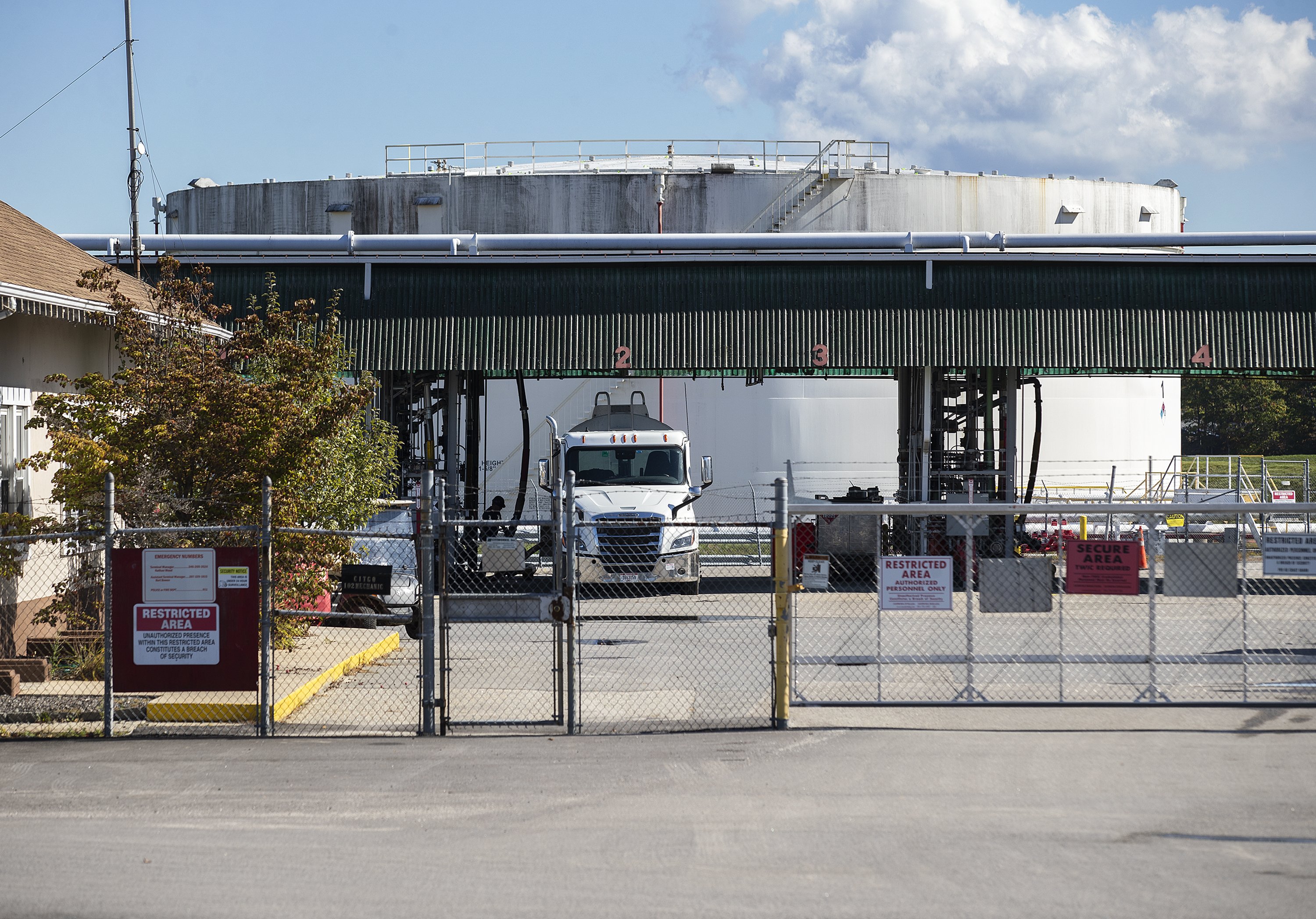
A tanker fills at the CItgo terminal on Turner Island in South Portland. (Derek Davis/Staff photographer) Purchase this image
Next year, Citgo plans to upgrade two floating roofs, or technology within a tank that creates a seal between the liquid product and the atmosphere. The company plans to upgrade two more tanks in 2028.
It also launched continuous emissions monitoring of benzene along the fence line about a month ago.
Karl Schmidt, the vice president of supply and marketing at Citgo, said the data has been enlightening, particularly because it’s so variable. He said he doesn’t yet know when it will be available to the public.
“We hear the community’s concerns about the study findings and we take those concerns seriously,” Schmidt said.
Reid Lamberty, a spokesperson for Global, said that the company will continue working with the DEP to meet the state’s monitoring and reporting requirements. He said he does not think that his company’s terminal emits high concentrations of benzene.
Hurwitz hopes something changes soon.
She tends to native plants in her yard, and has planted grapes, blueberries and hazelnuts, though she’s hesitant to eat what grows in her garden.
“I like my life here,” she said. “I would like to want to live here.”
Copy the Story Link
Tagged: environmental health, petroleum, South Portland City Council

Dana Richie is a community reporter covering South Portland and Cape Elizabeth. Originally from Atlanta, she fell in love with the landscape and quirks of coastal New England while completing her undergraduate. More by Dana Richie



