
Royal River dam removal begins in Yarmouth


Contractors have begun the removal of the Bridge Street dam on the Royal River in Yarmouth. (Derek Davis/Staff Photographer)
The work to “free the Royal River” — a common refrain for those working to remove a pair of dams in Yarmouth — has officially begun.
Contractors have started removing the town-owned Bridge Street Dam, which will bring the river one step closer to its natural flow. By the end of September, they will take down the concrete fishway, penstock and dam.
Next summer, if all goes according to plan, the Elm Street Dam will also be removed, allowing for a natural river flow through Yarmouth. The $3.8 million project, led by the town and the national conservation nonprofit American Rivers, has been decades in the making.
“It’s just a thrill to see it all come together,” said Debbie Landry, the chair of the Royal River Alliance, which has mustered support for the project over the years.
Related
Popular Yarmouth park will be closed for construction this summer
The Gulf of Maine Council on the Marine Environment and the Maine State Planning Office identified the Royal River as a restoration priority in 2005. After years of studies and public discussions, with years of stagnation in between, the Yarmouth Town Council approved the dam removal in January 2025.
The following year, the town collaborated and then broke with the Army Corps of Engineers on the project, whose plan to remove the dams and fund the project differed from the town’s vision. This January, the Maine Natural Resources Conservation Program approved $1 million for the project, allowing the Bridge Street Dam work to start this summer. Additional funding is being provided by American Rivers, the Casco Bay Estuary Partnership, the Nature Conservancy and other donors. The town resolution greenlighting the removal also prohibited any local taxpayer funds from being used for the approved work on the project.
Advertisement
Visible from the Bridge Street bridge, as well as through a photolog set up by the town on the bridge, Linkel Environmental Construction is first removing a section of the penstock — the large metal pipe that used to direct water to the Sparhawk Mill — and draining the impoundment to reduce the water level.
Next, the contractors will use jackhammers to take out the cement fish ladder on one side of the dam. Then, chunk by chunk, they’ll remove the dam itself. They’ll cut away the final piece of the penstock and fill the hole with cement. To complete the dam removal before October, the wall rising from the river up to support the historic house above will be rebuilt.
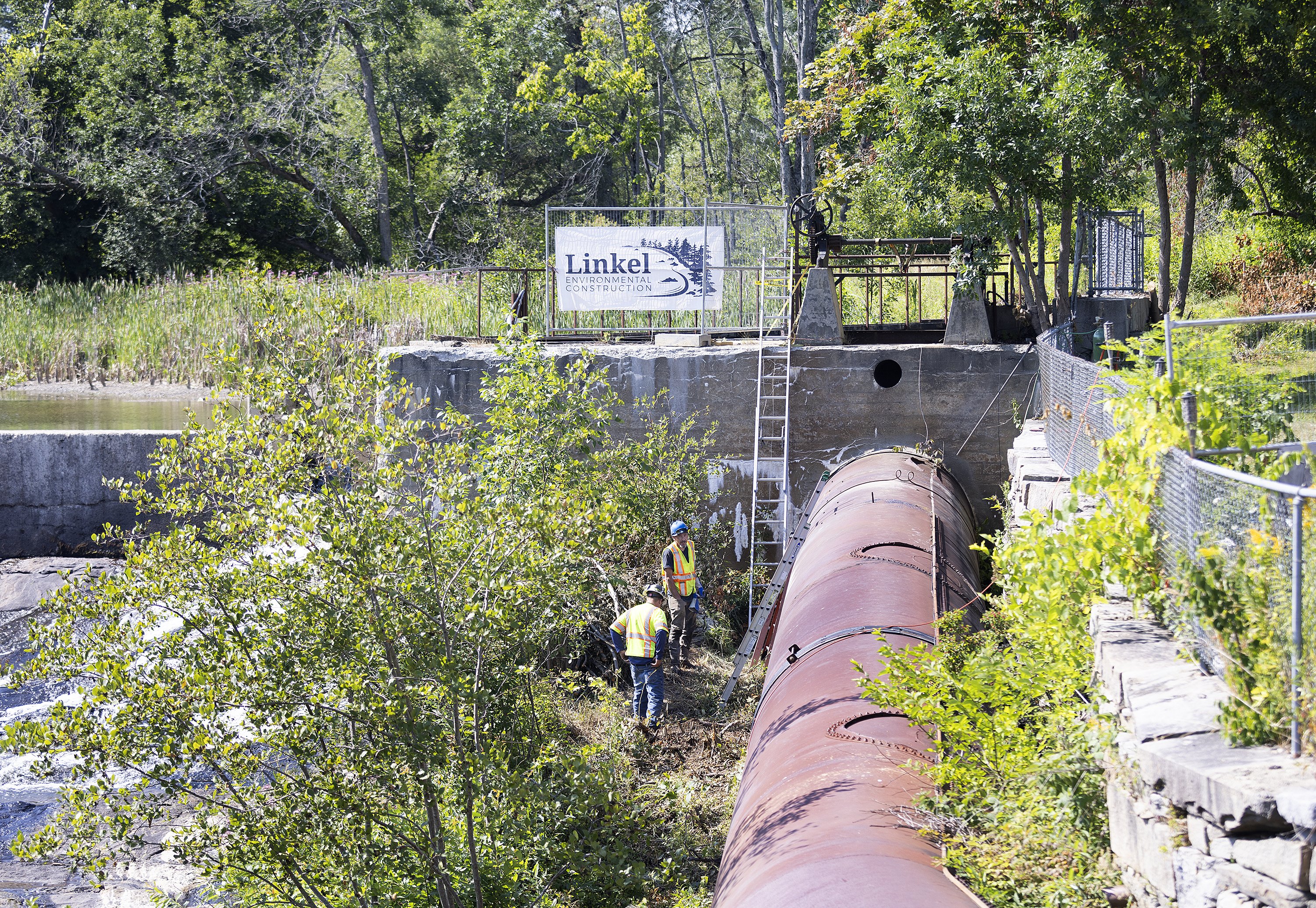
Contractors have begun the removal of the Bridge Street dam on the Royal River in Yarmouth. (Derek Davis/Staff Photographer) Purchase this image
Improving surrounding infrastructure is a regular practice when removing dams that were built to be integrated into communities, said Andrew Fisk, the northeast regional director of American Rivers. American Rivers holds all the contracts for the project.
The organization will observe the changing river flow and the newly exposed land, which is expected to return back to native wetlands. Cattails are already emerging, said Fisk, and for areas that need help, the contractors will remove invasive plants or sow native seeds.
“The river is going to look and flow and be different,” said Fisk. “Removing dams is the fastest way to restore a river.”
American Rivers and partners will also monitor the section of river for at least five years and make any necessary tweaks. During this time, the water quality and health of the river, including alewives and blueback herring that will likely be swimming upstream, will improve with the increased flow.
Advertisement
“It will be a more vibrant, interesting river,” said local project leader Karin Orenstein. “I think it is going to be a beautiful thing.”
Orenstein, who completed a term on the Town Council in June, is one of many Yarmouth residents dedicated to moving the dam removal project forward. Wanting to only serve one term, in three years Orenstein took an idea with public support that wasn’t going anywhere to a project with funding and a start date. She estimated she’s spent over 200 hours on dam removal work while on the council, and now serves as part of the informal team of project partners.
Related
Brunswick group wants to help fish navigate the Androscoggin, but there’s a dam in the way
The town has been waiting since last July to hear back from the National Oceanic and Atmospheric Administration about a grant that would cover the costs of the project. The town’s application scored high, said Orenstein, but with the current administration and uncertain answers, the town and American Rivers are not waiting on that to come through to move forward with the second dam removal.
“We’ll make this happen one way or the other,” said Fisk.
To fund the removal of the Elm Street Dam, project partners hope the visible example of the Bridge Street Dam removal will inspire financial support. In June, the Royal River Alliance gained 501(c)(3) status, allowing it to collect donations for this project, and American Rivers is continuing to pursue grants for the second phase as it did for the first, as well as accept gifts.
If the Elm Street Dam is removed next summer as planned, Fisk estimates that the final cleanup and vegetation restoration will be completed in spring 2028. Additional work might be needed at Middle Falls to ensure there is enough flow for the fish to swim up the side channel, he said.
While the project’s completion is years out, seeing construction workers out on the dam after over 20 years of anticipation is already a big change for Yarmouth. Project advocates said they are hearing excitement from the community about the work on the Bridge Street Dam.
“The feedback has been really heartening,” said Landry, who compared her years of work on the project to having a second job. “This has been such a long journey.”
Copy the Story Link
Tagged: dams, environment, Royal River

Sophie is a community reporter for Cumberland, Yarmouth, North Yarmouth and Falmouth and previously reported for the Forecaster. Her memories of briefly living on Mount Desert Island as a child drew her. More by Sophie Burchell