

Rare partial solar eclipse visible in Maine skies Wednesday


Kira Scholl, 7, and Dax Scholl, 8, of Cape Elizabeth, wear protective glasses as they view the 2024 solar eclipse at the Eastern Prom in Portland. (Shawn Patrick Ouellette/Staff Photographer)
The moon will appear to take a cosmic bite out of the sun on Wednesday afternoon, offering Maine sky watchers a celestial show in their own backyards as about a quarter of the sun goes dark for two hours.
While the temperature won’t plummet like it did for 2024’s total eclipse, it will be the last time that any part of the sun will be eclipsed in Maine skies until 2045, said Nikita Saini, a doctoral student who works at the University of Maine’s Versant Power Astronomy Center.
That is why this event is particularly important for the next generation of scientists, Saini said.
Related
A look back at the 2024 total solar eclipse in Maine
“Nineteen years is a long time,” Saini said. “If you’re a kid right now, there’s a good chance that you’ll have kids of your own before the next partial solar eclipse comes to Maine. So if you are here in Maine now, and if you are getting this opportunity, just go out and take a look.”
Mainers will recall the fever pitch of the 2024 total solar eclipse that drew thousands to watch from the path of totality. This time, the path of totality is sweeping across Greenland, Iceland and Spain. Saini’s adviser, astronomy center director Shawn Laatsch, is watching from Spain.
A partial solar eclipse occurs when the moon slips between the Earth and the sun, but the three don’t align perfectly, Saini said. Instead of a total blackout, as Maine experienced in 2024, the moon appears to clip the sun, leaving a glowing crescent behind.
Advertisement
The celestial event kicks off just before 1 p.m., peaks at about 1:53, and will last nearly two hours.
In Bangor, the eclipse begins at 12:54 p.m. and will reach its maximum coverage of about 24% at 1:53 p.m. before ending at about 2:49 p.m. The “bite” visible from Portland will be a little smaller, peaking at 19% obscurity. The timing remains consistent within a minute or two.
Safety should be the top priority for anyone viewing the eclipse. It’s never safe to look at the sun without specialized eye protection. Regular sunglasses, no matter how dark, cannot protect your retinas from permanent damage, Saini said.
Experts recommend using special “eclipse glasses” that meet international safety standards when viewing a partial or total solar eclipse. If you still have glasses left over from 2024, check them for scratches before looking at the sun, Saini said. Unscratched glasses should last for three years.
If you cannot find glasses, you can use a kitchen colander or your own crossed fingers to project the shape of the partial eclipse onto the ground. The small holes act as natural pinhole projectors, revealing the sun’s crescent shape in the shadows.
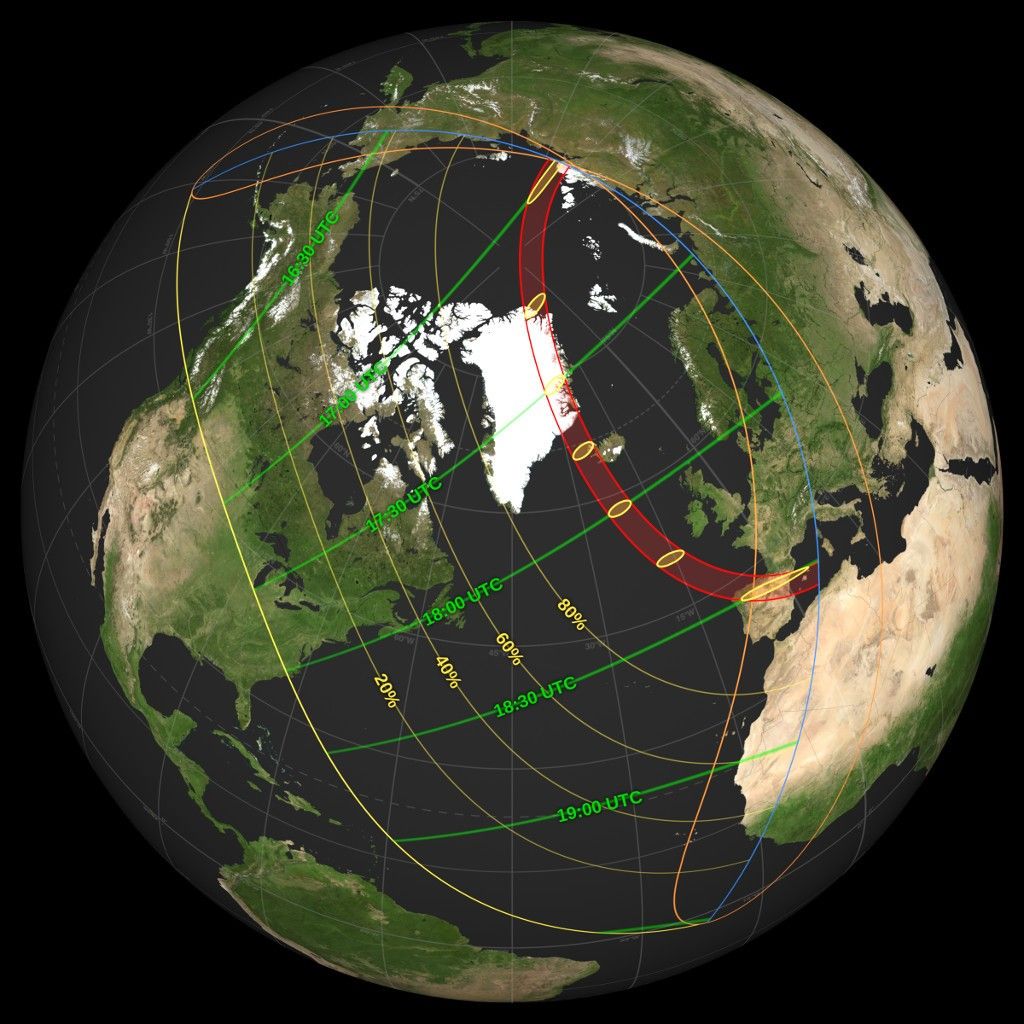
Maine sky watchers will be positioned under the yellow curves during Wednesday’s solar eclipse. The red band of totality, where the event will appear as a total eclipse, will run through Greenland, Iceland and Spain, but in Maine, the moon will obscure only about a quarter of the sun — 19% in Portland and 24% in Bangor — at the event’s peak, which will occur at about 1:53 p.m. (Courtesy of NASA’s Scientific Visualization Studio)
For a community experience, the UMaine astronomy center will host a viewing party. The center will be open to the public from 12:30 p.m. to 3 p.m., offering visitors a chance to look through the Clark Telescope, which is outfitted with a professional solar filter.
Advertisement
The event is free, though solar glasses will be available for purchase in the gift shop for $3.
Weather permitting, the Astronomical Society of Northern New England plans to hold a public viewing event at the Talmage Observatory, which it runs, on Route 35 in Kennebunk from noon to 3 p.m. on Wednesday.
If you miss the afternoon show, don’t put the lawn chairs away just yet. Wednesday night is also the peak of the Perseid meteor shower, one of the year’s most spectacular displays. The dark new moon sky will allow for views of up to 100 shooting stars per hour, Raini said.
A rare alignment of Mars, Jupiter and Mercury can be seen in the eastern sky just before sunrise.
The celestial marathon will wrap up on the night of Aug. 28, when a partial lunar eclipse will turn the moon an eerie shade of red or brown, Saini said. While solar eclipses are about the sun’s brilliance, the lunar eclipse offers a different kind of beauty.
“It looks otherworldly,” Raini said. “The Earth is so much bigger than the moon, so its shadow can cover the moon for a longer time. Weather permitting, that red moon will be hanging there in the sky for a half hour or so. You can’t help but think of vampires and werewolves.”
Copy the Story Link
Tagged: environment, solar eclipse

Penny is excited to be the Portland Press Herald’s first climate reporter. Since joining the paper in 2016, she has written about Maine’s lobster and cannabis industries, covered state politics and. More by Penelope Overton