

Portland waterfront workers question zoning change for Hearts of Pine stadium


Jack Humeniuk, representative to the local chapter of the International Longshoremen's Association at the working waterfront in Portland on Monday. He and other working waterfront mariners are concerned over a zone change required for the Hearts of Pine stadium at Cassidy Point, which they argue will continue to take away working waterfront land in Portland Harbor. (Derek Davis/Staff Photographer)
Workers who rely on Portland’s western waterfront for their livelihood are organizing against a zone change required for the Hearts of Pine’s stadium plans at Cassidy Point.
Mariners working in commercial shipping, tugboat operation and more say they’re concerned about losing a substantial swath of industrial waterfront property — and future jobs — following the Aug. 4 unveiling of a $50 million soccer stadium proposal.
The team said it has reached an agreement with Sprague Energy to purchase about 8 acres of its property at the western edge of Commercial Street along the Fore River, which includes a commercial pier, several warehouses and a controversial coal pile. No sale price has been disclosed.
However, in order for the 9,000-11,000-seat stadium to move forward, the city would need to approve a zone change. The Hearts of Pine said that request would be part of a robust public process — which begins with an Aug. 27 neighborhood meeting — to demonstrate why the project would be good for the city.
But the stadium plan is also reviving a perennial debate over the future of Portland Harbor.
Jack Humeniuk, representative for the local chapter of the International Longshoremen’s Association union and its roughly 70 workers, said removing the land from maritime industrial use is an “existential issue” and he’s concerned that a zone change could forever alter Portland’s working waterfront.
Advertisement
“There’s absolutely no reason to take that property out of maritime use,” he said.
The Maine Port Authority board of directors said in a statement Monday that while the Hearts of Pine have been “an incredible addition” to Portland and the board supports the vision for a new stadium, “we strongly believe that waterfront facilities, even ones that are currently underutilized, should be preserved for marine use.”
Team leaders have said the project’s impact on the working waterfront would be limited because the stadium development would retain the 600-foot pier owned by Sprague.
Jonathan Culley, a real estate developer and founding partner of the Hearts of Pine, said Monday that the team has secured a partner to take over the pier, which is in need of significant repairs if it’s going to be used for transportation of cargo.
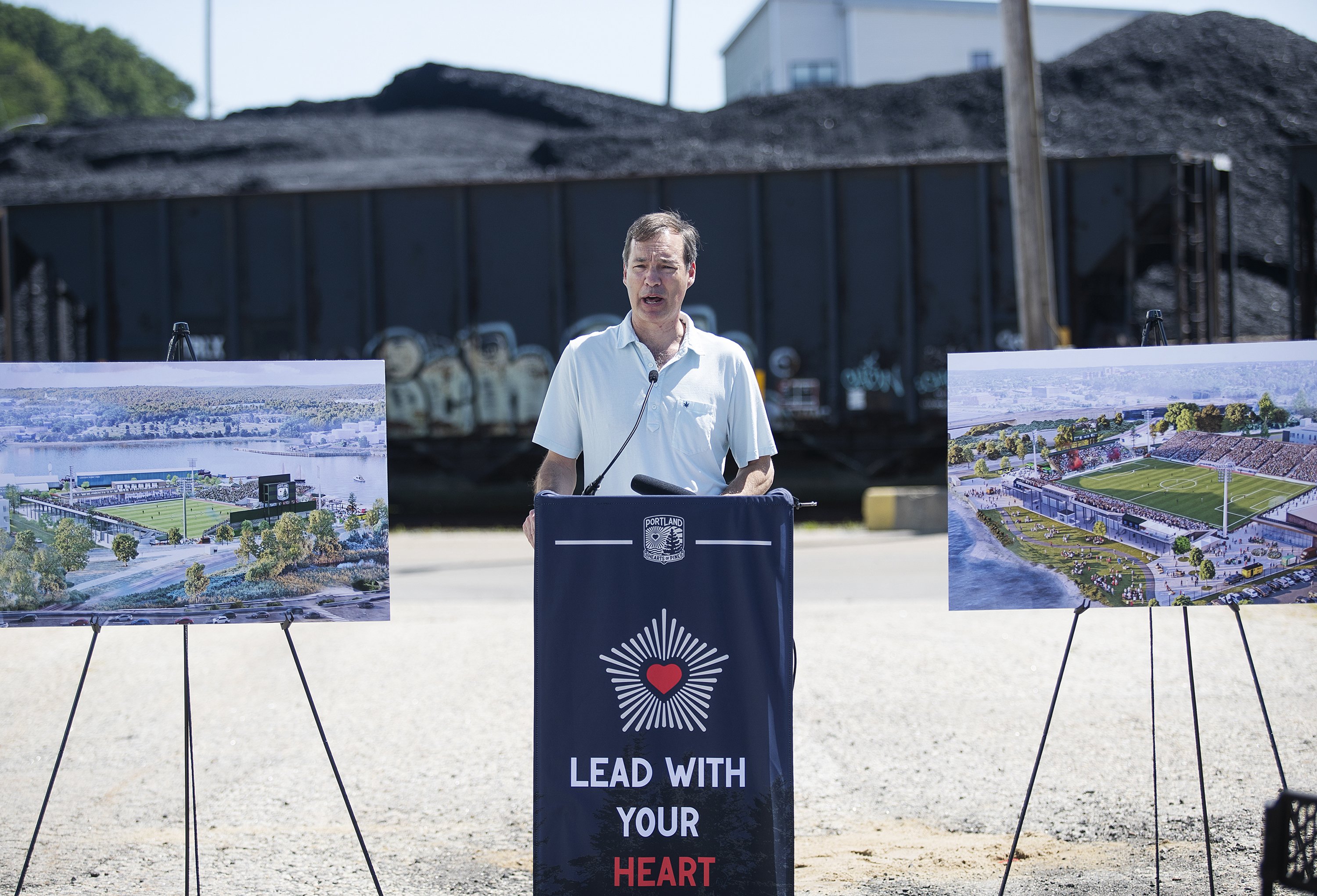
Jonathan Culley, one of the founding partners of the Hearts of Pine soccer club, speaks at Cassidy Point in Portland on Aug. 4. (Staff photo by Derek Davis) Purchase this image
Culley said the team has been meeting with several waterfront groups and is listening to concerns. He said there are currently not a lot of commercially viable port uses that are demanding the site, which drove Sprague’s interest in finding a user who can “reenvision” the land. The team has proposed walking trails and waterfront access as an amenity for people on the western side of Portland.
“There are certainly trade-offs anytime you propose something like this, and we’re confident and hopeful that our use will be well-received by a preponderance of Portland citizens,” he said.
Advertisement
‘A SHRINKING PORT’
Humeniuk and others aren’t convinced that a stadium and marine port are both viable, and said either way, a rezone would remove more land from the working waterfront.
“This is a shrinking port every day, so you take one more element out of that, it shrinks a little bit more,” said Brian Fournier, president of Portland Tugboat.
Fournier said that while he supports the Hearts of Pine and believes they have done “great things for the city,” preserving land in the working waterfront is “paramount.”
He’s seen other deep-water terminals disappear and doesn’t want to see it repeated, he said.
Humeniuk said the perception among officials and the public that Sprague’s property is an inactive industrial site is inaccurate, and that the Cassidy Point terminal and warehouses are full of maritime cargo.
The port authority, which oversees the state-owned International Marine Terminal near the Casco Bay Bridge, has been interested in the Sprague land for years to expand commercial shipping.
Advertisement
“The proposed location at Cassidy Point has provided the Port of Portland with deep-water access to marine cargo infrastructure for decades and has always been a part of the state and city’s long-term plans to develop and maintain the West End for industrial marine use,” the board said Monday.
According to city records, the state owns a section of railroad along west Commercial Street, and a strip of land along the line, which stops at Cassidy Point Drive.
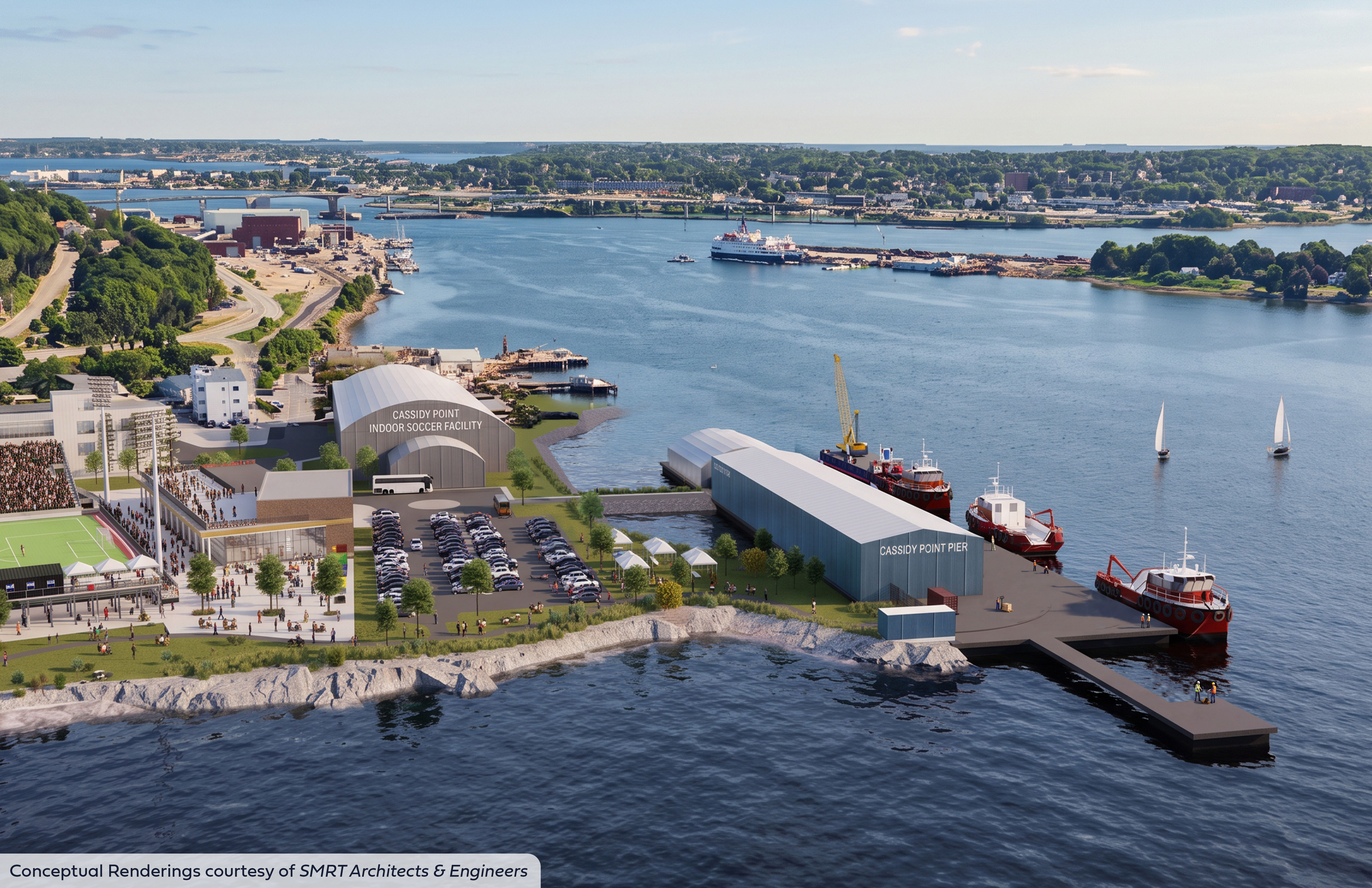
A rendering of the proposed new Hearts of Pine stadium, at left above, at Cassidy Point in Portland. (Courtesy of SMRT Architects & Engineers)
Nick Skally, managing director of marketing for Sprague, confirmed that while the company’s plan is not yet settled, the pier would likely go to a marine operator that could continue, and possibly expand, its use.
Skally said the company sees the potential sale to the soccer club as consolidating an area that’s primarily used for material handling with the property it owns across the harbor in South Portland.
Skally declined to comment on whether Sprague had been in previous talks with the Maine Port Authority to acquire the property.
Humeniuk said the union recently negotiated a new contract with Eimskip that will put more workers at the International Marine Terminal. But, he’s worried that the large investments made to expand shipping will be “lopped off” by losing the Cassidy Point land.
Advertisement
“It’s a serious issue to us to lose that. There is no other land for that,” he said.
‘STILL SOME HOPE’
Conflict over the development of Portland’s waterfront has been ongoing for years, and has included petition efforts by waterfront entities in order to retain more land for maritime uses. In 2019, the council adopted a six-month moratorium on development on the waterside of Commercial Street and formed a working group of city officials, fishermen and others to find solutions for issues raised by petitioners, who eventually dropped the effort.
However, the group continued to advocate for zoning that would retain working waterfront.
The Sprague terminal is located in the waterfront port development zone, one of three waterfront zones that break Portland’s waterfront into western, central and eastern sections. The port development zone stretches from the International Marine Terminal to Cassidy Point.
Humeniuk said during past discussions, he and other waterfront workers agreed with how the waterfront areas were zoned, which were retained during Portland’s recent ReCode effort: the area along western Commercial Street was meant for heavier maritime industrial use, the central waterfront to maintain tourism and commercial fishing uses, and the eastern waterfront for cruise ships, marinas and other development. So far, it’s been a success, he said.
“We played by the rules, everyone compromised,” he said.
Advertisement
The team has said that the project aligns with the city’s comprehensive plan, which calls for expanding public waterfront access and “supporting private, state and federal investment in the western waterfront.”
City spokesperson Jessica Grondin said the Hearts of Pine submitted an application to the planning office last week, and the planning board is slated to hold a workshop in late September after the club holds a neighborhood meeting.
Culley said the first neighborhood meeting to discuss the project will be at 6 p.m. on Thursday, Aug. 27 at the Waynflete School auditorium. He said they’re working with several neighborhood groups to spread the word.
Following at least two workshops this fall, the planning board would make a recommendation on the zone change to the City Council. Then, the council would vote.
“As long as they can maintain access to that pier by road or by rail, then there’s still some hope,” said Fournier, with Portland Tugboat. “But it’s in the City Council’s hands now.”
Copy the Story Link
Tagged: Hearts of Pine, portland maine

Andrew Rice is a staff writer at the Press Herald covering the city of Portland. He's been working in journalism since 2012, joining the Sun Journal in 2017, then the Press Herald in 2026. He lives in. More by Andrew Rice