Portland officials are still unsure about plans to move Downeaster train station


The Downeaster backtracks near St. John Street in Portland on Oct. 23. The train's operator and city of Portland staff still disagree on where a new train station should be located. (Daryn Slover/Staff Photographer)
Portland city officials, with support from the Greater Portland Council of Governments, could soon take a formal stance against a proposal to relocate the Downeaster train station to outer St. John Street.
But first, they’ll hear from all sides during a workshop Monday evening.
In August, the Northern New England Passenger Rail Authority, which operates the Downeaster, received $48 million in federal funding to relocate the train service’s Portland station to the authority’s preferred spot.

Related
Downeaster gets millions to relocate Portland train station
However, city staff and elected officials were caught off-guard by that announcement because of a lack of local and regional support for the authority’s preferred location, as well as their own preference for using Union Station Plaza, farther down St. John Street.
Rail authority officials have argued that the move from the Portland Transportation Center to a swath of land between St. John Street and Northern Light Mercy Hospital would reduce travel time and expand rail service, and that its application for the funding was for that specific location.
The project is estimated to cost roughly $60 million, with a proposed $12 million match in state funding.
Advertisement
Ahead of the council workshop Monday, city staff recommended against proceeding with the train station relocation and suggested that the state prioritize transportation funding for more urgent needs. Staff say the rail authority’s preferred site goes against nearly every zoning and long-term planning document in place, and that its chosen location is heavily weighted toward rail operations.
An analysis from city staff said Union Station Plaza would provide better bicycle and pedestrian access and better public transit connections, noting that it’s closer to Congress Street workplaces, businesses, residential neighborhoods and recreational sites like Hadlock Field.
The rail authority has argued that its chosen site would strengthen pedestrian mobility between two areas of the city — the Fore River Parkway/Libbytown neighborhood and the West End/Western Promenade — that are currently split by the railroad.
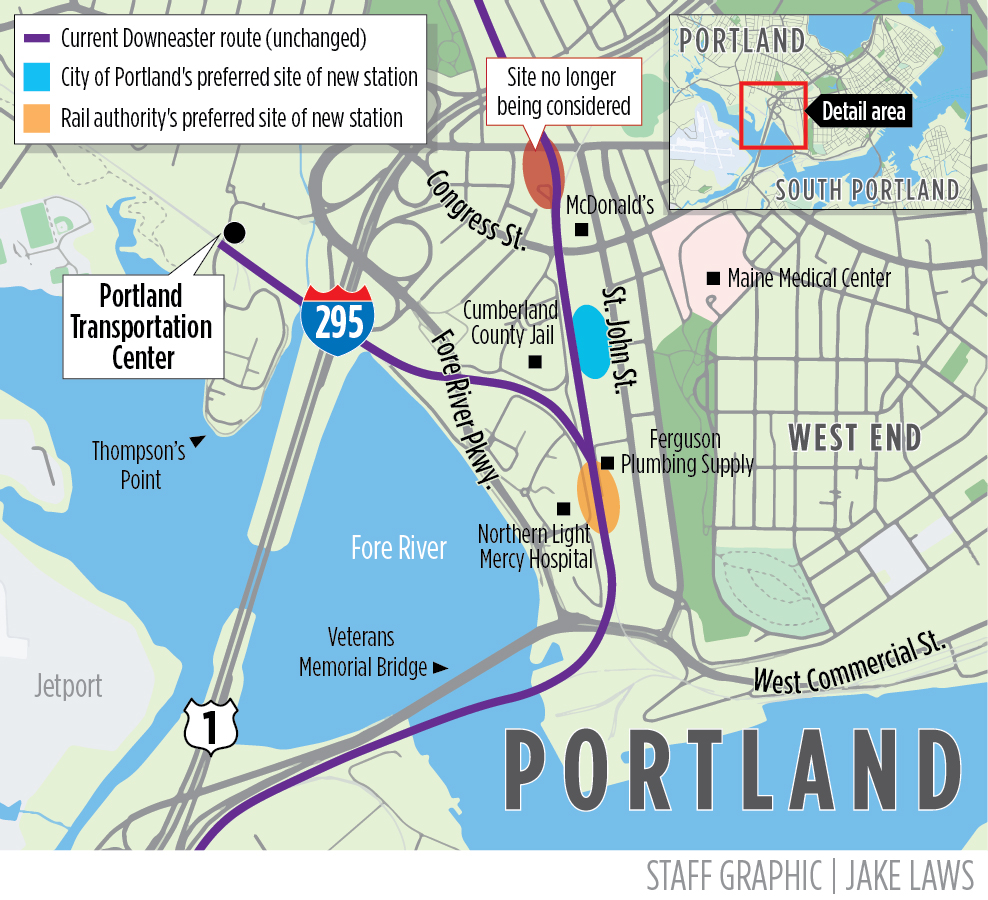
The GPCOG memo, written by Executive Director Kristina Egan, argues that moving the station from its current location would weaken the transportation hub at Thompson’s Point by splitting rail from buses.
“Should we spend $60 million in public dollars to move the station away from the
connections we’ve already built?” she said.
According to a memo, the city and GPCOG staff previously outlined concerns with the rail authority’s process and suggested that the advantages of Union Station warranted a more in-depth analysis that compared both St. John Street options to the existing Thompson’s Point location. However, that analysis was never completed, and staff said a subsequent effort to engage a mediator reached “an early impasse.”
Advertisement
City staff and GPCOG also argue that the proposed $12 million in state funds has not yet been committed to the new station, and that if the funding did become available, it should be spent on higher priorities in the region.
Those include a new Metro facility and buses, and needed pedestrian infrastructure along corridors like Forest Avenue, as well as elsewhere in southern Maine, the GPCOG memo states.
“This is a discretionary project and Portland and the region face substantial state funding limitations related to higher priority needs including road/bridge asset maintenance, pedestrian and traffic safety improvements, and public transit facility and service expansions that would benefit more people,” said Kevin Kraft, the city’s planning director.
GPCOG also said using the state funding on the station instead of on Metro infrastructure “widens the equity gap.” The presentation says 86% of bus riders have household incomes of under $50,000 compared to just 5% of train riders.
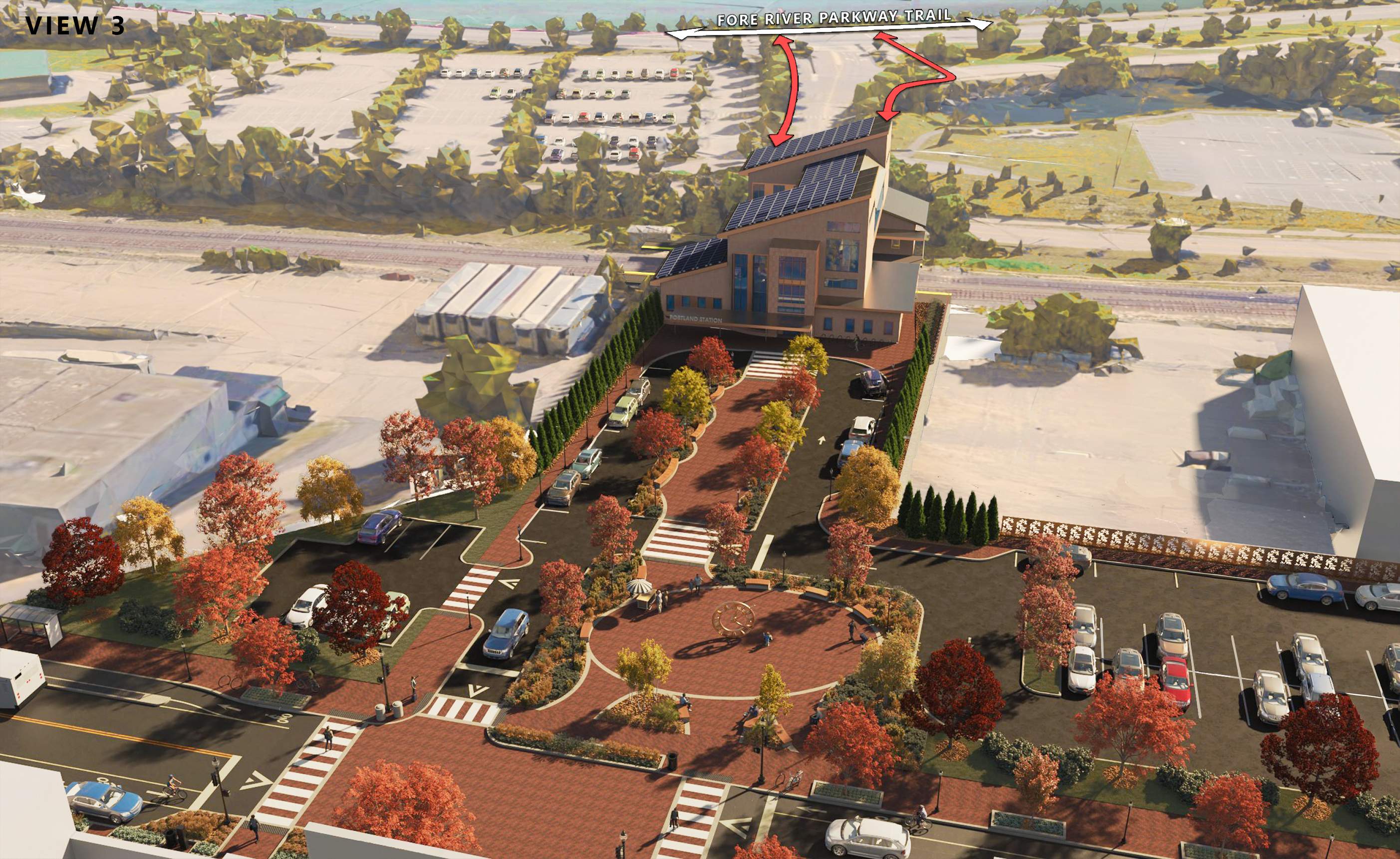
This rendering shows a planned new Amtrak Downeaster train station off St. John Street in Portland. The operators of the Downeaster received $48 million in federal funding to relocate the station, but Portland officials continue to oppose the chosen site. (Image courtesy of Northern New England Passenger Rail Authority)
An estimated $4 million of the $60 million budget would go toward the costs of property acquisition, which the city says would displace several businesses. The staff memo said the location at Union Station, which is owned by MaineHealth, could move forward without displacement.
Mayor Mark Dion has previously said that MaineHealth has not been interested in selling, which complicates the city’s position.
The City Council could take a formal position on the project in the form of a resolution at an upcoming meeting. Monday night’s workshop begins at 5 p.m. in council chambers.
This story will be updated.
Copy the Story Link
Tagged: amtrak downeaster, Portland City Council

Andrew Rice is a staff writer at the Press Herald covering the city of Portland. He's been working in journalism since 2012, joining the Sun Journal in 2017, then the Press Herald in 2026. He lives in. More by Andrew Rice