Portland gallery exhibit teems with Monhegan Island’s artistic magic | Column


Victoria Nelson, "Windswept Monhegan," 2018, oil on panel. (Image courtesy of Pearl Gallery)
If you’ve never visited Monhegan Island, about a dozen nautical miles off the coast of Maine, you are missing one of the most quintessentially “Maine” experiences there is. In its four-and-a-half square miles, it packs in an abundance of features we associate with the state: a working fishing village, vertigo-inducing cliffs that plunge beneath crashing waves 160 feet below, Cathedral Woods where hikers improvise “fairy houses” using materials foraged from the forest, the arching flight paths of gulls.
And, of course, art. Monhegan has been a thriving artist colony since the mid-1800s. Its dramatic landscapes, golden light and abundance of natural and human subject matter has attracted, among others, James Fitzgerald, George Bellows, Rockwell Kent, Edward Hopper, Jamie Wyeth, Lynne Mapp Drexler and countless others. During the summer season, the lighthouse and outbuildings presiding at its highest point, now the Monhegan Island Museum of Art and History, presents exhibits of all these artists and many others.
But one reason to rejoice in “The Monhegan Show” at Pearl Gallery in Portland (through Dec. 18) is because exhibitions devoted to contemporary art of Monhegan are rare. The Monhegan Museum’s policy is to only exhibit non-living artists. Yet painters have not stopped coming here. Singling out living artists for exhibition is, of course, a political hot potato within a small island community, so the “no living artists” policy skirts the controversy.
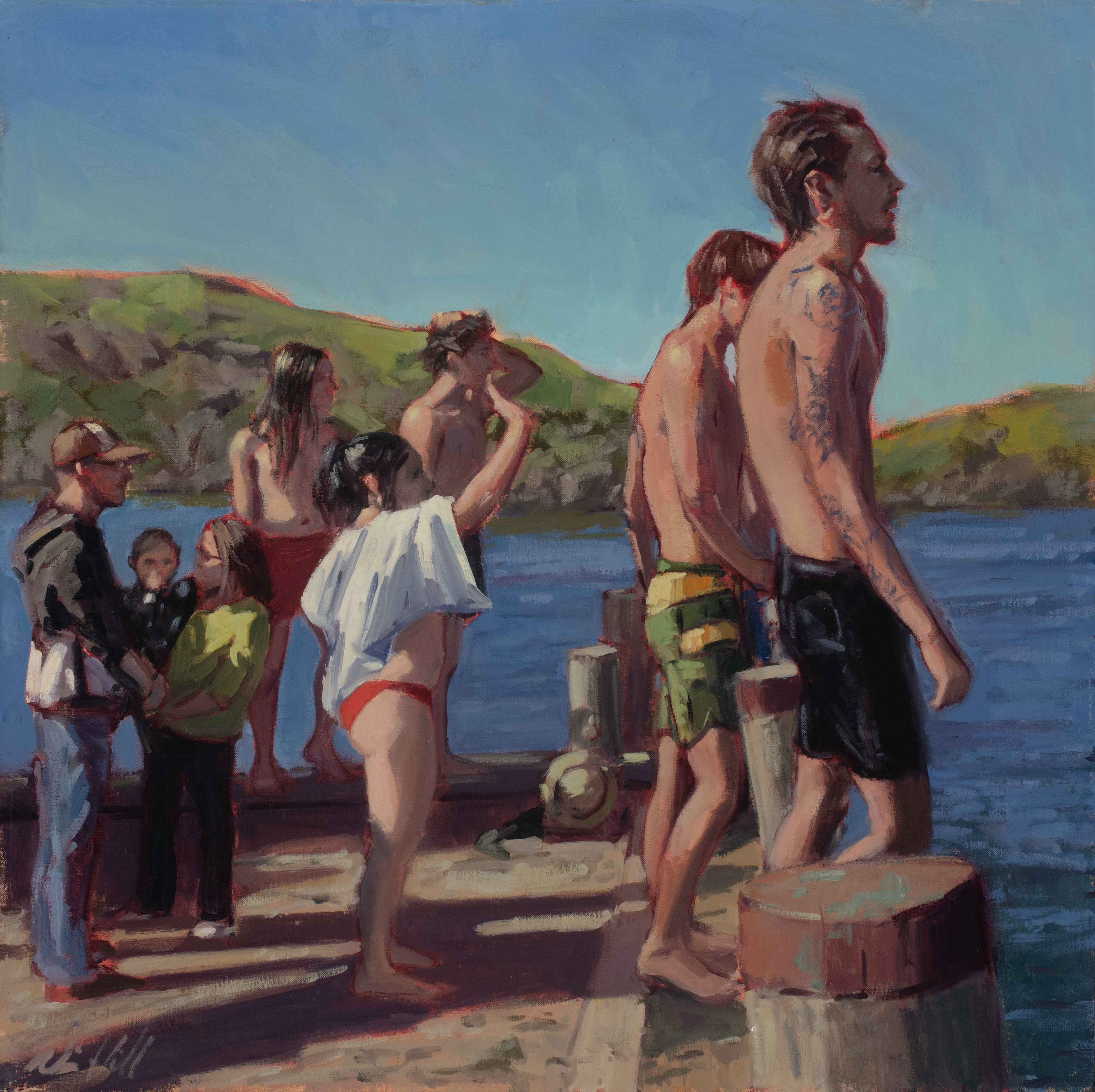
Alison Hill, “Saying Goodbye,” 2022, oil on linen. (Image courtesy of Pearl Gallery)
That leaves most of us piecing together the current vibrancy of the island’s art community through individual and disparate exhibitions where a painting or two of Monhegan by an artist or two who visited there might occasionally appear. If you’ve had no experience of it, then Monhegan’s significance — and its magical quality — are lost on you.
The Pearl Gallery exhibition does an admirable job of trying to rectify this situation. Owners Gary Perlmutter, M.D., and Rhonda Pearle have summered on Monhegan for over 20 years. Perlmutter, an orthopedic surgeon, is also a painter, as is his wife, Pearle. In the early days, they used to paint with Don Stone, a modern impressionist painter who died in 2015 (and is represented here by a few paintings, most resplendently the golden-hued “First Light Manana” of the island across the channel from Monhegan). The couple has assembled 27 artists — all but six still actively working — to give us a snapshot of what is happening there today.
The show grounds us with work by deceased painters from past generations of Monhegan artists. There is a wonderful watercolor “Mariners” by James Fitzgerald (1899-1971), the oldest work in the show. It exhibits all the qualities we’ve come to admire from this painter: the simplified forms, large areas of white space, the chalky palette. Yolanda Fusco’s (1920-2009) “Gull Rock” depicts this marine landmark as a mound of multicolored blocky forms. It’s an abstraction that would have paired beautifully with living artist Bruce Kornbluth’s “Gull Pond,” which essentially composes his watercolor in the same way, except that he outlines the forms in black ink, giving his picture the stained-glass quality of a Georges Rouault painting.
Advertisement
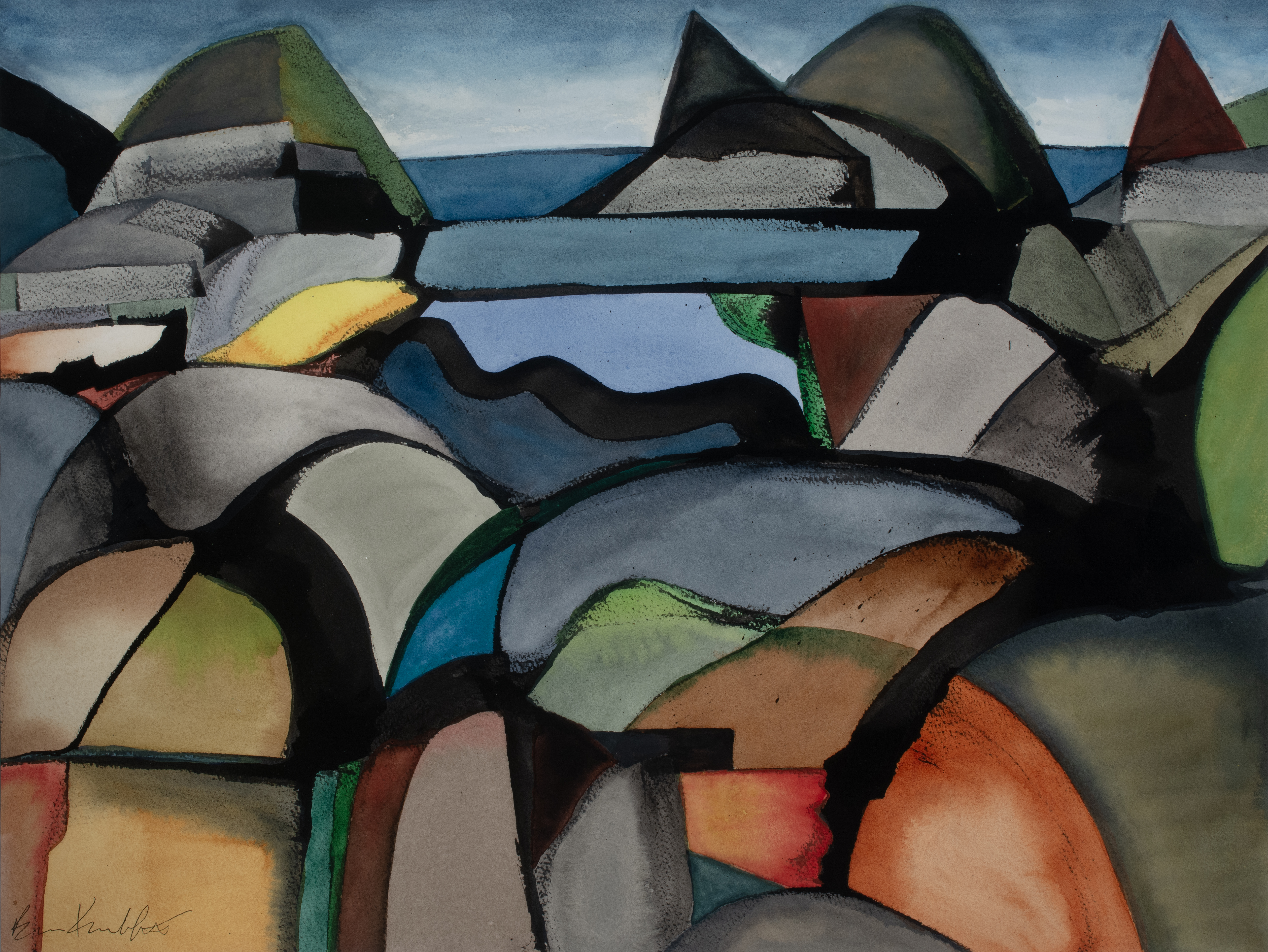
Bruce Kornbluth, “Gull Pond,” 2025, watercolor and ink on paper. (Image courtesy of Pearl Gallery)
But Fusco’s oil-on-canvas is downstairs in the coffee shop, while the Kornbluth resides on the second floor. Bruce Kornbluth, of course, is the son of Frances Kornbluth (1920-2014), who is represented nearby with two abstract landscapes in her late 1980s-early 1990s style (my guess since there are no dates on works, unfortunately). She spent 57 summers in Monhegan, studying under Reuben Tam, William Kienbusch and Robert Richenburg (none of whom are in the show). By the date of this painting, she had developed a style that subtly segmented the surface into bands or, like Richard Diebenkorn, fractured it into prisms. It is interesting to juxtapose her linearity with her son’s more rounded, organic forms.
There are other family connections here. The actor Zero Mostel (1915-1977), who used to joke that he acted so he could afford to paint, is represented by “Aspects of the Moon,” a very atypical work that looks almost like a pastel-colored Paul Klee. Mostel’s palette was usually as bold and brash as his personality. One wonders whether he was experiencing a rare moment of peace and serenity when he painted “Aspects.” His son Josh Mostel, also an actor, offers two ink-and-colored-pencil works on paper of fleshy pink nudes, which are cropped to focus on torsos and limbs of the women’s bodies. They are lighthearted and not at all influenced — at least not apparently — by his father’s work.
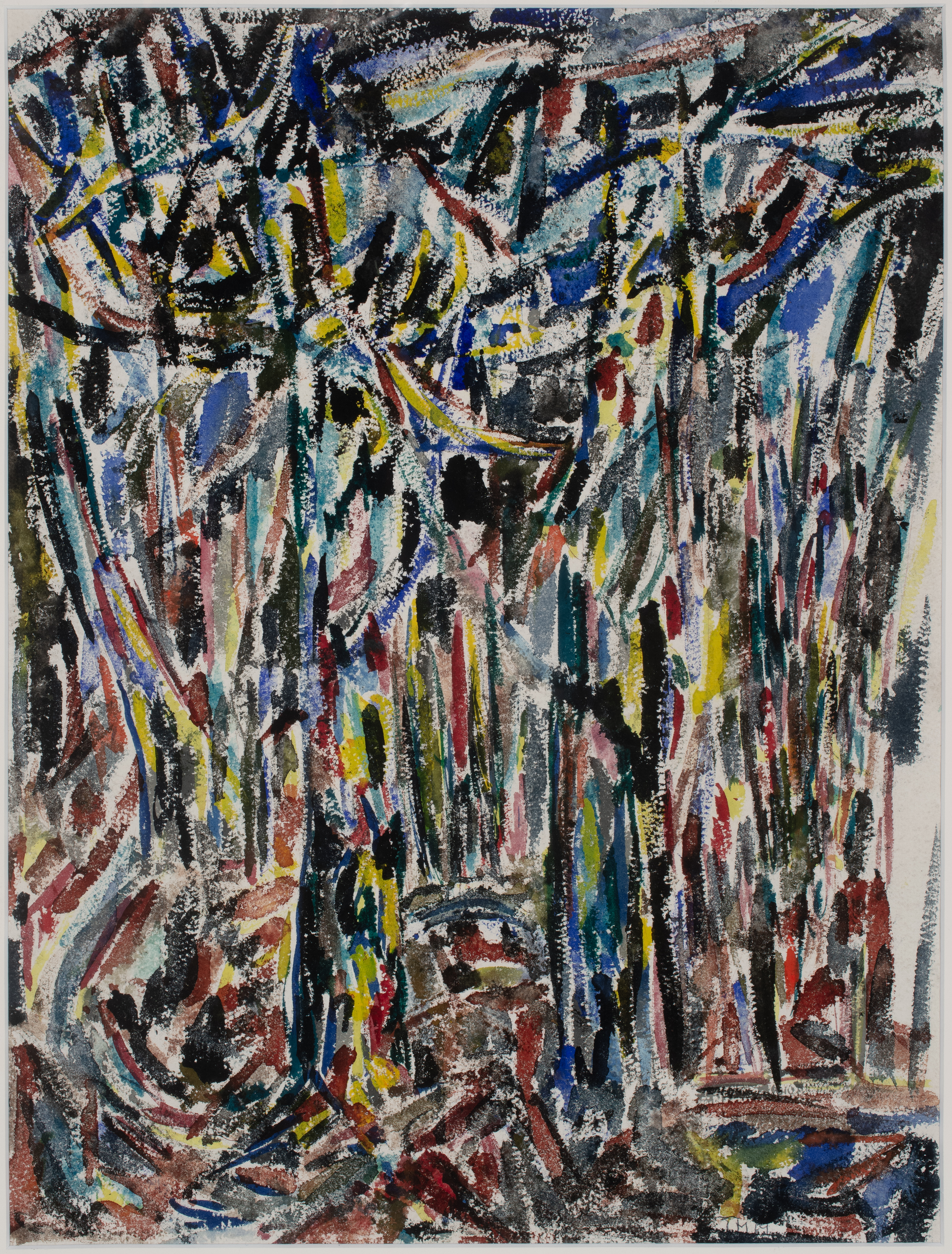
Tobias Mostel, “Monhegan Forest Afternoon,” 1969, watercolor on paper. (Image courtesy of Pearl Gallery)
Tobias Mostel, however, is one of the show’s revelations. He presents two watercolors (my favorite is “Monhegan Forest Afternoon”). They are almost completely abstract, save for vaguely discernible forms of trees. I say vague because they are easy to miss amidst the restless cacophony of brush strokes. Hundreds of quick jots in prismatic colors make the work feel electrically charged. Though Zero also flirted with this dance between abstraction and representation, he was too fond of the figure to go this far. These made me want to see more of this Mostel’s work.
Another Zero connection is Perlmutter’s oil-on-linen, “Zero’s Trinkets.” He and Pearle have often rented out the house where Zero lived (now home to Josh). Perlmutter assembles still-life paintings from groupings of objects he finds on the shelves. This one, like much of Perlmutter’s work, is charming. But it is also executed with considerable skill, which keeps the essentially kitsch character of the objects in check.
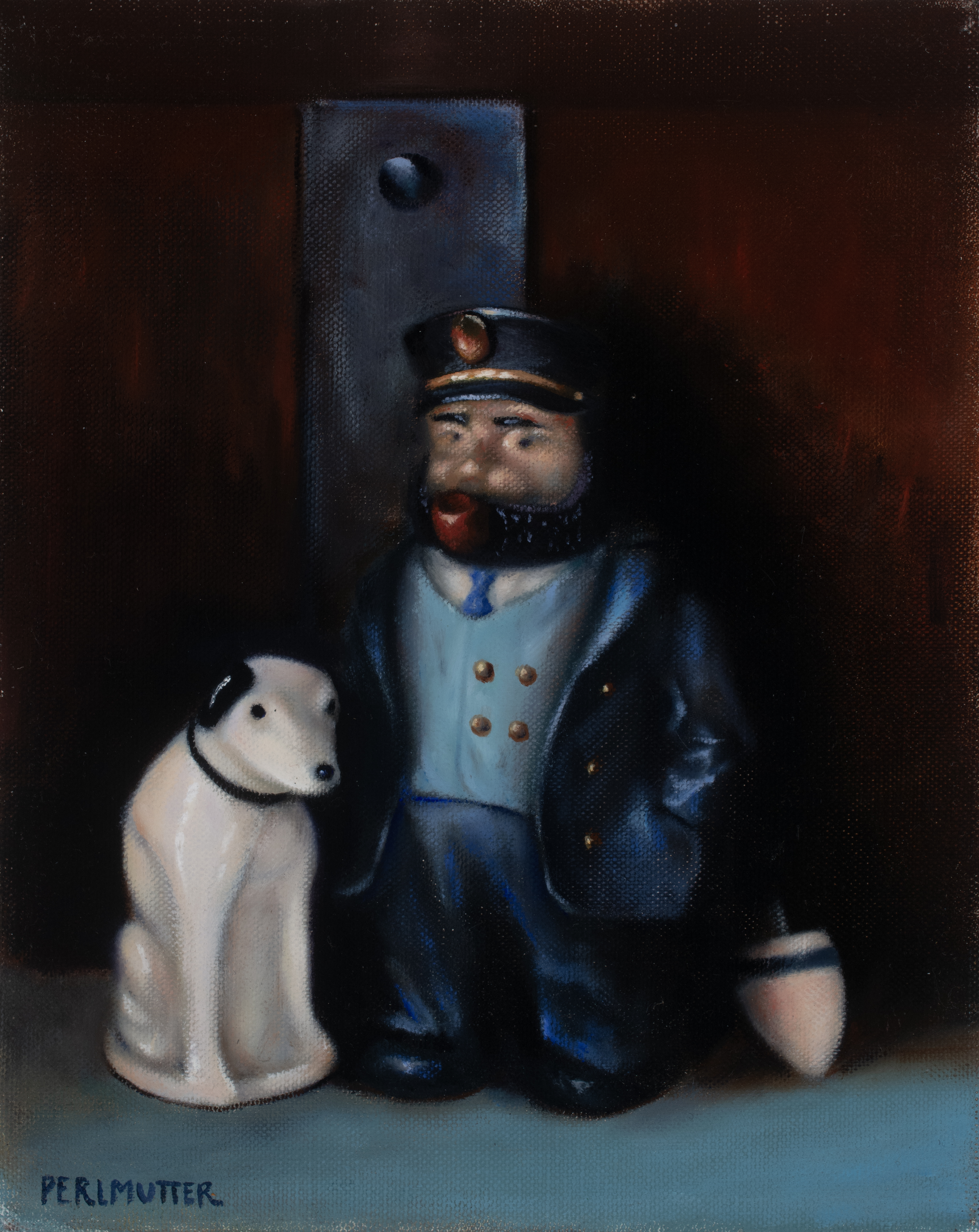
Gary Perlmutter, “Zero’s Trinkets,” 2017, oil on linen. (Image courtesy of Pearl Gallery)
Pearle is known to folks who pass by the H.H. Hay Building on Congress Street as a painter of expressionistic barn fowl and huge poppies with fairy-like beings hanging from their petals, which she hangs in the windows of the building. Judging by the two paintings in this show, she would do well to refocus her attention on landscape. Her “View from Mostel House” is a truly lovely painting that gets the spirit of that landscape exactly right. But “Wind Through the Trees” in the coffee shop reminded me of the landscapes of Carl Sprinchorn. Vividly colored with energetic brushwork, it makes the phenomenon of wind coming off the water and blowing the trees into a leftward sweep come alive.
Other highlights are two paintings that reenact the rituals of the island — one of which is bidding farewell to visitors at the ferry dock (often your host brings wildflowers picked from the island for you to throw overboard as the boat pulls away, which supposedly assures you will return). Alison Hill’s version of this is one of the most resonant paintings in the exhibition. We feel the heat of the sun on the bodies of the young people gathered there. It is perfectly composed, with the boat out of sight, but the slightly sad feeling of farewell lingering in the golden light.
Advertisement
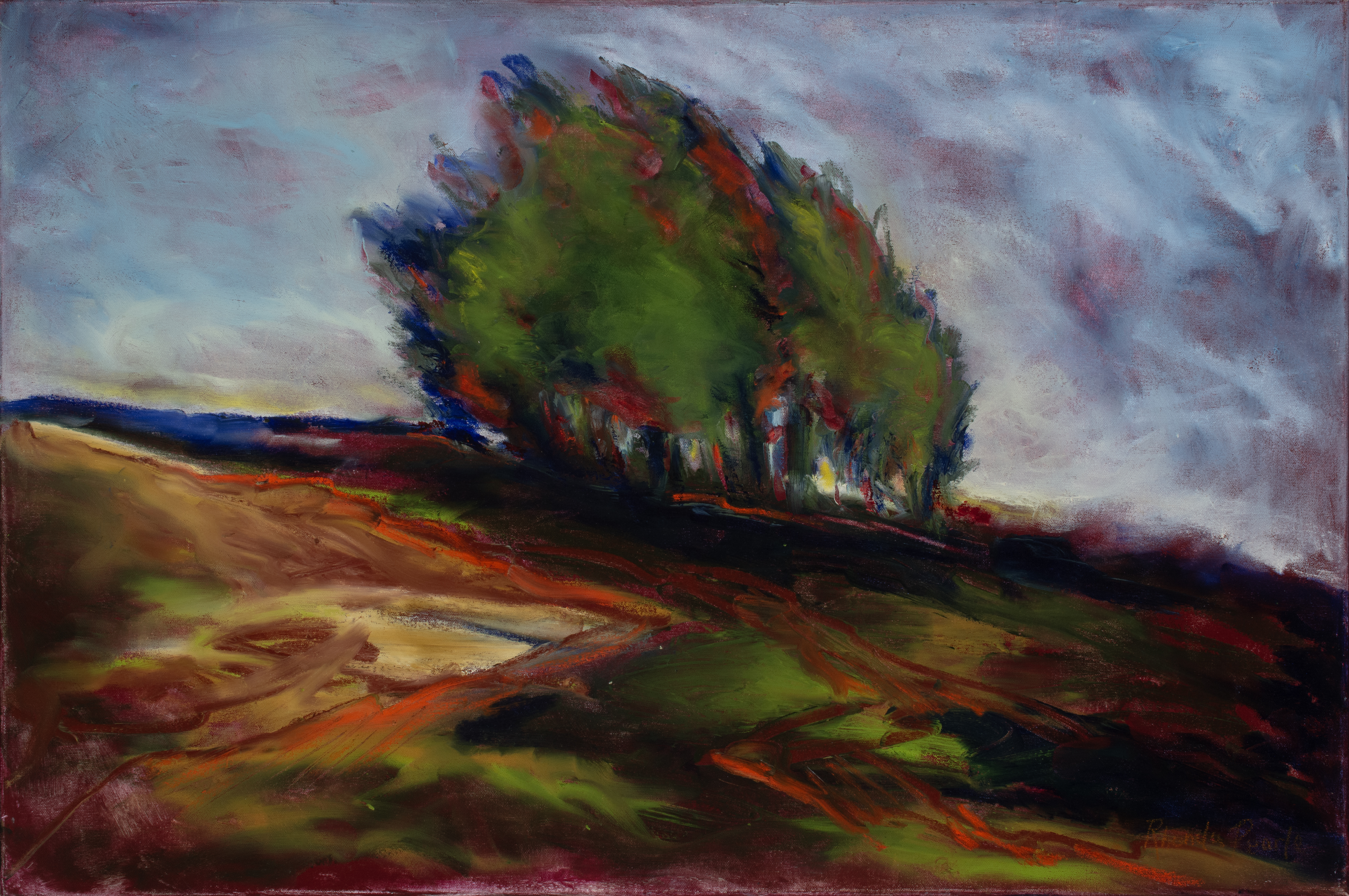
Rhonda Pearle, “Wind Through the Trees,” 2018, oil on canvas. (Image courtesy of Pearl Gallery)
Stan Moeller’s appreciation of the everyday life of the island is apparent in two wonderful paintings: “Novelty/Evening Light,” which shows a woman in an apron behind the counter of the popular store, and “Table for Four,” which captures a busy night at the restaurant of the Island Inn, which Moeller fills with that very particular low, slanting glow that makes one feel that everything in the world is perfect. Both are evocatively painted and feel at once unremarkable as subjects, yet entirely essential to this special place.
There is, of course, much more. Those who have spent a fair amount of time on the island will feel longing for the woozy, magical spell Monhegan invariably casts, especially in high season. But what the show asserts — aside from its sense of summer’s warmth and abundance mixed with the melancholy that descends as it passes into fall — is that these scenes are not preserved in amber. The island is a constancy and a locus. Yes, Edward Hopper and George Bellows came here years ago. But the painters never stopped coming, never got tired of taking a new stab at the view of Fish Beach or Manana across the water. It is still very much a living, breathing inspiration. These paintings will make you want to visit.
Jorge S. Arango has written about art, design and architecture for over 35 years. He lives in Portland and can be reached at [email protected]. This column is free to access through support by The Dorothea and Leo Rabkin Foundation.
“The Monhegan Show” Pearl Gallery, 594 Congress St., Portland. Through Dec. 18. Thurs-Sat., 11 a.m. to 4 p.m. or by appointment. For more, 207-712-9499 or pearlgallerymaine.com
Copy the Story Link