Portland City Council advances plan for overhauling Franklin Street


A draft rendering of the intersection of Franklin Street and Marginal Way. (Courtesy of city of Portland)
PORTLAND — The City Council on Monday formally endorsed a plan for redesigning heavily traveled Franklin Street that was at least two decades in the making. It will be at least another few years before any shovels are in the ground.
Despite concern for the loss of the mature oak trees that line the grassy median of the road between Marginal Way and Commercial Street, there was overwhelming support for the redesign among officials and the public.
The final concept calls for significant reductions in road and lane widths, restoring connections to several neighborhood streets, adding separated bicycle lanes and improving pedestrian crossings, Kevin Kraft, the city’s planning director, said during a presentation to the council.
Kraft pointed to two recent pedestrian fatalities on the stretch, and said the plan would add raised crosswalks and intersections and create tighter turning aprons to slow cars. The crossing at Marginal Way, considered by advocates to be among the city’s most dangerous, would be reduced to 70 feet from 101 feet.
The redesign would also create roughly 3.5 acres of new land for future development, or up to about 720 new housing units, according to city staff.
City residents and groups like the Franklin Reclamation Authority and Urbanist Coalition of Portland have long pushed for a redesign of the roadway to revive a neighborhood that was lost during urban renewal in the mid-20th century.
Advertisement
Wendy Cherubini, who has long advocated for the change, said it’s the best design she’s seen out of the many iterations over the years. While “not perfect,” she said it strikes a balance between competing interests.
Another commenter, who said they were in their 30s when discussions began and is now in their 60s, called the plan “a tremendous achievement.”
“We didn’t get everything we wanted, but there’s a lot to like,” he said.
Related
Portland sees big turnout — and varied opinions — on long-awaited Franklin Street redesign
City staff held several public sessions with the public in order to glean feedback, which included a session at the Portland Public Library in September.
Kraft said Monday that the city saw roughly 560 comments on its webpage dedicated to the effort.
Among the most debated elements of the plan have been the addition of parking between Congress and Commercial streets, and the proposed orientation of the road, which would necessitate cutting down mature trees.
Advertisement
Avery Yale Kamila, co-founder of local environmental group Portland Protectors, said while she supports several facets of the plan, she takes issue with clear-cutting the oak trees and she urged councilors to vote it down or modify it. She said the Bayside neighborhood already has the smallest amount of tree canopy in Portland, and that new trees planted during the project will take 20 to 50 years to reach the same benefits as ones there now.
“We will spend millions to make our downtown hotter,” she said.
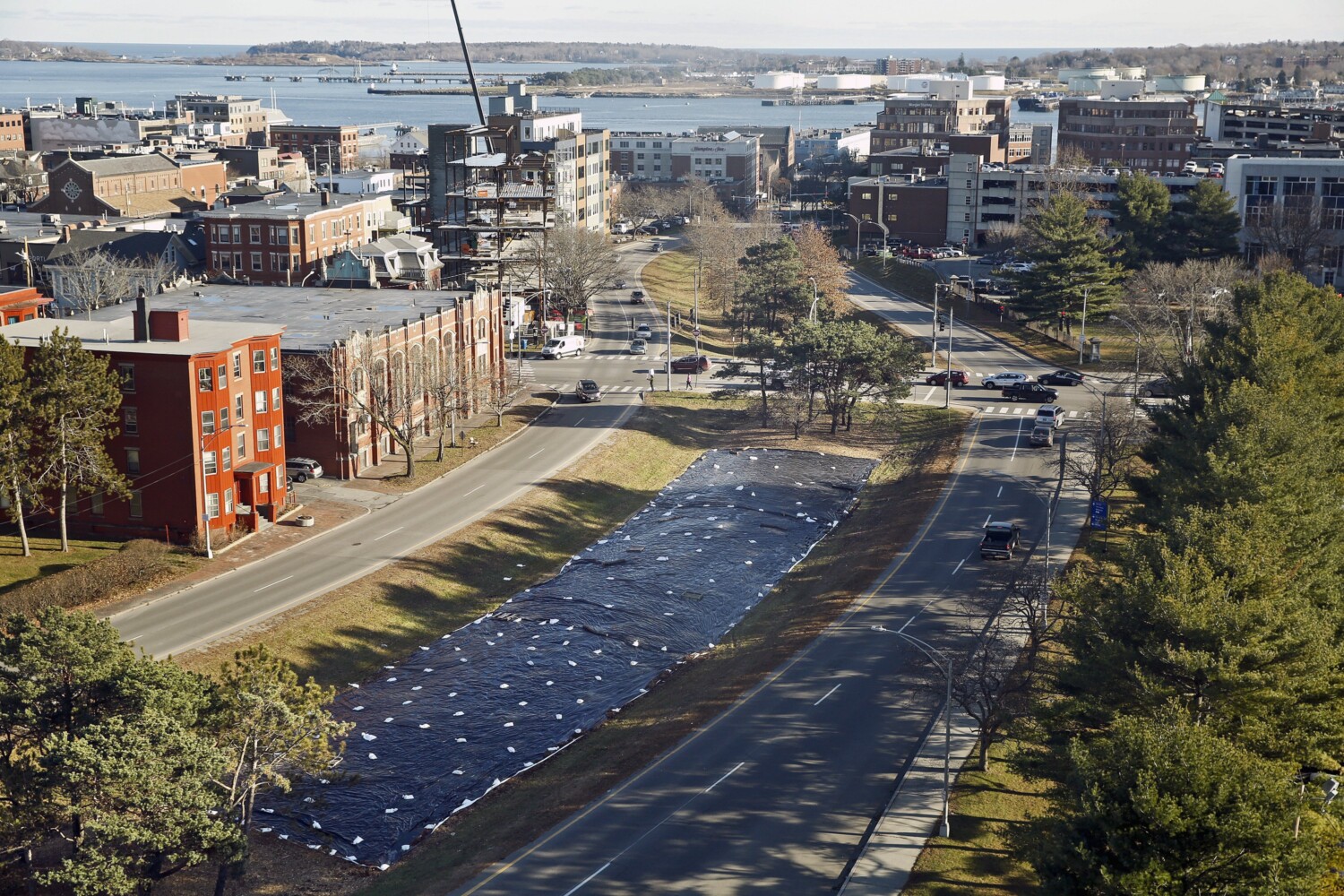
The median on Franklin Street looking toward Cumberland Avenue and Congress Street in 2019. (Ben McCanna/Staff Photographer)
Kraft said the plan calls for 230 new street trees and that the city is committed to preserving existing canopy on the outside of the road.
Councilor Sarah Michniewicz requested that the city research whether certain trees on the median could be relocated. A city staff member said that “with enough money and resources” it’s possible to relocate trees.
The design would retain two travel lanes in each direction between Marginal Way and Congress Street but reduce to one lane in each direction between Congress and Commercial streets to add on-street parking.
While some argued against the inclusion of parking, Kraft said on-street parking is a known traffic calming measure, and staff have estimated the added metered parking could bring in $260,000 in revenue. He said parking also could be used for food trucks, bike corrals, or space for outdoor dining.
Advertisement
The plan would create separated bike lanes and wide sidewalks on a stretch that currently has neither.
Lily Sage, a teacher at Portland schools, said she recently brought a group of seventh graders on a field trip and had to cross Franklin Street. Unfortunately, she said, she had to give the students a serious talk regarding the unsafe traffic conditions there.
“You can sense it is not your space. It was made for cars,” she said.
The plan will now advance to design and engineering, with the initial design phase already funded through a $2 million federal grant, and $500,000 in local contributions split between the city and the Maine Department of Transportation.
Kraft has said ballpark estimates for eventual construction costs are in the $30 million to $40 million range, and that once the preliminary design phase is complete, the city will seek funding for implementation.
He said in between those stages, the city may explore demonstration or pilot projects to test certain elements.
Copy the Story Link
Tagged: Portland City Council, traffic safety

Andrew Rice is a staff writer at the Press Herald covering the city of Portland. He's been working in journalism since 2012, joining the Sun Journal in 2017, then the Press Herald in 2026. He lives in. More by Andrew Rice