Nearly Seven Years Later, a Federal Jury Found Lowe’s Negligent
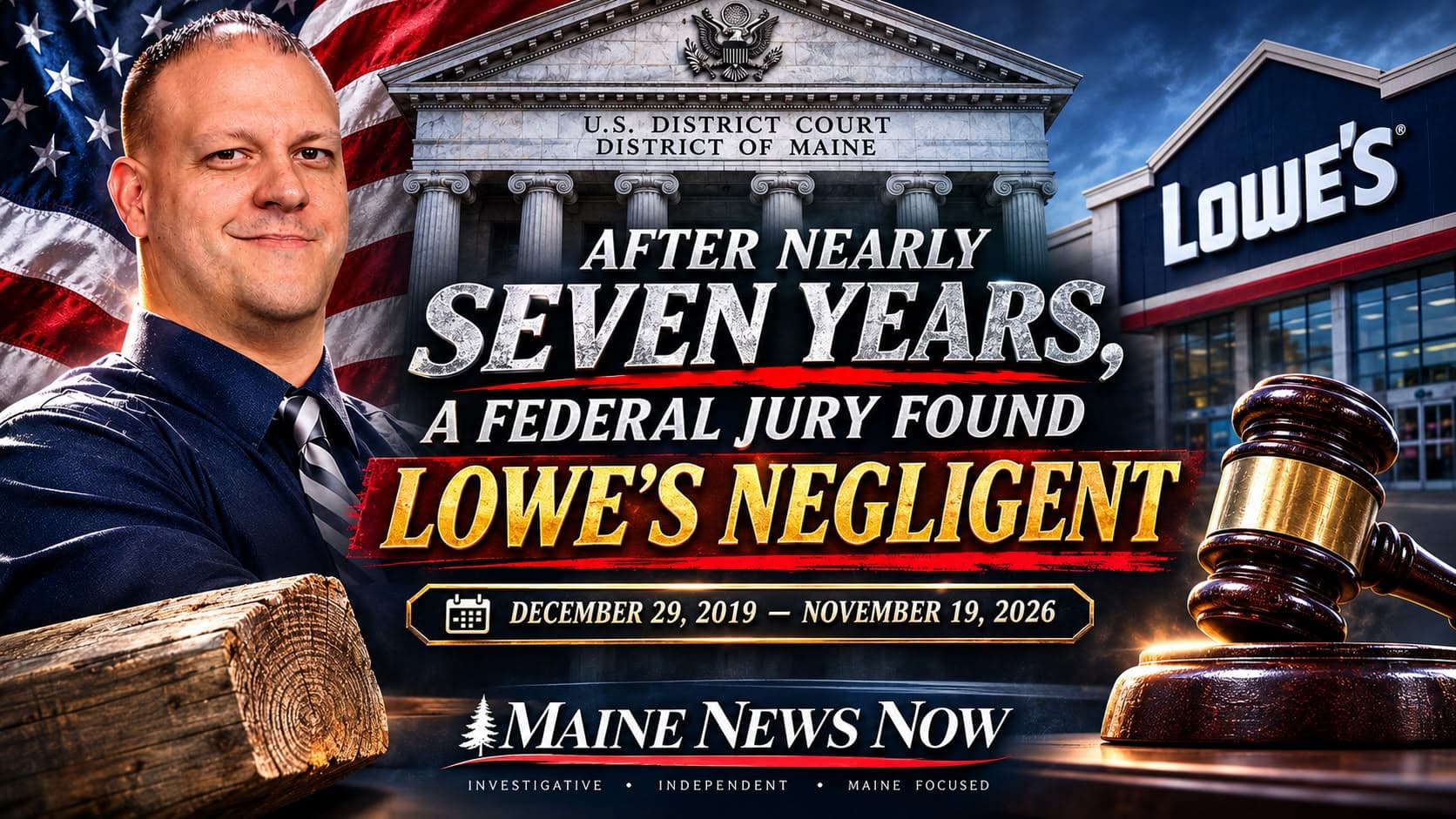
Maine businessman Nathan Reardon represented himself against a corporate defense attorney in federal court—and secured a negligence finding after a legal battle dating back to December 2019. But the fight over responsibility for his injuries is far from over.
BANGOR, MAINE — It began with an ordinary shopping trip to Lowe’s. Nearly seven years later, it ended with eight federal jurors being asked a straightforward question: Was Lowe’s negligent? Their answer was YES.
For Nathan Reardon, a Maine businessman, father of five, and automotive master technician who spent years pursuing the case, that answer represented a significant moment in a long and difficult legal fight against one of America’s largest home-improvement retailers.
The verdict came November 19, 2026, following a federal civil jury trial before U.S. District Judge John A. Woodcock Jr. in Maine. Reardon represented himself. Lowe’s was represented by attorney Brian Suslak, a corporate defense lawyer from New Hampshire.
The jury did not, however, find that Lowe’s negligence was a proximate cause of Reardon’s claimed injury. That second finding prevented an award of damages, and judgment was entered in Lowe’s favor on November 20. For Reardon, the negligence finding nevertheless represented an important acknowledgment of negligent conduct.
A Shopping Trip That Changed Everything
In December 2019, Reardon visited a Lowe’s store in the Bangor area. Among the materials he was purchasing was a pressure-treated four-by-four wooden fence post.
According to Reardon’s account, a female cashier lifted the post from his shopping cart while attempting to count or scan the merchandise. During that process, he says, the employee lost control of the lumber. As the post moved toward him, Reardon instinctively reached to catch or stop it. He maintains that it struck his right thumb and hand.
The incident was captured, at least in part, by store surveillance cameras. Reardon contended that the footage showed the employee handling the post and his immediate reaction, including pulling his hand away in apparent pain. Lowe’s disputed whether the footage established that the post actually struck his hand.
Reardon maintained that the resulting thumb problems affected his ability to perform the mechanical and property-maintenance work central to his livelihood.
From a Thumb Injury to Surgery
Reardon eventually sought medical treatment for persistent problems with his right thumb. His subsequent treatment included evaluations, physical therapy, and surgery performed by his treating hand surgeon, Dr. Branch.
Reardon argued that the injury and resulting limitations were connected to the Lowe’s incident. Lowe’s challenged that connection. Its defense relied in part on an opinion from Dr. Leslie, a Massachusetts physician who reviewed evidence but did not personally examine Reardon.
Reardon challenged the weight of an opinion from a doctor who had never examined his hand. The distinction between whether the employee acted negligently and whether that negligence legally caused the claimed medical condition ultimately became decisive.
A Legal Fight That Would Last Nearly Seven Years
The incident occurred in December 2019. The case was litigated for years before reaching a federal jury in November 2026. Throughout that period, Reardon maintained that Lowe’s should accept responsibility for its employee’s conduct. Lowe’s contested negligence, medical causation, and damages.
The litigation involved discovery, surveillance footage, medical evidence, expert opinions, pretrial motions, and witness disputes. Reardon ultimately entered the courtroom without an attorney. He prepared his arguments, questioned witnesses, presented evidence, responded to objections, and navigated federal procedural and evidentiary rules against experienced opposing counsel.
The Case Reached a Jury
An important pretrial development was the denial of Lowe’s motion for summary judgment. That decision allowed disputed factual issues to be considered at trial; it was not a ruling that Lowe’s was liable.
For Reardon, reaching a jury was meaningful. After years of litigation, he could present his account directly to citizens charged with deciding the facts.
The Battle Over the Missing Doctor
Reardon wanted his treating surgeon, Dr. Branch, to testify about his findings, treatment, and surgery. Questions arose concerning service of the subpoena and the required witness fee. On the eve of trial, the court quashed the subpoena, and the trial proceeded without the surgeon’s live testimony.
Although medical records were admitted, the absence of the treating physician became a point of contention. Reardon recalls that Suslak drew attention to the doctor’s absence during closing argument. Reardon says he responded in rebuttal that he had attempted to secure the doctor’s appearance but made a procedural mistake as a self-represented litigant. The precise wording should be checked against the official trial transcript.
Reardon has identified the missing-witness issue and the denial of additional time to address the subpoena as potential grounds for post-trial relief.
A Corporate Defense Meets a Federal Jury
The trial took place November 18–19, 2026. Reardon presented his account of the incident, the surveillance evidence, his medical history, and the effects he attributed to the injury. Lowe’s challenged whether the event caused the medical problems for which he sought compensation.
The jury was asked two separate questions. On negligence—whether Lowe’s failed to exercise legally required care—the jury answered YES. On proximate causation—whether that negligence legally caused an injury—the jury answered NO.
Both findings matter. The first was a finding against Lowe’s on negligence. The second meant Reardon did not establish the elements necessary to recover damages.
Why the Negligence Finding Matters
After nearly seven years of disputed allegations and litigation, a federal jury found that Lowe’s was negligent. The jury did not accept every element of Reardon’s case, and the judgment was entered in Lowe’s favor.
Still, the finding matters to Reardon. A self-represented plaintiff persuaded a federal jury to agree with him on the question of negligent conduct. It also illustrates an important distinction in civil law: a defendant can be found negligent without being held liable for the damages claimed in a particular lawsuit.
The Fight Is Not Necessarily Over
Reardon has identified potential post-trial issues involving the treating surgeon’s absence, the subpoena dispute, closing argument, and the treatment of medical causation evidence. Whether any challenge results in further proceedings remains uncertain.
The verdict stands as a finding of negligence by Lowe’s and a legal defeat for Reardon on the damages claim.
Seven Years, One Question, One Answer
The story extends beyond a wooden fence post, a checkout counter, and a disputed thumb injury. It raises questions about the cost of litigation, the resources of corporate defendants, the obstacles facing self-represented litigants, and the challenge of proving medical causation years after an incident.
Reardon did not secure everything he sought. But after almost seven years, he secured a clear answer to one question he had fought to put before a jury: Was Lowe’s negligent?
Eight federal jurors answered yes.
EDITOR’S DISCLOSURE: Nathan Reardon is associated with Maine News Now and is the plaintiff discussed in this article. This account draws on the litigation history and Reardon’s firsthand recollections. The separate jury findings on negligence and proximate causation are reported to distinguish the negligence determination from the final judgment.