More tribal leaders step into Maine’s fraught Senate race


Chief William Nicholas Sr., of the Passamaquoddy Tribe at Motahkomikuk (Indian Township), endorsed Republican Sen. Susan Collins on Friday. (Courtesy of William Nicholas Sr.)

Read all of our coverage of Maine's 2026 election or stay up to date with the latest developments through the Maine Political Report in your inbox or text messages from politics editor Kirby Wilson.
Amid a bruising and expensive knock-down-drag-out U.S. Senate race in Maine, Wabanaki leaders are stepping into the fray. It hasn’t been entirely smooth.
Chief William Nicholas Sr., of the Passamaquoddy Tribe at Motahkomikuk (Indian Township), told the Portland Press Herald on Friday that he’s endorsing the five-term Republican incumbent Susan Collins.
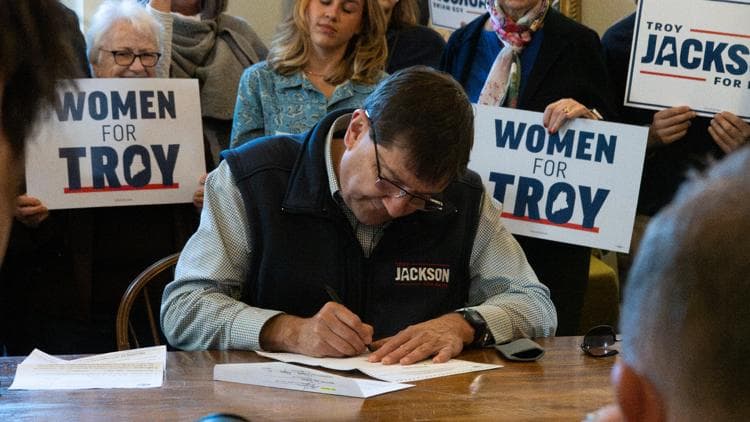
He joins Chief Amkuwiposohehs “Pos” Bassett of the Passamaquoddy Tribe at Sipayik (Pleasant Point), who announced his support for Collins last week in what seems to be a first for the senator. Democrat Troy Jackson, Collins’ opponent, picked up his first tribal endorsement in the Senate race from the Houlton Band of Maliseet Indians chief and tribal council on Monday.
Jackson was endorsed by the Mi’kmaq Nation when he ran in the Democratic primary for governor this spring.
Maliseet Chief Clarissa Sabattis noted Jackson’s long-standing commitment to tribal sovereignty in a statement announcing her endorsement.
“From championing clean drinking water initiatives to his role in creating the commission to reexamine the 1980 Maine Indian Claims Settlement Act, Troy has consistently proven that he listens to indigenous voices and stands with the Wabanaki people,” she said.
Advertisement
Nicholas praised Collins’ directing of federal dollars to his community and her responsiveness.
“Every time we’ve had an issue in our community and she’s been called upon, she’s personally stepped up,” Nicholas said.

Related
Jackson backs sovereignty, Collins delivers cash. Which matters to Wabanaki communities?
He rattled off a list of projects — 335 heat pumps, 70 hybrid hot water heaters, 230 doors and exterior and storm doors and at least 10 single-family homes — that Collins has helped fund. He was touched by the senator’s visit to the reservation this summer.
“It’s hard to turn away from an ally and a friend who has done so much for this community,” Nicholas said.
As both sides fire volleys of nasty accusations at one another, Nicholas felt compelled to cut through the noise.
“People are going to base their information on what they’re seeing,” he said. “But you know, every time somebody turns on a heat pump, somebody helped us with that.”
Advertisement
Collins said in a statement Friday afternoon that she was honored by the endorsement and looks forward to continuing to work with the tribe.
Although Collins has not championed tribal sovereignty in the way some Wabanaki leaders would hope, Nicholas is backing Democratic gubernatorial candidate Hannah Pingree to address the issue at the state level.
Nicholas was careful to state that he personally is endorsing Collins as tribal chief — but that he does not speak for the entire community, which remains divided.

Related
4 Wabanaki chiefs back Hannah Pingree in Maine governor’s race
His counterpart in Sipayik, Bassett, drew criticism when he alone penned an endorsement letter on behalf of the tribe.
After the Collins campaign celebrated what they billed as the endorsement of the Passamaquoddy Tribe at Pleasant Point, several tribal members questioned the chief’s authority to make a unilateral endorsement without consulting the tribal council.
“Absent direction by the tribal community or its governing body, the chief does not have the authority to speak for the Passamaquoddy Tribe at Sipayik,” tribal member Gail Dana, who narrowly lost the election for chief against Bassett last month, wrote in an opinion column in the Bangor Daily News.
Advertisement
Council member Adam Newell said he was blindsided by the announcement.
At a minimum, Newell said, Bassett should have consulted the council in advance. He voiced his objections to the chief directly and on Facebook, where he sought to distance himself from the divisive race.
“It’s a new thing for tribes to start doing it,” he said, warning “it’s a slippery slope for me.”
The campaign referred questions to Bassett, who did not respond to a request for comment.
Reuben M. Schafir is a Report for America corps member who writes about Indigenous and rural communities for the Portland Press Herald.
Copy the Story Link
Tagged: election 2026, senate 2026, Susan Collins, Troy Jackson, wabanaki nations

Reuben, a Bowdoin College graduate and former Press Herald intern, returned to our newsroom in July 2025 to cover Indigenous communities in Maine as part of a Report for America partnership. Reuben was. More by Reuben M. Schafir