
Meet Bob Dodd, the history enthusiast who’s recreating Cape Elizabeth in miniature


Bob Dodd was the Cape Elizabeth Historical Preservation Society president for five years. (Dana Richie/ Staff Writer)
CAPE ELIZABETH – Bob Dodd hovered over Pond Cove, the palm of his hand larger than town hall.
No, he’s not a giant.
He shrank down two town landmarks to make scale models of Fort Williams and Pond Cove circa 1930s, and his two masterpieces are now on display in the Cape Elizabeth Historical Preservation Society’s museum.
The former president of the society was awarded the 2026 Spirit of America Award by the Town Council last week in recognition of his contribution to the preservation of and education about local history.
During his five-year tenure as president, he said he’s most proud of the group’s efforts to make their work more visible to town residents. For instance, the group curated an exhibit in town hall for the 250th anniversary of the American Revolution that will be on display throughout the year, and they host monthly lectures.
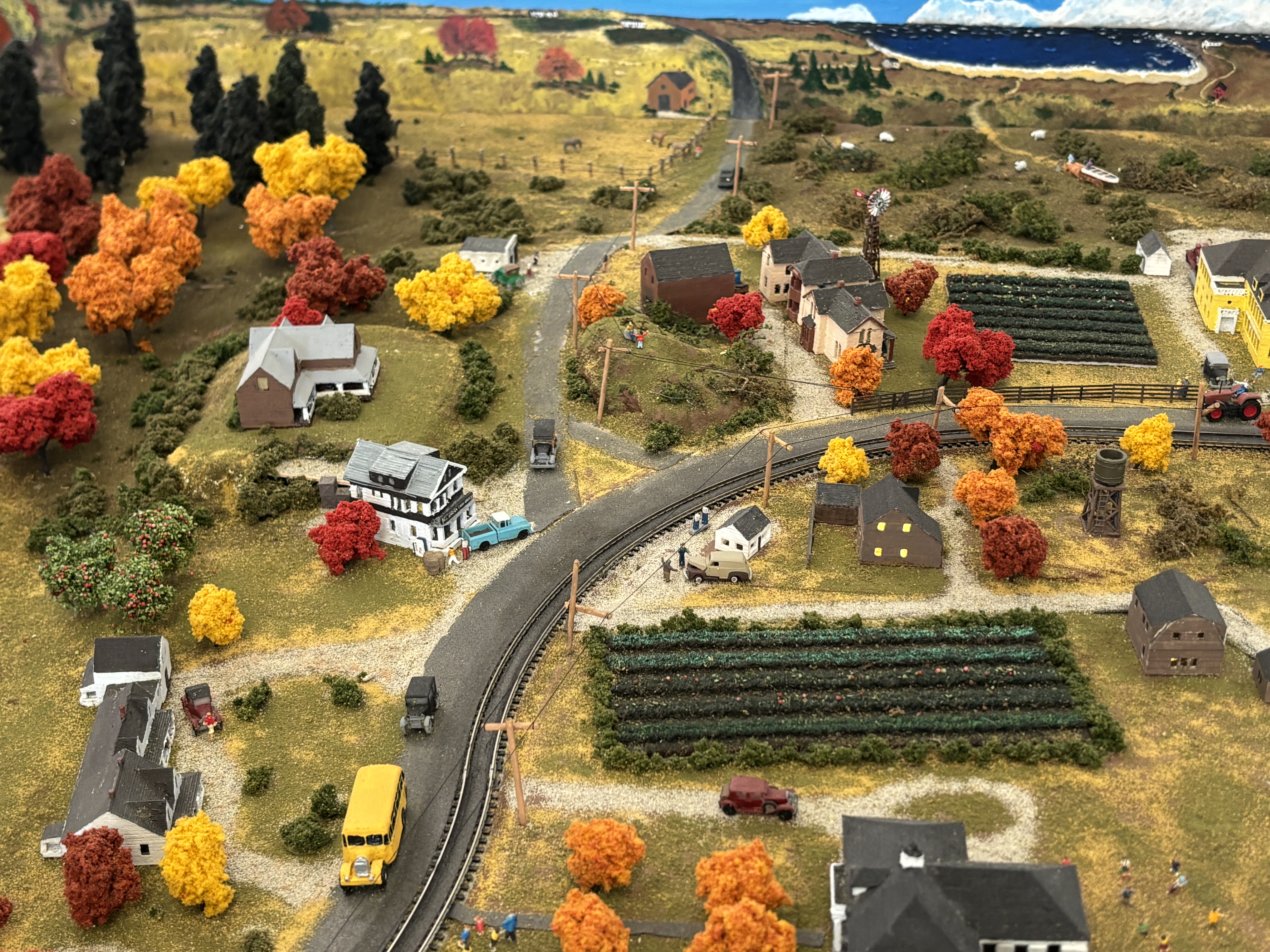
The scale model of Pond Cove circa 1930s that Bob Dodd made. (Dana Richie/ Staff Writer)
Dodd’s participation in the historical society was somewhat serendipitous.
Advertisement
While he was editor of the Cape Courier, he tracked down a Connie Murray, who founded the historical preservation society, seeking a more lenient photo release policy. Turns out, Murray was his high school history teacher.
“I only knew her as Dr. Murray,” he said. Dodd grew up in Lexington, Massachusetts, which he described as a “fairly historical place.” He remembered Murray talking about being from a seaside town, but he didn’t put it together until he was looking her in the eye.
Murray not only inspired Dodd’s lifelong love of stories, but she was also instrumental in the preservation of Cape Elizabeth’s records. Before she started the historical preservation society, the centuries-old documents were kept in boxes in the basement of Town Hall. She fought for them to be stored in a climate-controlled room in the old library before the society was temporarily moved to the police station while the library underwent renovations.
Dodd started helping out more with the society in 2018, after he retired. “I needed something to do with my time,” he said, and many of his colleagues from the Courier were also volunteering there. It seemed like a natural fit.
Dodd primarily photographed donated artifacts for the digital archives. He remembers dressing mannequins in 19th century garb in the hallways of the police station.
“The officers probably got a kick out of that,” he said.
Advertisement
Dodd also started making a scale model of Fort Williams in his free time, something to keep his hands and mind busy during the COVID-19 pandemic.
It was his way to get acclimated to a part of the town that he didn’t grow up remembering, like many of his friends. He was pleasantly surprised by how many places there were for people to gather together, like a bakery, theater and dance hall.
He drew upon maps and pictures for reference, and fell deep into online forums for model train enthusiasts. To find a railroad track to fit the necessary dimensions, he had to order pieces from a hobby shop in Japan.
Dodd completed his model of Fort Williams after 9 months, working about ten hours a week. Tiny cars drove to tiny houses, and tiny cannons were protected by tiny fortifications.
He still had the workshop space in his garage and a historical curiosity about the town after it split from South Portland in 1895. “Why not make another one?” he said.
Dodd collected stories from friends and neighbors who remembered what town center was like nearly 100 years ago, back when there were sprawling farms. The original high school, which is now part of the middle school, was under construction in this scale model. He painted each piece by hand.
Advertisement
“It must have been a shock,” he said. “All of a sudden, they had to create a new town structure. A rural village became the center.” Before the split, the municipal buildings and schools were located in the more densely populated northern part of town, the part that became South Portland.
The people living nearby had to adapt.
“I wanted to create little stories of what’s going on,” he said. A tractor pulls the fireman band outside of town hall (yes, they had a band in the 1930s). A sister convinces her brother to come down from Mount Misery, a mound at the corner of Shore and Ocean House roads that was eventually leveled. Farmers harvest from what was Hannaford land.
He’s already thinking about his next model, perhaps the Liberty Shipyards in South Portland, in collaboration with their historical society.
While he’s no longer the president, he’s still actively involved in the historical preservation society.
“I love when people come in and just start talking about growing up in Cape Elizabeth or South Portland,” he said. “To me, history is just that. Stories.”
Copy the Story Link
Tagged: Fort Williams Park, history

Dana Richie is a community reporter covering South Portland and Cape Elizabeth. Originally from Atlanta, she fell in love with the landscape and quirks of coastal New England while completing her undergraduate. More by Dana Richie