Maine’s first Senate election was steeped in political chaos

110 years ago, Mainers went to the polls, and for the first time in the state’s history, cast ballots for their next U.S. senator. They’d elect not one, but two representatives to the upper chamber in 1916.
In that tempest of a campaign, voters turned out in four separate statewide elections, dramatically expanding the democratic process. And just like this election season, the eyes of the nation were on Maine.
Prior to 1914, the role of picking senators fell solely on state legislatures. This changed with the passage of the 17th Amendment in 1913, which mandated the regular election of senators by popular democracy. (Which, of course, in Maine, like most of the country, meant just men.)
The first group of popularly chosen senators were elected in the 1914 midterms, with Mainers slated to cast their first ballots two years later in 1916.
The elections could hardly have come at a more pivotal time for the politics of the day.
Facing the backdrop of World War I, rising racial tensions, the height of the women’s suffrage movement and a rapidly evolving federal government, even observers at the time knew the 1916 elections would be a pivotal moment in American history. Just like today, Maine was a key bellwether.
Advertisement
Throwing out the old guard
Despite decades of dominance, the Maine Republican Party was dealt a significant electoral blow in 1910. Voters upended 60 years of precedent when they ousted incumbent Republican Gov. Bert M. Fernald in favor of Augusta Democrat Frederick W. Plaisted.

Sen. Charles F. Johnson (Library of Congress)
But more critical to national politics, Democrats were able to flip the state Legislature, giving them the power to pick Maine’s next U.S. senator.
The man they picked was Charles F. Johnson, a former mayor and state representative from Waterville.
“Keen and logical in debate, wise in council and astute in politics, he was looked upon as the Democratic leader in the House,” a Bangor Daily Commercial article said of Johnson after his election. “His speeches were among the best delivered at Augusta during those winters, and he never arose to speak without the respectful attention, not only of the members of his… party, but of his Republican political opponents as well.”
Republicans found their footing in 1912, taking back both the governorship and the Legislature, meaning they could pick their own candidate, former governor Edwin C. Burleigh, as the state’s next senator. Burleigh would be Maine’s last senator to be elected by the Legislature.
But just as it looked like Maine was ready to return to one-party rule, things got weird.
Advertisement
First, Republicans fumbled away the governorship.
A different dynamic
To say the electoral dynamics of the early 1900s were different from today’s would be a massive understatement.
Neither the Democratic or Republican parties had a claim to any major ideology. Left-right, progressive-conservative, liberal-nativist, both major parties made their plays for voters from across the wide political spectrum of early 20th-century America. U.S. President Woodrow Wilson’s nativist positions may have appealed to anti-immigrant fervor, but his policy of neutrality amid World War I through his first term also won over German and Irish immigrants wary of an alliance with Great Britain.
The Republican Party, which included members like the popular progressive President Theodore Roosevelt as well as socialist Rep. Fiorello La Guardia, also served as the political home to opponents of organized labor and the champions of unfettered commerce. The most prominent activists within the women’s suffrage movement often aligned with the GOP, and yet the western states that expanded the vote to women years before the 19th Amendment was passed were largely Democratic strongholds.
The contradicting coalitions created by alliances of incoherent ideologies were as fragile as the peace that shattered across the Atlantic Ocean two years earlier. That factional fraying is what allowed Wilson – facing reelection in 1916 – to ascend to the presidency in the first place.
In 1912, Teddy Roosevelt, nearly four years removed from his White House tenure, made the controversial decision to challenge his former vice president, then-President William Howard Taft, accusing his one-time political protege of abandoning the progressive movement. When Taft and the more moderate factions of the party successfully beat back the challenge, Roosevelt opted to form a new party dedicated to a more liberal vision of America. Roosevelt and his backers built the Progressive Party, widely known as the Bull Moose Party, in an effort to surge past the unpopularity of the Democrats and Republicans.
Advertisement
They failed.
In the end, the Progressives and Republicans split the vote, and Wilson and the Democrats coasted into office winning 435 electoral college votes, despite finishing with 100,000 fewer votes than the party’s nominee in 1908.
National politics affect Maine
Back in Maine, the same split would throw a wrench into the 1914 gubernatorial election.

Gov. Oakley C. Curtis (Library of Congress)
In the same year Wilson was elected president, William T. Haines and a united Republican Party at the state level successfully unseated Gov. Plaisted.
But two years later, that GOP unity wavered. In 1914, Maine Progressive Party candidate Halbert P. Gardner pulled nearly 13% of the vote in the governor’s race, much of that seemingly coming from Haines’ base of support, and paving the way for another Democrat, Oakley C. Curtis, to take power.
With Democrats riding high and Republicans limping forward, few could have predicted the political calamity on the horizon.
Advertisement
‘The curtain raiser’
Adding another layer of drama to 1916 was Maine’s unusual election timing. Until the late 1950s, Maine was one of only two states to hold its state elections (everything but the presidency) in September, two months before the rest of the country voted.
This led to heightened national attention and the perception of Maine results as a bellwether for the upcoming nationwide races. In the leadup to the Sept. 11 election, GOP presidential nominee Charles Evans Hughes visited Maine to campaign extensively with state Republicans, seeking to boost his own candidacy at the same time.
Teddy Roosevelt also traveled to Maine to campaign for Republicans as the elections neared, delivering a rousing speech at an event in Lewiston that the Daily Sun called the state’s “greatest ever staged” demonstration.

A political cartoon featured in the Lewiston Daily Sun depicting former President Teddy Roosevelt during his 1916 visit to Maine.
“Maine is our political forecaster,” the Boston Globe wrote in a September editorial. “The outcome in Maine is the curtain raiser for the big show two months hence.”
With Roosevelt back to supporting the GOP and Wilson’s popularity teetering, a reunited Republican Party smelled blood, and was ready to test its strength in northern New England.
But picking the right candidates wouldn’t be as simple as in the past.
Advertisement
Directly electing a senator wasn’t the only change for Maine voters that year. In 1916, the state held its first primary elections for federal and statewide races, abandoning the less democratic nominating process of party meetings and conventions.
The Democratic incumbents, Governor Curtis and Senator Johnson, faced no official opposition en route to their nominations, but a deep field of Republican candidates lined up for these top positions.
“Senatorial and gubernatorial candidates of Maine’s finest material,” in the words of a Daily Kennebec Journal headline, would draw tens of thousands to the polls in Maine’s first-ever statewide primary on June 20.
But just days before the primary, the political world was rocked by the sudden and unexpected passing of a Maine political mainstay.
A parade of primaries
Republican Sen. Burleigh died in Augusta after falling ill earlier in the afternoon. The cause of death was “acute indigestion,” according to an article in the Lewiston Daily Sun.
Respected by people in both parties, Burleigh’s death stunned the public.
Advertisement

An article announcing the death of Sen. Edwin Burleigh in the Lewiston Daily Sun.
But for Republicans, the tragedy also compounded the stakes for 1916. Burleigh had been the only statewide Republican left standing. He was a prominent presence in Maine politics for decades, and his was the only major race where the party expected to have the incumbency advantage. In the U.S. Senate, Burleigh’s death brought the GOP’s caucus down 39 members, matching their lowest count in decades.
To fill the seat, the state would need to hold a separate primary, since it was too soon to incorporate a special election into the June 20 race. So, a month after Maine’s first-ever statewide primary, it hosted its second-ever statewide primary.
Two days after Burleigh’s death, Maine Republicans picked the bulk of their ticket.
Former Maine Senate President Carl Milliken, of Pittsfield, handily won the primary for governor. Meanwhile, Frederick Hale, a former U.S. representative and member of a prominent political family in the Pine Tree State, came out on top in a tight three-way race with former-Gov. Bert Fernald and state Sen. Ira G. Hersey.
Finishing closely behind Hale, Fernald resurrected his campaign and entered the special race to replace Burleigh. He went on to comfortably win the July 24 primary, claiming the second Republican nomination for U.S. Senate.
Advertisement
On the Democratic side, Bowdoin College professor Kenneth C. Sills threw his hat in the ring to replace Burgleigh, with the party clearing the field for him like they did for their other statewide candidates.
Suffragists’ say
Despite being shut out by a repressive political system, women’s rights groups would make their mark on the 1916 elections.
Neither party had the inherent support of the feminist movement. But when, after securing the Republican presidential nomination, Hughes came out in support of a Constitutional amendment for women’s suffrage, the choice for advocates became clear.
Wilson and the Democrats claimed to support women voting, but insisted that it was an issue best left to the states. While suffrage groups worked to expand the vote in individual states, a Federal amendment had been the preferred path of the most prominent activist groups.
Two years earlier, a women’s suffrage amendment had been rejected in the Senate. Johnson, now seeking reelection, voted against it.
“We women in Maine are terribly behind the times,” author and activist Florence Brooks Whitehouse said in early 1916 during an event in Lewiston, the Daily Sun reported.
Advertisement

Florence Brooks Whitehouse. (Daily Kennebec Journal)
Whitehouse, an Augusta native who later moved to Portland, was the face of movement in Maine. In the runup to 1916, Whitehouse helped launch the state’s branch of the National Woman’s Party, a political organization at the suffrage movement’s radical vanguard that would be instrumental in winning passage of the 19th Amendment.
In 1916 Maine suffragists attended both parties’ state conventions, where they questioned candidates and pushed for their support. At the GOP convention in Portland, equal-suffrage supporters were so well-represented that they spilled over from their allotted convention space.
“Both morning and afternoon, the solid phalanx of women behind the suffrage banner, wearing suffrage colors, massed in the balcony opposite the stage,” Whitehouse wrote in a column featured in the Lewiston Evening Journal. “When the suffrage-plank in the platform was read, the women showed their appreciation in peals of applause.”
At the Democratic convention in Bangor, the party’s perceived “avowed antipathy” toward suffragists diminished the activists’ enthusiasm. But they were able to press candidates and officials on their enfranchisement position.
Sen. Johnson, who gave a “splendid speech” to the convention, according to Whitehouse, spoke with suffragists after the event, echoing the president’s position of supporting expanding the vote to women, but getting to it through action from the individual state governments.
After Hughes declared his support for a federal amendment, the National Woman’s Party concentrated its effort on defeating Wilson and the Democrats.
Advertisement
At the national level, their electoral effort to mobilize voters against the incumbent administration in equal-suffrage states ultimately failed, with Hughes losing all but one state where women had the ballot.
But in Maine, where a slate of Republican candidates far more receptive to the suffragists’ cause were on the verge of regaining power, the prospects were better.
‘A Republican landslide’
The Associated Press reported that in the final 24 hours of the Maine campaign, prominent speakers on both sides combined for 292 speeches in “every city and sizable town.”
On Election Day, returns weren’t coming in long before suspense evaporated and the Republican victory materialized.
Hale beat the incumbent Johnson by nearly 10,000 votes (or about 6.5%). In the race to replace the late Burleigh, Fernald outran Sills by more than 13,000 votes.
“Republicanism is triumphant in the state of Maine,” declared the front page of the Daily Kennebec Journal.
Advertisement
“It’s a Republican landslide,” echoed the Lewiston Evening Journal.
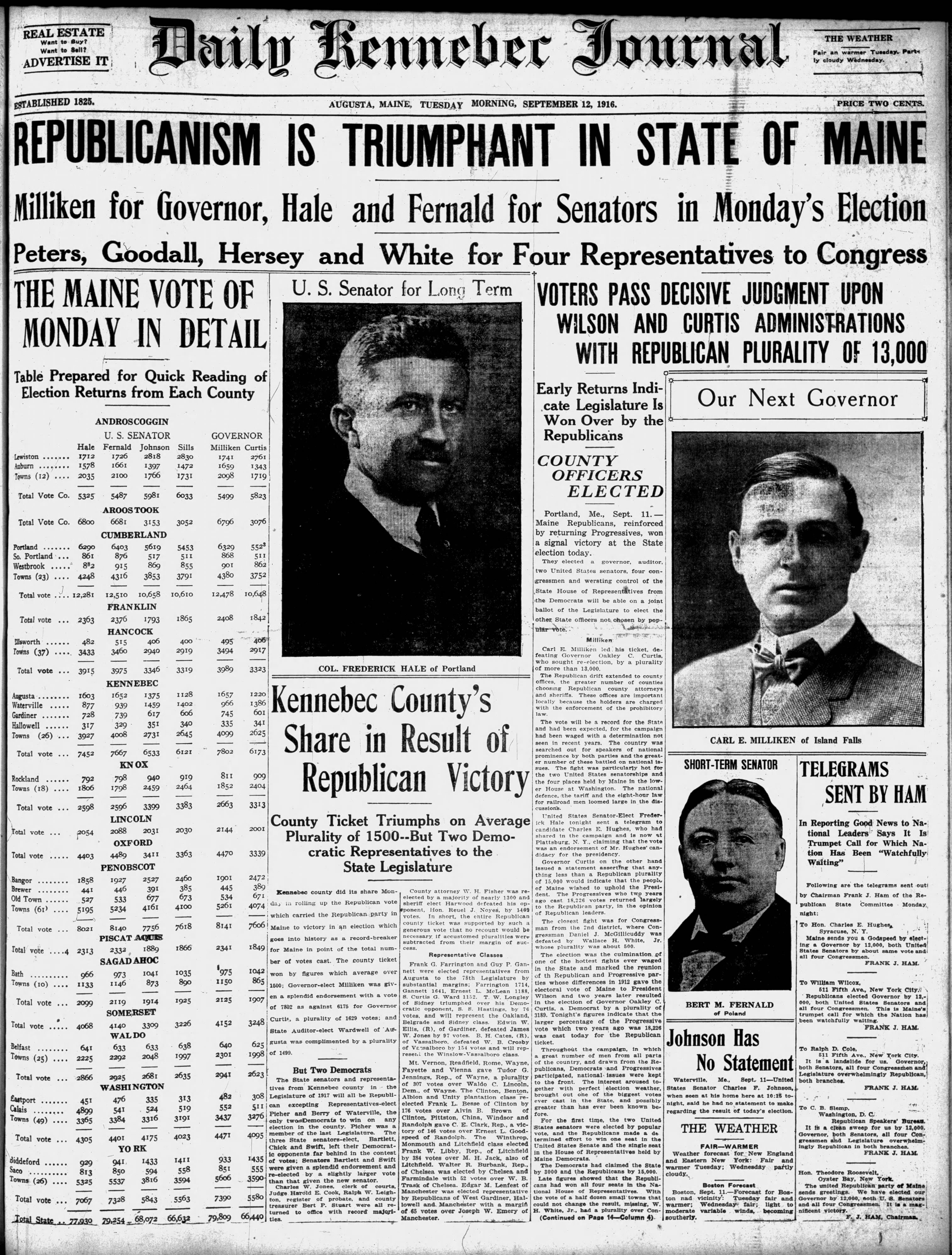
It was even worse down the ballot for Democrats. Incumbent Gov. Oakley Curtis lost to Republican Carl Milliken by a margin of over 9%. But Curtis was gracious in defeat.
“The best man won,” Curtis said, according to a story in the Lewiston Evening Journal, “and there are no bones broken.” He added that his party “got a good licking, and that’s all there is to it.”
Republicans swept four U.S. House races as well, including a flip of the 2nd District, which covered much of Androscoggin County and western Maine.
An article in the Lewiston Evening Journal summed up the scope of Democrats’ collapse in Maine: “In the election of Monday, which marked the end of one of the liveliest and most hotly contested campaigns in the state’s history, the Republicans elected their governor, two United States senators, four representatives to Congress, 28 out of the 31 members of the state Senate, and, probably, 112 members of the state House of Representatives.”
Looking at a wipeout, Democrats still sought to spin the results into their favor, claiming that, even in defeat, they had “materially reduced” the usually large Republican majority.
Advertisement
“The results of the election in Maine indicates a sweeping Democratic victory in November,” said Vance C. McCormick, Woodrow Wilson’s 1916 campaign manager and party chairman. “I have never claimed that we would win in Maine because I realized that to carry such a rock-ribbed Republican stronghold in a presidential year would be practically impossible.”
Republicans, naturally, said the sweep would reflect a victory for Charles Evans Hughes and the GOP. In October, Hersey told a group of Republican editorial editors and publishers that “the verdict of Maine will be the verdict of this nation,” the Kennebec Journal reported at the time.
But Maine was a bad bellwether.
Democrats rebound in November
Two months after Maine’s slate of state elections, voters returned to the polls to have their say in the presidential race. And while things appeared to be going Republicans’ way early, a closer look at Maine’s results showed an electorate dramatically shifting toward Wilson and the Democrats.
Turnout from September to November dropped by around 15,000 votes, and the GOP’s comfortable margins from earlier in the year was nearly halved, with a little over 5,000 ballots separating Hughes and Wilson.
Some missed the signs.
Advertisement
Doing their own “Dewey defeats Truman” 32 years earlier, the Portland Daily Press declared an erroneous result across their front page.

“Hughes elected president,” the headline read.
In reality, Wilson had squeaked by in one of America’s closest elections. If a couple thousand votes in California had gone the other way, Hughes would have become the 29th President of the United States.
However, it wasn’t all bad for all Republican supporters. Wilson eventually came around on suffrage, and by 1918 he was calling on Congress to pass a federal amendment. A vote that year came up just short, with Maine’s senators diverging: Fernald voting in favor, and Hale voting against.
Over the next year, Florence Brooks Whitehouse headed an effort to press Hale into supporting the amendment. Eventually, when it was clear which way the wind was blowing, Hale relented and joined the rest of the Maine delegation to pass the 19th Amendment to the United States Constitution. After calling a special session to ratify the amendment, Gov. Milliken signed it in the company of prominent Maine suffragists, including Whitehouse.
“Maine has been worthy of her best tradition today, and in a measure justified her motto by leading the second half of the ratification states,” Whitehouse said after the signing, according to an article in the Lewiston Evening Sun. “She has tipped the scales in favor of the enfranchisement of American women, and it is safe to predict all the states which have arranged for special sessions will hurry to be counted.”
Copy the Story Link