

Maine farmers want Hannaford to buy more local produce. What’s the holdup?

BRUNSWICK — This spring was actually the second time Seth Kroeck noticed empty carrot shelves in Hannaford produce sections.
Kroeck, an organic vegetable producer at Crystal Spring Farm in Brunswick, first spotted vacant slots back in 2022, shortly after he ended his own contract supplying organic carrots to the Maine-based chain.
Hannaford, he said, would not entertain bringing his produce back to fill those spots. Not if it included a discussion about how much the grocer paid him.
And this spring, when those same carrot shelves again sat empty because of California weather and supply-chain disruptions, other Maine farmers noticed, too.
The Maine Organic Farmers and Gardeners Association started a petition in March to pressure Hannaford, the state’s largest grocer with 68 stores here, to adopt a Maine-first produce sourcing policy. In April, the petition and its then-2,500 signatures accompanied a strongly worded letter from MOFGA to Hannaford. Now, more than 6,000 people have signed on.
“Maine grocers should look to Maine growers first and fill the gaps with products produced outside the region, not the other way around,” MOFGA’s letter said. “We hope you will invest in our farmers by offering fair prices and sustainable contracts.”
Advertisement
The farmers argue that, by choosing to primarily source from local producers, Hannaford can eliminate most of the supply chain and shore up produce stock, preventing sudden shortages and bolstering Maine’s agricultural economy. In particular, MOFGA said, carrots, onions and potatoes are ripe for local partnerships.
Hannaford Vice President of Category Management Norm Daigle said the supermarket brand has engaged in good faith with MOFGA and wants to grow the presence of local produce in its stores.
But farmers say sourcing from Maine first would require Hannaford to overhaul and reprioritize its sourcing system. And it could lead to some higher-priced stock on the shelves, while affordability is a top concern for both the company and its shoppers.
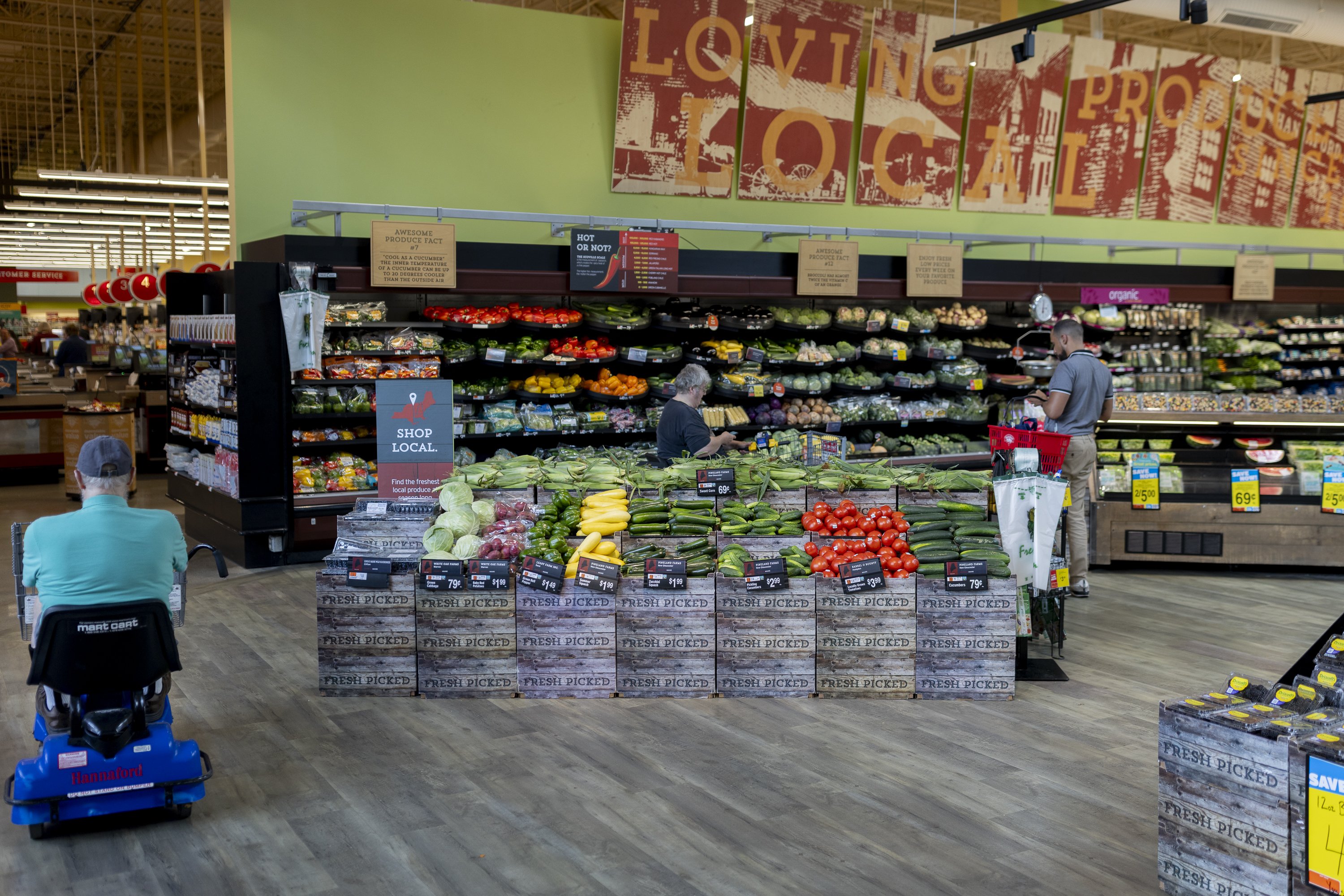
A local produce display at Hannaford in Westbrook on Wednesday, July 29, 2026. The Maine Organic Farmers and Gardeners Association is petitioning Hannaford to adopt a Maine-first produce sourcing policy. (Brianna Soukup/Staff Photographer)
Hannaford, for its part, promptly responded to MOFGA’s letter and agreed to talk out the policy. MOFGA has met three times with Hannaford leadership.
Whether Hannaford and MOFGA can bridge the gap remains to be seen.
“We haven’t gotten to the point where we don’t have to meet anymore,” said Kroeck, who’s been at the table as MOFGA’s treasurer and representing Crystal Spring Farm. “It is a slow process.”
Advertisement
FARM TO SHELF
Kroeck has been farming for almost 30 years now, 22 in Maine.
He grows all kinds of things on his 32-acre farm: wild blueberries, grains, Brussels sprouts, peppers and carrots. Crystal Spring Farm is certified to produce organic food — part of a club of just 7% of Maine’s farms.
Seven years ago, Kroeck reached a deal with Hannaford to get his bagged, branded carrots on shelves. His produce was in front of customers at Maine’s largest grocery store brand, in branded plastic bags, with “Maine” plastered bigger than any other word. That’s how you sell to Mainers, he said.
And then the COVID-19 pandemic hit. Kroeck’s own supply chain — the plastic he used to bag the carrots, the fertilizer he used to grow them and the fuel for his equipment — skyrocketed in price. He stopped selling to Hannaford in 2021, turning back to reliable farmers markets and the Belfast Co-Op.
There’s always a trade-off selling to large retailers, he said. In exchange for the simplicity of a one- or two-stop market, the farmer makes slightly less profit. The retailer wants a profit margin, too, and marks up what’s given to them by farmers.
Thirty Acre Farm in Bremen relies heavily on sales to Hannaford and Whole Foods through a distributor, co-owner and farmer Daniel Price said. Hannaford sales make up about 75% of the farm’s business.
Advertisement
But Hannaford’s produce section is not always a straightforward nut for vegetable farmers to crack, he said. Even he inherited Thirty Acre Farm’s already-existing relationship with the grocer when he joined years ago.
Individual store-based produce managers make most decisions about what vegetables come in, Price said. Those managers have substantial leeway over shelf space, especially on the local farm stands that often sit prominently in the front of stores. Scale and price can be immediate deal-breakers for those managers.
Price’s organic-certified farm sells fermented foods such as sauerkraut — a niche that he said helps get his products on shelves more easily than whole produce. Thirty Acre Farms’ $11.99 dill pickle kraut is one of the local products advertised in Hannaford’s free coupon booklets.
Price said he empathizes with vegetable farmers. He’s had his hard times selling his produce, too. Tricky weather, combined with having to “claw into markets,” he said, eventually drove him to sell his plot in western North Carolina years ago and return to Maine.
“You might be able to get into the farmers market in Hallowell, but are you going to make a living there?” Price said.
Megafarms like California’s Grimmway Farms, the most prolific carrot producer in the world and a Hannaford supplier, can offer more competitive pricing; Kroeck said they produce more carrots in a day than Crystal Spring Farm does in a year — about 40,000 pounds.
Advertisement
He just can’t compete if the primary consideration for Hannaford — and its customers — is price.

Related
Hannaford faces backlash over eggs, food prices
“We developed other markets, other local distributors, other local businesses that were willing to pay us the actual cost of the production of our produce, so that we could also then make a profit,” Kroeck said. “The pricing that Hannaford at that time was offering did not do that.”
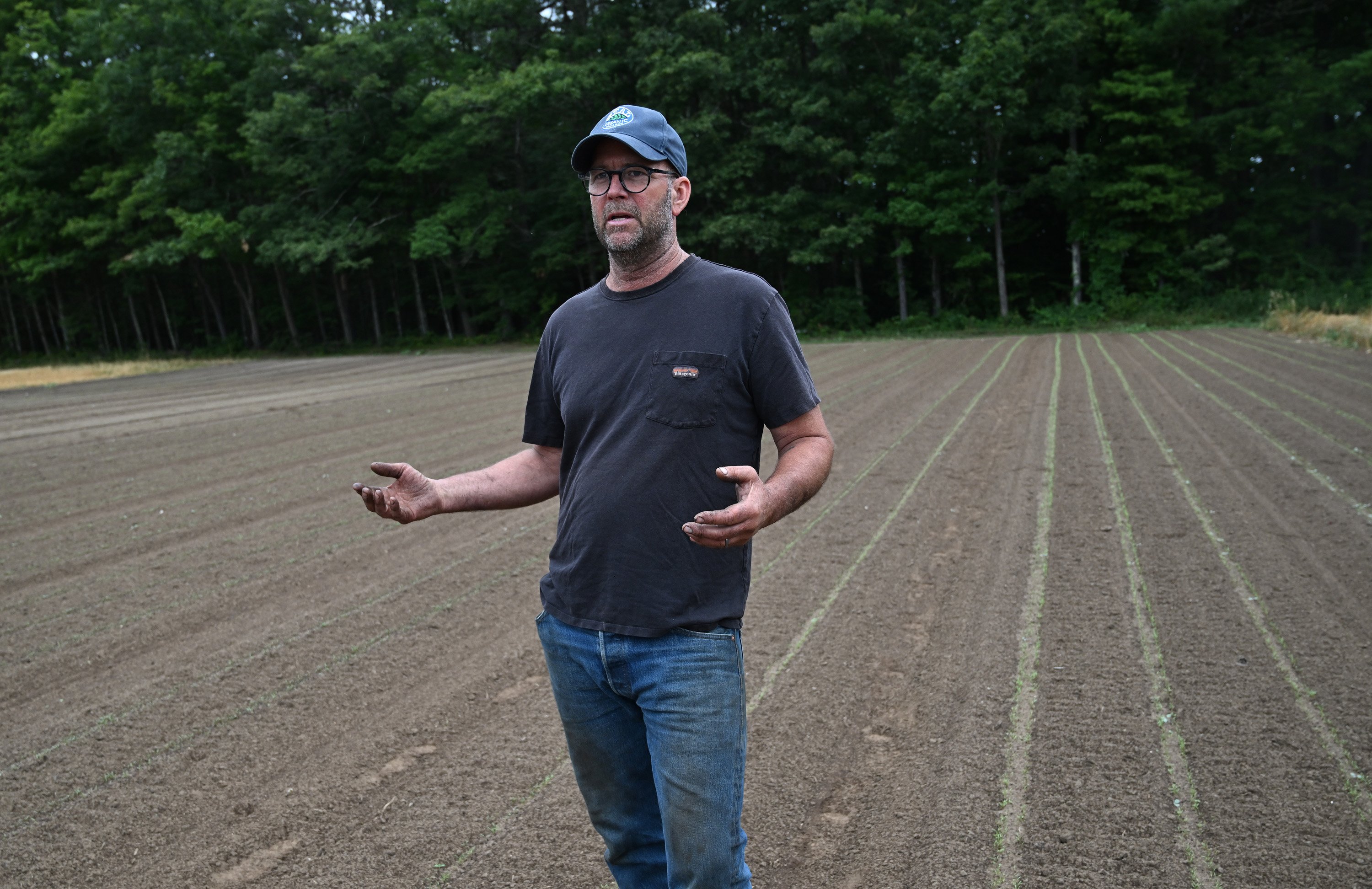
Seth Kroeck, at Crystal Spring Farm in Brunswick Wednesday. (Shawn Patrick Ouellette/Staff Photographer)
That’s why, in March, Kroeck was irked by the signs in Hannaford’s produce sections across New England apologizing for the carrot shelves, which sat empty of weeks when weather conditions in California disrupted supply. That wouldn’t have happened if Maine produce was Hannaford’s primary source, he said.
“These disruptions reveal the vulnerabilities of a global food market that prioritizes the lowest possible price over long-term reliability,” MOFGA Executive Director Sarah Alexander said in the letter to Hannaford executives.
If Hannaford prides itself on its “love local” slogan, Kroeck said, their shelves sometimes don’t show it.
THE AFFORDABILITY CONUNDRUM
In 2025, Hannaford sourced $40 million worth of produce from more than 70 Maine farms and suppliers.
Advertisement
Across the five states where the grocer operates — Maine, New Hampshire, Vermont, Massachusetts and New York — about 8,000 products are sourced from local producers. Maine, where Hannaford started, has the largest number of stores, about a third of the total.
Daigle, the vice president of category management, said individual stores don’t keep track of how much produce is local, compared to how much is grown out of state.
Customers immediately encounter farm stands and “love local” branding upon entering most Hannaford locations. That prominent shelf space is part of Hannaford’s above-and-beyond commitment to local produce, Daigle said.
Hannaford also uses local suppliers for many of its store-brand items: Its yellow potatoes are mostly sourced from Green Thumb Farms in Fryeburg, and its pizza ingredients are from Portland Pie Co.
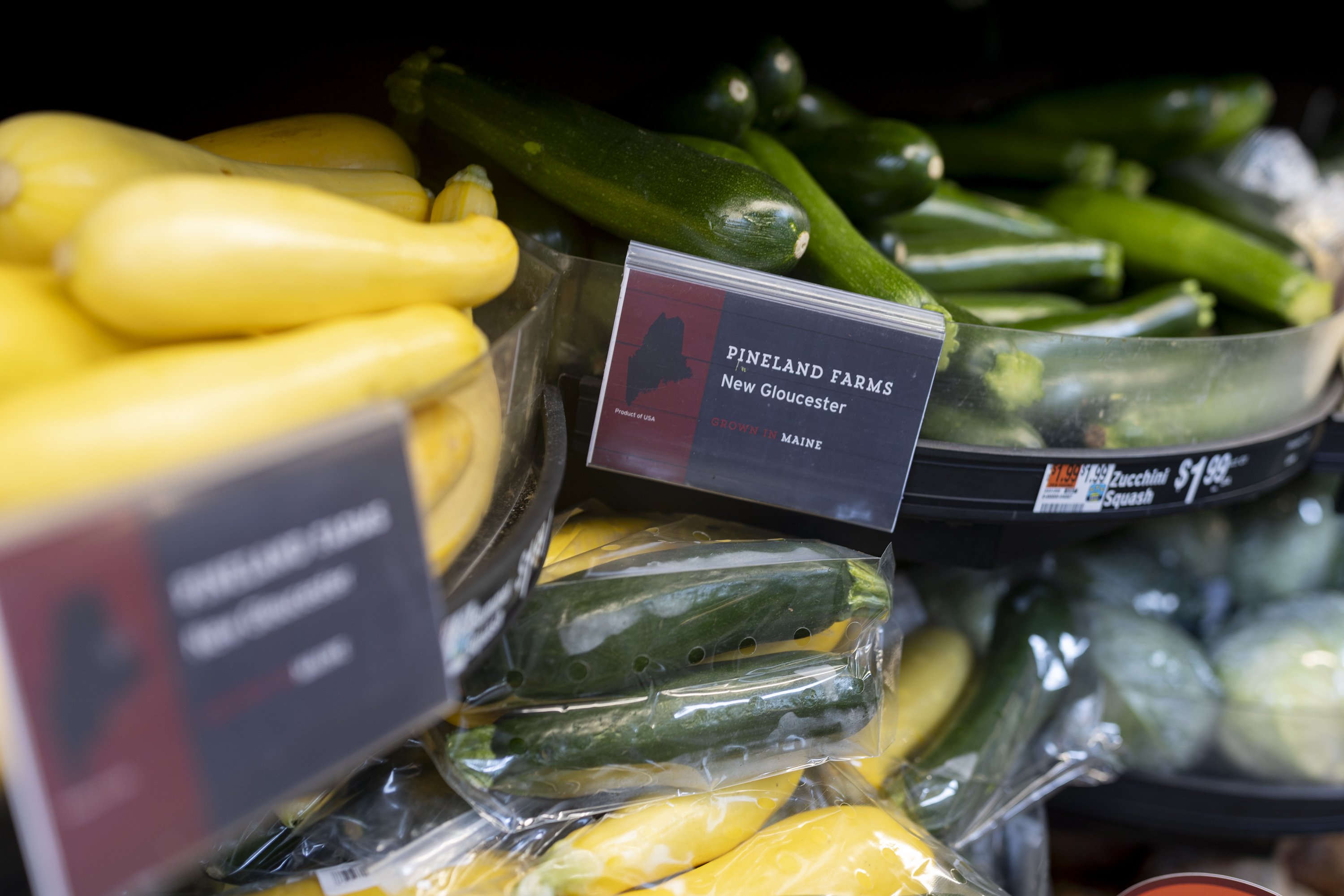
Produce from Pineland Farms at Hannaford in Westbrook on Wednesday, July 29, 2026. The Maine Organic Farmers and Gardeners Association is petitioning Hannaford to adopt a Maine-first produce sourcing policy. (Brianna Soukup/Staff Photographer)
The way products get onto shelves is complicated, Daigle said, and can vary from store to store and farmer to farmer. Some produce comes in through the back of the store, mostly from smaller producers, and some comes in through Hannaford’s distribution centers.
Some farmers need help, he said, to pass regulations and get on farm stands or shelves. Daigle has tough conversations with others about the competitiveness of their produce and whether that relationship will be mutually beneficial.
Advertisement
Some decide it’s “easier to just do their own farm stand,” he said.
Affordability looms over every consideration, and consumer research backs that up, he said.

Related
Report says Hannaford grocery prices are higher in low-income Maine communities
Grocery prices have jumped more than $200 per month for the average Maine family since January 2020, according to the Urban Institute’s American Affordability Tracker.
“Affordability is about as strong a need as it has ever been, so that plays a large role,” Daigle said. “With finite space, trying to meet a variety of customer needs, we’re looking at surety of supply, cost, labels, sustainability.”
STAYING IN MAINE
In its petition, MOFGA asks Hannaford for three specific changes: to engage in local contracts to provide long-term stability for local farmers, establish open dialogue with farmers on logistics and pay for the “true cost of local production.”
Hannaford’s store brand organic carrots come from Nature’s Promise, and they sell for about $1.50 per pound — about $1-2 less per pound in-store than Maine-sourced carrots would.
Advertisement
MOFGA Public Policy Organizer Bill Pluecker said discussions have also included the potential for a central location for farmers to drop off produce to Hannaford. That would help with cost, he said.
Many farmers have the ability to bag, brand and truck their produce across the state, but that work is time-consuming and expensive, especially for small-scale operations, Pluecker said. Distribution companies can serve as a good middle man, but can be expensive, too. Local products often end up being more expensive than those produced across the country but at a large scale.
“We understand that Hannaford needs us to be competitive on pricing, and when we have a single hub that we can deliver to with a relatively large volume, then we can begin to be competitive on price,” Pluecker said.
A deepened, extended commitment to local produce may mean Hannaford will pay more, both to Maine farmers — whose produce costs more per pound — and for distribution, but it’s an investment in Maine’s economy, Kroeck said.
Maine’s agricultural capacity — especially in potatoes, onions and carrots, the three crops MOFGA hopes to push Hannaford to buy locally — is relatively strong. Maine’s potato industry supported 6,500 jobs on 52,000 acres in 2024. Onions were grown on nearly 500 farms, mostly for fresh markets, in 2022, and carrots on more than 300 farms, including Kroeck’s.
“The fertilizer that’s used to grow that crop — that money is going to be spent in Maine,” he said. “The fuel that needs to run the equipment — that money is going to stay in Maine. The labor that helps us get those crops out of the field, get them washed, get them packaged, get them delivered — that money is going to stay in Maine.”
A real love of local, Kroeck said, supports Maine’s whole agriculture industry.
Hannaford choosing to support that, instead of buying the cheapest produce on the international market, means fewer empty carrot shelves and a more sustainable food supply, he said.
Talks between MOFGA and Hannaford are ongoing.
Copy the Story Link
Tagged: cost of living, food, hannaford, hannaford supermarkets, local food, Maine farmers, Maine Organic Farmers and Gardeners Association

Ethan reports on cost of living for the Portland Press Herald. Before he joined in mid-2026, he covered local news in Augusta and surrounding areas and ran a weekly newsletter for the Kennebec Journal. More by Ethan Horton