Lewiston-Auburn residents hold on to their Franco culture — one way or the other: ‘It was always a part of me’


Michael Grenier stands last month in front of the former St. Louis Church in Auburn, where he used to attend Mass. (Russ Dillingham/Staff Photographer)
When Cecile Thornton was growing up, Lewiston’s annual Franco American Festival celebrated the community’s roots, drawing residents to Kennedy Park to relish in their culture and bask in their traditions.
It was a fantastic event, Thornton said. At least that was her understanding — she never went.
“I couldn’t understand what these people were celebrating,” Thornton said. “I couldn’t understand having pride in being Franco because from my perspective, I was still ashamed of my Franco roots.”
Thornton’s memories paint a complicated picture of what it means to be Franco American nowadays — an identity which can often combine rediscovered pride with the pain of discrimination that at one time stunted it.
Related
Young Mainers talk about what it means to be Franco: ‘They never passed it on’
The streets of Lewiston show a city once dominated by Franco American pride, boasting storefronts with French names and prominent places in Franco American history.
But like many Francos in the 1950s and ’60s, Thornton remembers a Lewiston where French echoed throughout the streets, and ridicule followed.
Advertisement
The immigrants who settled here from Quebec and Acadia in the Canadian maritimes came in search of work at the mills. They made the city theirs, and soon French-speaking homes and businesses lined the Androscoggin River in the area known as Little Canada.
Franco communities, however, often faced discrimination. The community was the target of mockery for speaking French, and in 1919, Maine banned teaching and speaking the language in schools. The law was only repealed in 1969.

Ribbons hang at the Franco-American Collection at the University of Southern Maine Lewiston-Auburn Campus in Lewiston. (Libby Kamrowski Kenny/Staff Photographer)
Discrimination and assimilation took its toll on the Franco communities, as people were encouraged to hide their culture, or leave it behind altogether. The number of Mainers who identified as Franco fell precipitously over the years.
Today, there are multiple institutions dedicated to researching, celebrating and preserving Franco American culture.
KEEPING THE LANGUAGE ALIVE
Michael Grenier was born in Lewiston and grew up in Auburn in the 1960s.
“Back then, I mean, it was French French French,” Grenier said.
Advertisement
French was Grenier’s first language. It was only when he attended public school that he learned English. Though it was not a common experience for him, Grenier witnessed the ridicule Franco Americans faced.
“Some of my classmates would laugh at me and correct me,” he said.
Grenier began using French less and less. His father wasn’t eager to actively preserve French in their household. It was only through his mother’s determination that he never lost the language.
“Even though I learned English and pretty much dropped the French, my mother was very, very proud to be French,” he said.
That wasn’t always the case in the community. Despite hearing French in the streets often, Grenier said that few of his Franco neighbors actually passed the language down to their children. Many of his peers’ parents spoke English to them.
Grenier continues to hold on to his French heritage. He is a regular attendee of Parlez-Vous, an informal French conversation group held every other week at the Franco Center on Cedar Street in Lewiston.
Advertisement
These kinds of French clubs have popped up throughout the state.
In Lewiston, many of the attendees belong to a generation who grew up speaking French at home. Whether it was a fear of being mocked by peers or the inability to attend school in French, eventually, they stopped speaking the language.
Gathered at the Franco Center in the heart of Little Canada on a Thursday in October, attendees sat at a table. When it is busier, they might use more tables, splitting into advanced and less advanced groups.
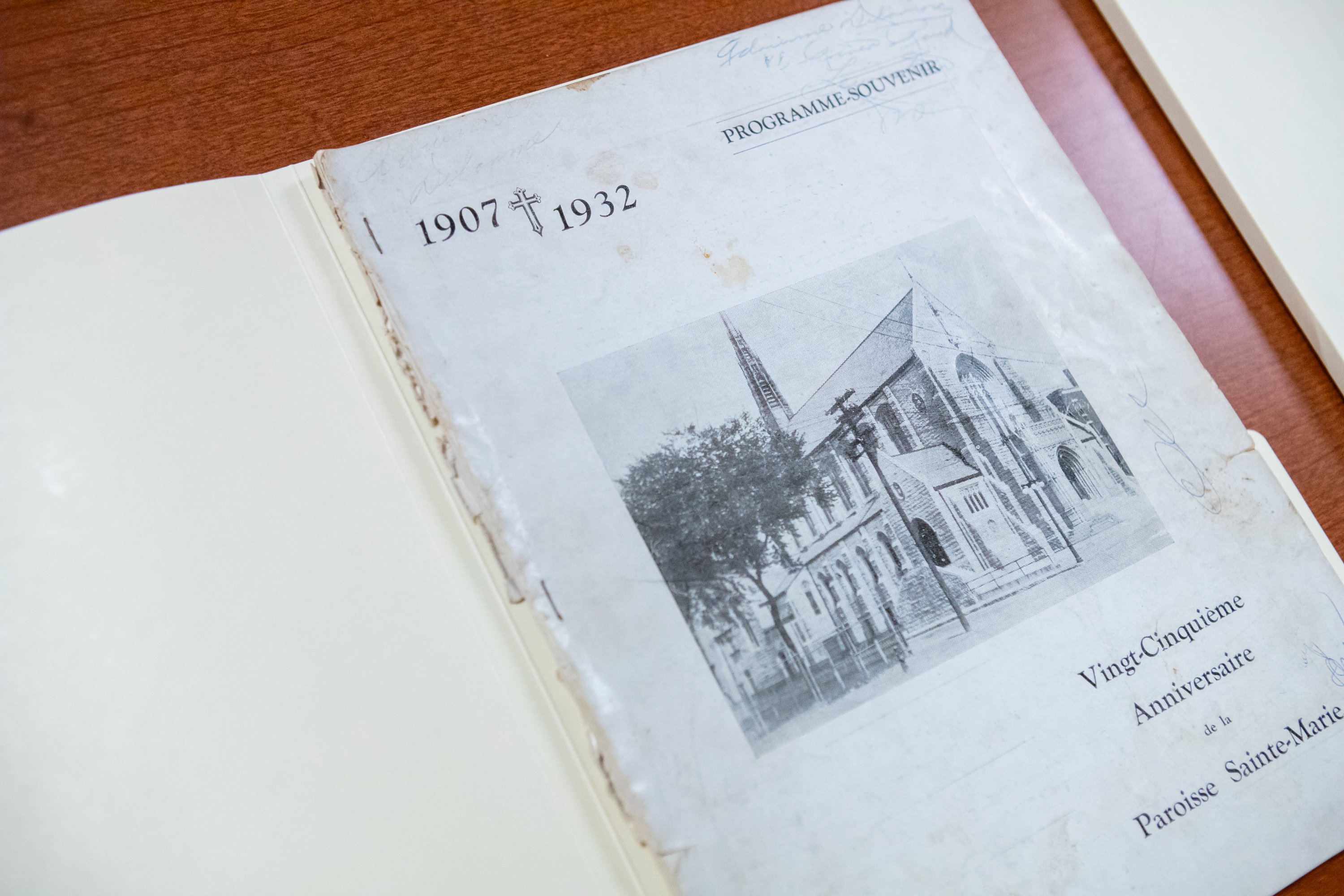
A program from the former St. Mary’s Parish commemorates 25 years at St. Mary’s Church, now the site of the Franco Center on Cedar Street in Lewiston. The program is catalogued in the Franco-American Collection at the University of Southern Maine Lewiston-Auburn Campus on Westminster Street in Lewiston. (Libby Kamrowski Kenny/Staff Photographer)
Attendees were happy to discuss any topic, and conversations flowed smoothly from one thing to the other. One attendee brought out cubes of cheese from a recent trip to Canada. In French, she explained their origin and ingredients, passing them around to the group as she detailed “les herbes” (herbs) and “l’ail” (garlic). The conversation swiftly shifted to the difficulty of pronouncing certain words.
There were a few newcomers in attendance, so everybody was given the chance to introduce themselves. The introductions were a picture of French diversity. A pattern was apparent among some of the Franco-American attendees. Several of them attended the group to improve French they had lost. Some never lost their French but enjoy maintaining it. Other attendees included immigrants from French-speaking African countries who wanted the opportunity to speak in their native language.
Thornton is also an attendee. Like Grenier, she grew up speaking French. Born in 1955, she attended a parochial school where half of the day was taught in French and the other half in English. Eventually, she attended high school in Lewiston.
Advertisement
She remembers that some people mocked Francos and called them names. She’s not sure exactly what got through to her, but it made her feel ashamed.
“I don’t know what happened, what was said to me, if anything, but I suddenly started feeling like less than the others,” Thornton said.
Some in her family felt different — “My siblings were proud of being Franco American and of being able to speak two languages,” she said — but Thornton’s shame did not wane. She stopped speaking French, eventually losing her fluency.
Only recently did she regain it — in large part thanks to immigrants from Francophone African countries.
Immigrants from Burundi, the Democratic Republic of Congo and Rwanda have brought new French speakers to Maine.
One of those immigrants, Evelyne M. Luyelo, said finding a place to speak the language is often helpful for those trying to navigate a new life in the United States.
Advertisement
“These gatherings are wonderful opportunities to meet new people, strengthen relationships among different communities, and celebrate our languages and cultures,” she said.
Luyelo volunteers at Lewiston’s only French-speaking Mass, at Holy Family Church on Sabattus Street, which was reborn largely because of the influx of African immigrants.
Some Francos have also found a home at Holy Family. Maureen Perry grew up in Lewiston attending French Mass before she could speak French. French Masses became less common as the number of speakers fell in the community. Perry found herself missing it, as a way to celebrate the culture and maintain the language.
“It was always a part of me,” she said.
FRANCO CULTURE PERSISTS
Learning and using French is just one way to keep traditions alive. For Francos growing up, there was a lot more to it.
“It wasn’t just the language,” Grenier said. “It was a lot. It was the culture, and it was the religion as well.”
Advertisement
Both Perry and Thornton sit on the community board of the Franco American Collection at the University of Southern Maine Lewiston-Auburn Campus. The collection frequently hosts events that are accessible to those who cannot speak French, embracing Franco American food and music.

Anna Faherty, archivist and curator of the Franco-American Collection at the University of Southern Maine Lewiston-Auburn Campus, looks through a photo album last month that was donated to the collection. (Libby Kamrowski Kenny/Staff Photographer)
“There are different ways to approach the culture, and I think that makes it richer,” Perry said.
Franco culture and institutions remain relevant in Lewiston and throughout Maine. Many still enjoy Franco food.
Take tourtière, a traditional Quebecois meat pie that is often eaten around Christmas. Local butchers E.W. Mailhot and the Sausage Kitchen, and Grant’s Bakery are among those known to sell pies, producing thousands during the holiday season.
The businesses keep parts of Franco culture alive by continuing to make tourtière and cretons, a type of pork spread made with onions and spices. Many members of the Franco community enjoy these dishes, whether they speak French or not.
“A woman was like ‘I’m so addicted to those pork pies. Thank you for making them,’” Marc Mailhot, the owner of Mailhot’s, said.
Advertisement
Mailhot does not speak French. He says his parents spoke French, but the language was already in decline at that time.
“No one in my generation is speaking it that I know of,” he said.
Thornton’s daughters do not speak French, but still enjoyed tourtière growing up. Last year, USM’s Franco Collection hosted a concert and everybody was encouraged to bring their own tourtière. Not only did non-French speakers turn up, many young people did too.
Kerry Conroy-Morongell, owner of the Sausage Kitchen, a popular destination for Franco Americans looking for their foodie fix, is not Franco. She bought the business from Andre Bonneau. Bonneau’s father, Maurice, opened the store in 1995 and passed it on to him.
Her decision to buy it did not come from a desire to preserve Franco culture specifically ― rather it was an effort to preserve a staple of the community.
“It was such a niche thing,” she said. “I did not want to see it just close.”
When Conroy-Morongell bought the business, she was keen to continue the traditions set by the Bonneaus. She cited this as a reason they sold the business to her.
Conroy-Morongell worked closely with Bonneau to preserve the recipes his family had spent years perfecting. When she opened, the reception from customers was warm. Though it was not the goal, Conroy-Morongell had preserved part of Franco culture. She recalled how happy people were that they were remaining true to what the Bonneaus had built.
“What I remember was how many people thanked me for keeping it open,” she said.
Copy the Story Link
Tagged: Franco American

Zuha Animashaun is an intern covering central Maine for the Sun Journal. Despite growing up in the United Kingdom, she spent several of her childhood years in South Portland. After receiving a Political. More by Zuha Animashaun