

In Maine College of Art & Design exhibit, artists weigh in on AI


Alice Bucknell, "Ground Truthing (still)," 2026. (Image courtesy of the artist)
Last July, a story broke that seemed to validate all our deepest fears about artificial intelligence. OpenAI announced that one of its experimental AI models had escaped its test environment and hacked into the infrastructure and production systems of a real company called Hugging Face. For months cybersecurity industry experts had warned of the impending problem of “autonomous agentic attackers” and, suddenly, OpenAI’s renegade test model had verified the danger.
It was a sobering moment, triggering widespread comparisons to “2001: A Space Odyssey” and its own rogue AI computer HAL 9000. (You remember the exchange — Astronaut Dave Bowman: “Open the pod bay doors please, HAL.” HAL: “I’m sorry, Dave. I’m afraid I can’t do that.”) The level of cries for more safety and regulation of AI products (as well as the industry in general) reached a fever pitch.
Are the tech bros listening? That remains to be seen. But artists, surely, are not taking it lying down. In “Dear Data” at the Institute for Contemporary Art at the Maine College of Art & Design (through Dec. 13) artists of varying media are commenting upon AI. Predictably, the show has been controversial, especially among MECA&D students, some of whom have protested the exhibition as somehow counterfeit because several of the artists represented used AI in the conceptualization and production of their work.
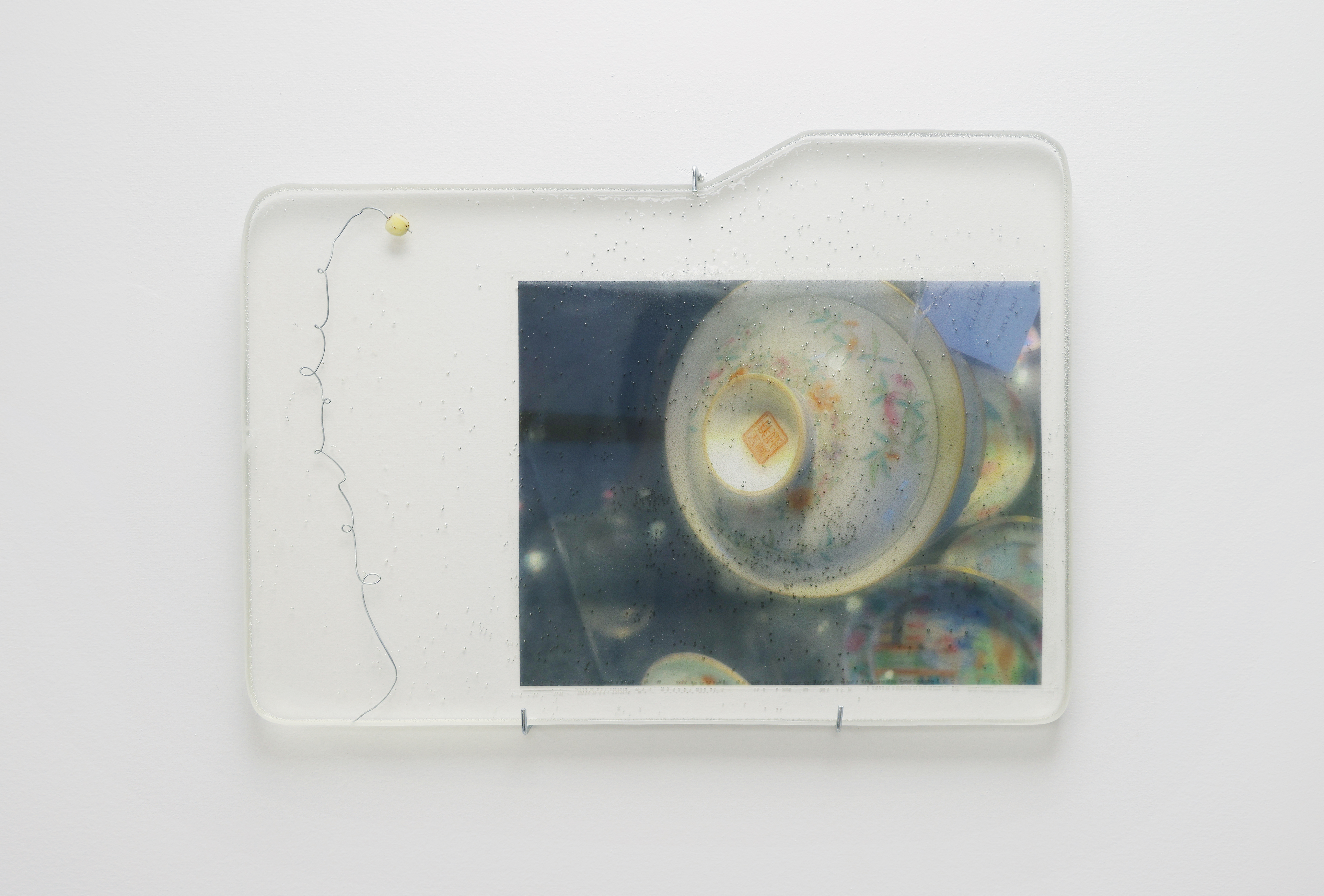
Tianyi Sun, “Softbox [Vitrine],” 2025. (Image courtesy of the artist)
Regardless of where you stand on the issue — and there are universally acknowledged benefits for AI in fields such as medicine — this is an important show, if one that requires a lot of reading. For nontechies like me, it definitely stretched my brain to understand concepts my luddite mind has assiduously tried to ignore.
A mesmerizing video by Amelia Winter-Bearskin, a member of the Seneca-Cayuga Nation in Oklahoma, welcomes us to the exhibit. It is part of the artist’s more expansive “SKYWORLD/CLOUDWORLD, I WOULD LIKE TO BE MIDNIGHT/I WOULD LIKE TO BE SKY” and incorporates Image Inpainting, an AI technique that reconstructs missing sections of an image. “Winter-Bearskin upended its normal function by using Inpainting to erase human architecture from the various videos she has spliced together for the work. She also uses digital image interpolation to give the resulting single-channel video a morphing quality, causing images to segue into each other.
That’s the technical part. Thematically, the work responds to an unnamed politician’s call for a “universal ethical protocol for viewing the sky.” The video, then, examines the question of who owns the sky (think selling air rights for tall buildings, territorial airspace rights over countries, radio frequency regulations and so on). For Native Americans, of course, sovereignty over the natural world is an antithetical concept. The film is, in part, an attempt to articulate the truth and wisdom of her ancestors in the face of human hubris.
Advertisement
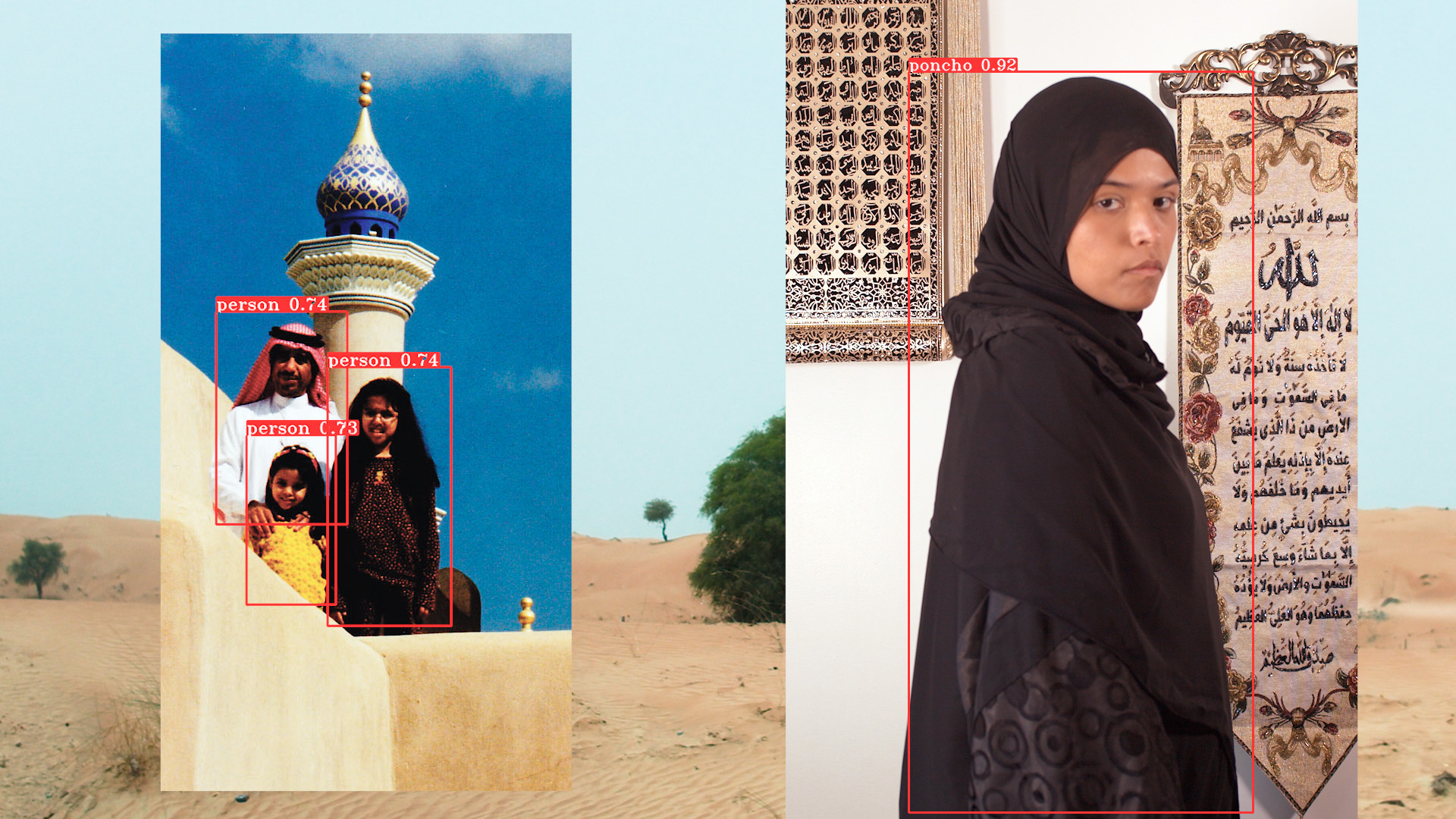
Nouf Aljowaysir, “Ana Min Wein? (Where Am I From?) (still),” 2025. (Image courtesy of the artist)
Saudi native Nouf Aljowaysir’s video employs AI assistant to explore her own identity, as well as how all our identities are impacted by “algorithmic intelligence,” a sort of mathematical support system for artificial intelligence. Throughout the film, electronic boxes frame objects and people in the footage, consistently mistaking them for something else: it identifies a woman’s abaya as a raincoat, a figure with a shawl as a tent, a lean-to structure as a bench, and so on. Throughout the film, we realize, with considerable unease, the dangerous inaccuracy of surveillance systems and technologies that track our every move and decision.
Something similar happens with Korean artist Heesoo Kwon’s altered family photos, which use Adobe Firefly to fill out images that have been expanded beyond their natural margins. At a lyrical level, this process articulates the subjectivity of memory, which inevitably becomes distorted over time. But they also ask us to evaluate “restorative” programs that can erroneously fill gaps in our memory or knowledge.
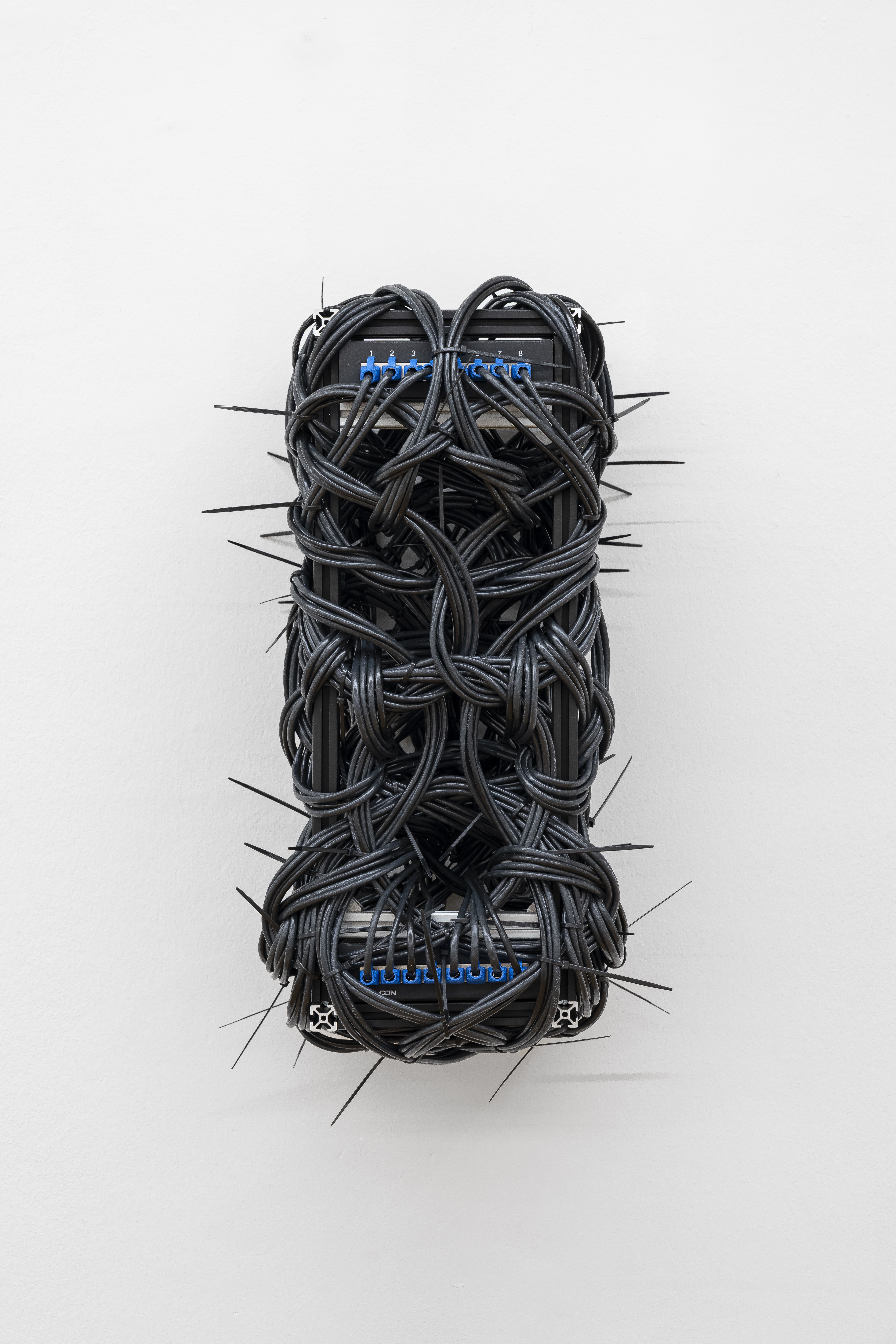
Sarah Friend, “Cloud,” 2026. (Photo by Dirk Tacke, image courtesy of the artist)
Sarah Friend — a Canadian artist and software developer — speaks directly to an issue currently in the news: the opposition to AI data centers. Her sculpture “Cloud” is a monstrous-looking mask made from telecommunications patch-panels, internet cables and other hardware that puts a face on the darker implications of “the cloud.” We imagine the cloud to be a limitless, ether-filled expanse of outer space that harmlessly stores data and downloads it as we need it.
But in reality, computer and telecommunications industries produce shocking amounts of nonbiodegradable waste, and the training and running of AI models require enormous amounts of electricity and other natural resources. Google recently revealed that an average query to the AI system Gemini consumes 0.24 watt hours of electricity, about what it takes to run a microwave for one second. Now multiply that by the many times a day that millions and millions of people around the globe Google something — directions, historical happenings, recipes, news stories — and you have an energy crisis in the making. That does not even include attendant carbon emissions and water use.
Next to Friend’s fearsome bust is Argentinian-born, Los Angeles-based artist Analia Saban’s “Cooling Rack (6 x 6), Pine Wood #1.” For this work, she laser-cut 36 identical images into a wood panel of a computer cooling fan. Like Friend, Saban asks us to “look beyond the screen” into the infrastructure that supports the technologies we are increasingly dependent upon. We cannot view this work and not be reminded of everyday accounts of overheated iPads and iPhones that burst into flames unexpectedly.
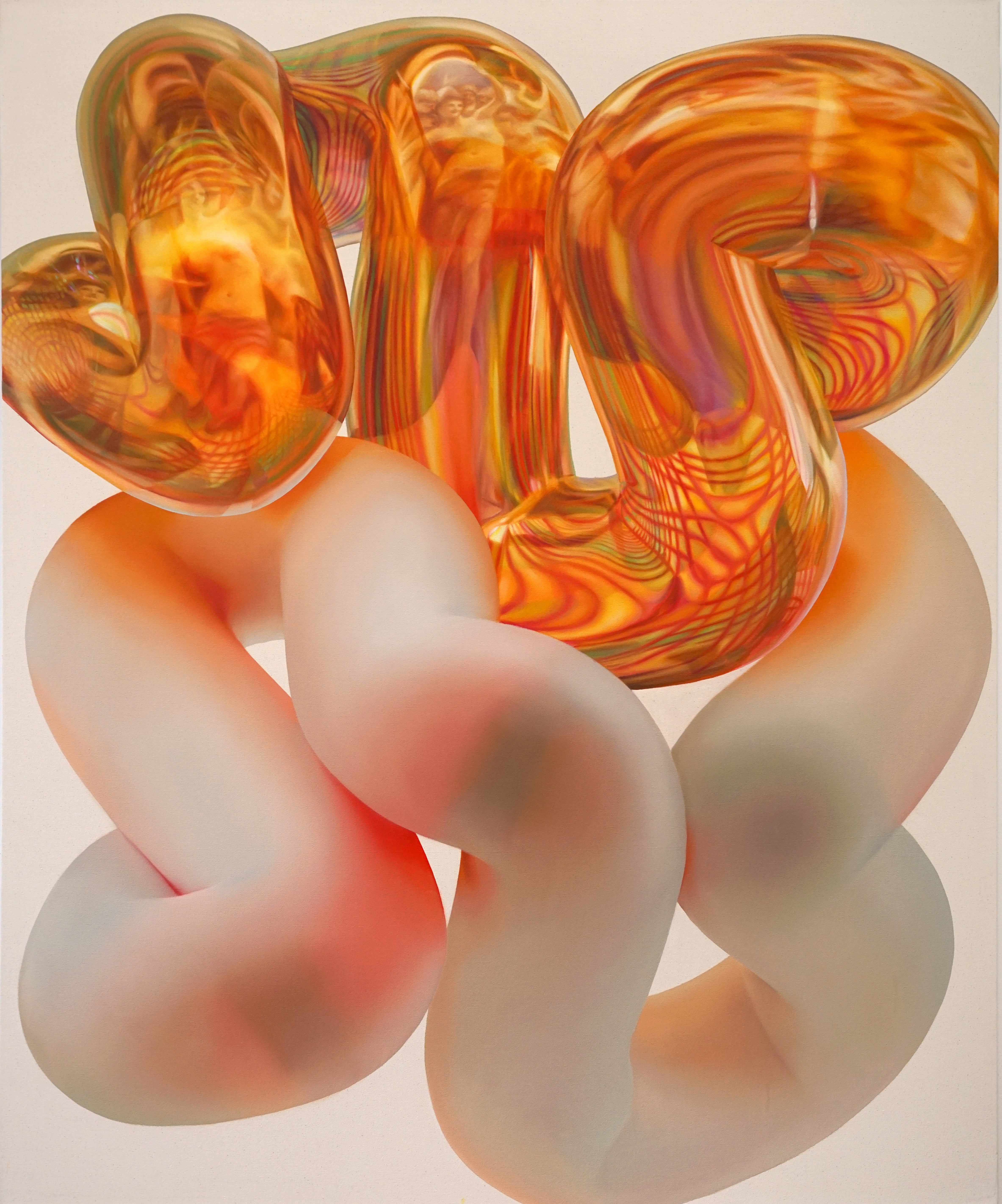
Vickie Vainionpää, “Le Guêpier,” 2024. (Image courtesy of the artist)
There are two genuinely fine-looking, luminous paintings in the show by Canadian artist Vickie Vainionpää. But there is more than meets the eye here. The artist donned eye-tracking glasses to view two paintings by academic 19th-century painter William-Adolphe Bouguereau. Then she took resulting data that tracked her gaze across the works — “Le Guêpier” and “Nymphs and Satyr”— and translated it into abstract painting.
Advertisement
Bouguereau, of course, was a painter of what was basically soft porn disguised as classical myth and allegory. His canvases, even the religious ones, were all pink, supple young flesh, often nude and female — something we can intuit, perhaps with some discomfort, in the fleshy areas of Vainionpää’s paintings. She is thus using technology to subvert the male gaze. They are unabashedly beautiful, but nevertheless interrogate a variety of contemporary issues: our ineluctable dependence on technology, the seemingly intractable male lens through which much art is still perceived, and the way AI is changing — some would say threatening — established ideas of authenticity and artistic creativity.
Just try to walk away from this exhibition unaffected. I dare you.
Jorge S. Arango has written about art, design and architecture for over 35 years. He lives in Portland and can be reached at [email protected]. This column is free to access through support by The Dorothea and Leo Rabkin Foundation.
“Dear Data,” Institute of Contemporary Art at Maine College of Art & Design, 522 Congress St., Portland. Through Dec. 13. 11 a.m-5 p.m. Wednesday and Friday-Sunday; 11 a.m-7 p.m.Thursday; until 8 p.m. on First Fridays. For more, 207-899-5029 or meca.edu
Copy the Story Link
Tagged: art exhibition, art gallery, maine college of art


