

How horse riding heals at this Buxton farm


Hearts & Horses Riding Center instructor Karen Rice helps E Flaherty ride backward on the therapeutic horse Blaze. (Madeleine Kaptein/Staff Writer)
Cara Flaherty and her wife, Chrissy Flaherty, tried to put their 2-year-old foster daughter, E Flaherty, into a range of sports, from soccer to swimming to gymnastics, in hopes of shaking up her therapy-dense schedule. But her struggles with sensory issues and primitive reflexes due to early abuse prevented her from staying calm during most recreational activities.
That was, until they put her on a horse.
At Hearts & Horses Therapeutic Riding Center in Buxton, patients with physical, emotional, cognitive and developmental challenges enroll in therapeutic programs to ride or spend time with horses. The treatment, which is offered by at least 10 horse farms across southern Maine, helps in ways that other therapies and activities often don’t.
For E, who has frequent meltdowns and night terrors, having spent just half an hour every week for two months on one of the farms’ 12 therapeutic horses, Blaze, has been transformative, Cara and Chrissy say.
“She tends to be very chaotic on the ground, and then you get her up there and it’s like a completely different kid,” Cara said.
E is among the farm’s youngest riders, its oldest being an 83-year-old stroke patient. Other patients have conditions from autism to brain trauma to cerebral palsy. Therapeutic riding is effective for different reasons depending on the rider, but broadly it works because of the rhythmic movement the horse provides as it walks. It’s also about the emotional connection the rider might form with the horse, giving them a sense of trust and stability.
Advertisement
At a lesson in late June, instructor Karen Rice, who is also an occupational therapist, helped E mount Blaze from a platform in the barn. With Cara and Chrissy trailing behind, they set off onto the farm’s trails.
Following Rice’s bubbly, conversational guidance, E raised her hands in the air, put her hands on her hips, and counted to 10. She sat sideways, pivoted to lay down on her stomach and faced Blaze’s rear.
“Being on her belly kind of just helps reset her nervous system,” Rice said.
Pressing her hands on the horse’s rear and feeling his steady movement assists E with her own motor control and alleviates some of the excessive drooling that comes with her speech issues, Cara added.
Like Rice, most of the instructors at Hearts & Horses are self-proclaimed “horse girls” who also lead careers working with people with disabilities. Allie Hafford, for example, is a full-time special education teacher, and Gabrielle Nelson is an American sign language interpreter.
From a speaker, Rice played songs like “Chicken Dance” for E to sing and dance along to as she rode.
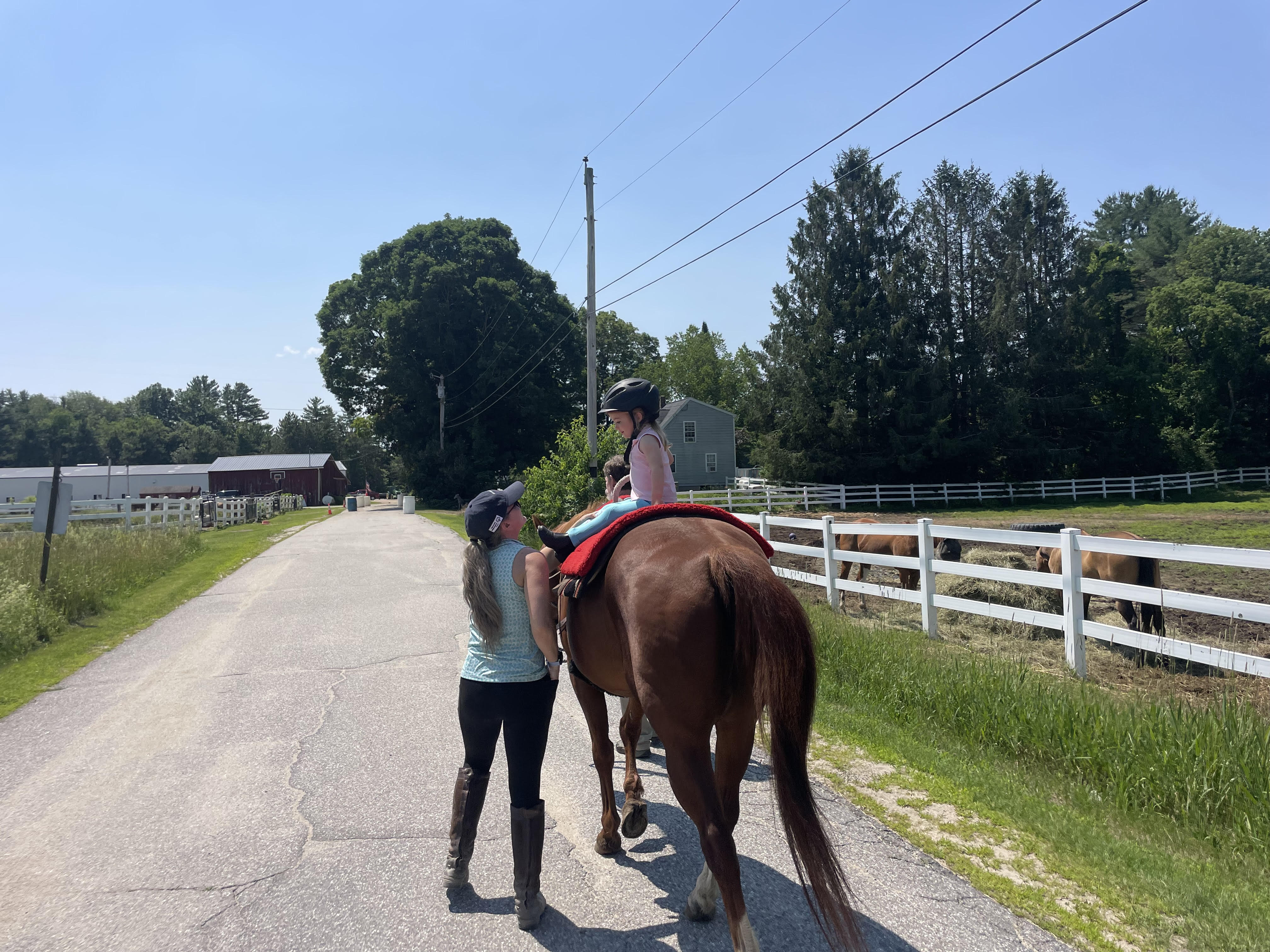
Instructor Karen Rice speaks with E Flaherty outside of Hearts & Horses Riding Center in Buxton. (Madeleine Kaptein/Staff Writer)
“At her bedtime, it typically takes up (to) an hour to soothe her. She can’t stop moving, rolling, needing this, that and the other thing,” Cara said. “After her first ride here, she went to bed in five minutes.”
Advertisement
The horses that work with the riders with disabilities must undergo rigorous testing to ensure they will consistently stay calm around patients that make a lot of noise or have sudden outbursts. Rice and Stephanie Keene, executive director and head riding instructor, explained that they expose the horses to wheelchairs, crutches, strollers and bikes before they can be used for therapeutic lessons.
“Nine out of 10 horses flunk, eight of out 10 do it for a while and then kind of burn out. It takes a special kind of horse to be able to do that forever,” Keene said. “We’re always looking for that special little diamond horse that will be amazing.”
While being on a horse calms E from her typically sporadic state, the treatment has the opposite effect on some other patients, helping them speak up if they’re normally quiet.
Keene started the horse farm as a therapeutic riding center in 1994. It was among the first of its kind in Maine.
“We started with three kids on Saturday mornings with cerebral palsy, and then it grew,” Keene said. The farm also offers regular riding lessons, hosting 125 riders each week in total.
The therapeutic lessons used to be funded by school departments and rehab centers, meaning insurance covered it for a lot of patients, Keene said. Now, clients pay privately. Hearts & Horses has a fundraiser each fall called Bands Behind the Barn with live music, food trucks, games and raffles, and the money raised goes toward scholarships for therapeutic riders. This year, it’s on Sept. 19.
Cara and Chrissy are on the path to adopting E, and have taken in other children with behavioral issues in the past. They previously fostered her two older brothers, who they still see regularly after they found permanent homes with other families.
Having grown up riding horses and remembering how it helped with her own undiagnosed ADHD, Cara said she hopes E can eventually start riding more than once a week.
“(The horse farm) has made (E) feel really safe,” Cara said.
Copy the Story Link
Tagged: disabilities, Health, horses

Madeleine is a community reporter for Gorham, Buxton and Standish. She started her journalism career in Vermont, where she reported for Seven Days and served as the editor-in-chief of Middlebury College's. More by Madeleine Kaptein