Hogtied by rising costs, Maine meat farmers rely on loyal clients

Deedee Caldwell makes weekly beef deliveries to markets and restaurants. Between stops one recent Thursday, she recounted the growing challenges her cattle farm in Turner faces.
Nearly every input, from her electric bill to the cost of wood shavings for cattle bedding, has shot up dramatically in price. Caldwell Family Farm used to be able to get a load of chicken manure fertilizer from Hillandale egg farm in Turner for as little as $275. But Hillandale went out of business in 2024, and a truckload of pelletized chicken manure from Connecticut now costs Caldwell $9,000.
Because of the drought, her land couldn’t produce as much hay and silage as Caldwell needed in 2025 to feed the cattle, so the farm had to buy $45,000 of corn silage last winter.
At the end of summer, it cost Caldwell $350 for diesel to fill her delivery truck. A week later, it was $450, and that was before diesel jumped to more than $6 a gallon. The petroleum-based plastic bags her farm uses to package its meat cost 45 percent more this year.
Last year she bought 75 fewer head of cattle than she needed because the cost had more than doubled in two years. “There will be some businesses that, for the first time in two decades, I won’t be able to deliver to this winter, because I don’t have the beef,” she said.
Caldwell has raised prices on her animal welfare-certified, pasture-raised beef as little as possible, but still lost a few lucrative restaurant accounts in Portland this year, as restaurateurs face their own financial struggles.
Advertisement

Related
Menu prices in Portland are high. Restaurants aren’t happy about it either.
“We’ve been going drastically behind in terms of making a living for a couple of years,” Caldwell said. “My grandpa told me when I was a little girl, ‘Deedee, if you get up a little earlier, work a little harder, go to bed a little later, you’ll always be able to pay your bills.’ And it doesn’t work that way anymore.”
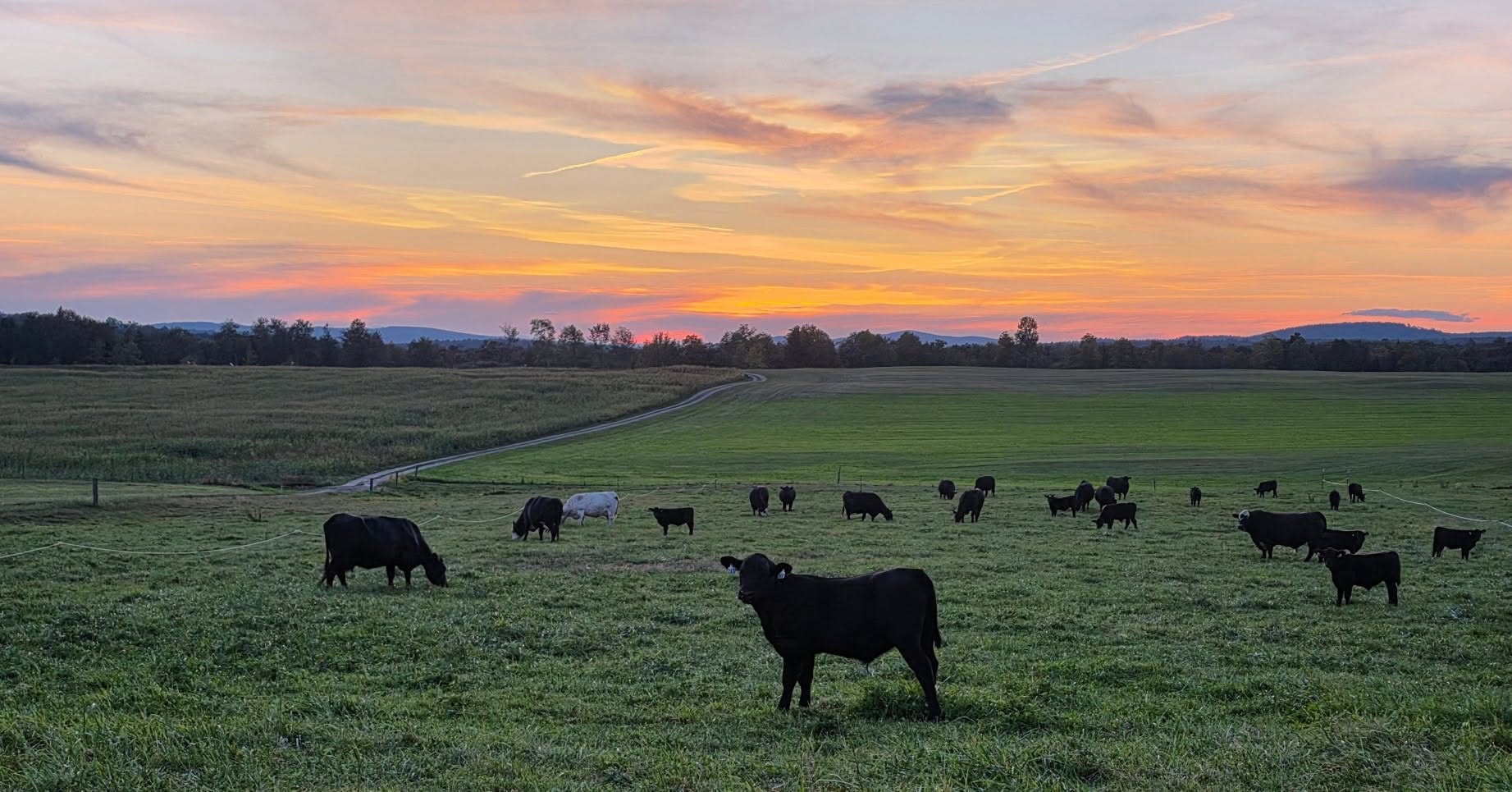
A September sunset at Caldwell Family Farm in Turner. (Courtesy of Caldwell Family Farm)
Wholesale and retail prices of local meat are creeping upward as Maine meat farms grapple with these unprecedented burdens. As some grocers and restaurateurs balk at the price hikes and switch to cheaper commodity meats, local meat farmers are now more reliant on — and grateful for — the chefs, shop owners and residents who remain loyal customers.
“There’s a really wonderful network in Maine of restaurants, small stores and butcher shops that are really committed to supporting these products,” said Mark Law, CEO of Rosemont Market & Bakery. “They believe it’s the right thing to do, but they also recognize that the quality of the product is superior, and it makes a difference for their customers.”
‘DEATH BY A MILLION CUTS’
“We want to make sure our farmers are getting the volume they need to sustain their business,” said Jack Barber, co-owner of Barber Brothers Meat & Provisions in South Portland. “And if they need to make another price increase, we’ll absorb as much as we can into our costs and try not to pass it on to the customers, because not having local meat would be a travesty.”
Law said Rosemont has absorbed some farm price increases as well, like with their holiday turkeys. “This year, we’ve made a conscious effort to lower our margin a little bit so we can keep our prices the same and commit to volume for (the farmers),” he said. “They’ve been under such duress economically, we want to really support them by selling as much as possible.”
Gabe Clark, co-owner of Cold Spring Ranch in New Portland, has seen costs at his cattle and pig farm jump 30 percent since 2024.
Advertisement
“This seems like a unique, tough situation this year,” Clark said. “I don’t think there’s a single part of our production costs that has gone down in price, and usually we see some give and take. It’s death by a million cuts.”
Clark usually raises his meat prices just once a year. Last year, for the first time, he had to increase prices three times. “The only way to address these increases in costs is to pass it on to consumers,” he said. “And it’s hard because consumers are facing higher costs across the board themselves.”

Related
Where to buy Maine-raised meat
Pork chops go for around $2 a pound at the supermarket. Chris Wilcox, owner of Sawyer’s Butcher & Delicatessen in Portland, pays twice that much per pound for whole local pigs. After Wilcox and his team of skilled whole-animal butchers break down the carcasses, chops sell for about $14-$15 a pound.
Sawyer’s can offer specialty cuts you won’t find at supermarkets, like coppa pork roasts and beef steak cuts like Denver, merlot, hanger and flat-iron. Sawyer’s sells other parts wholesale to local restaurants — pig heads, jowls, marrow bones — putting the entire animal to use, without waste.
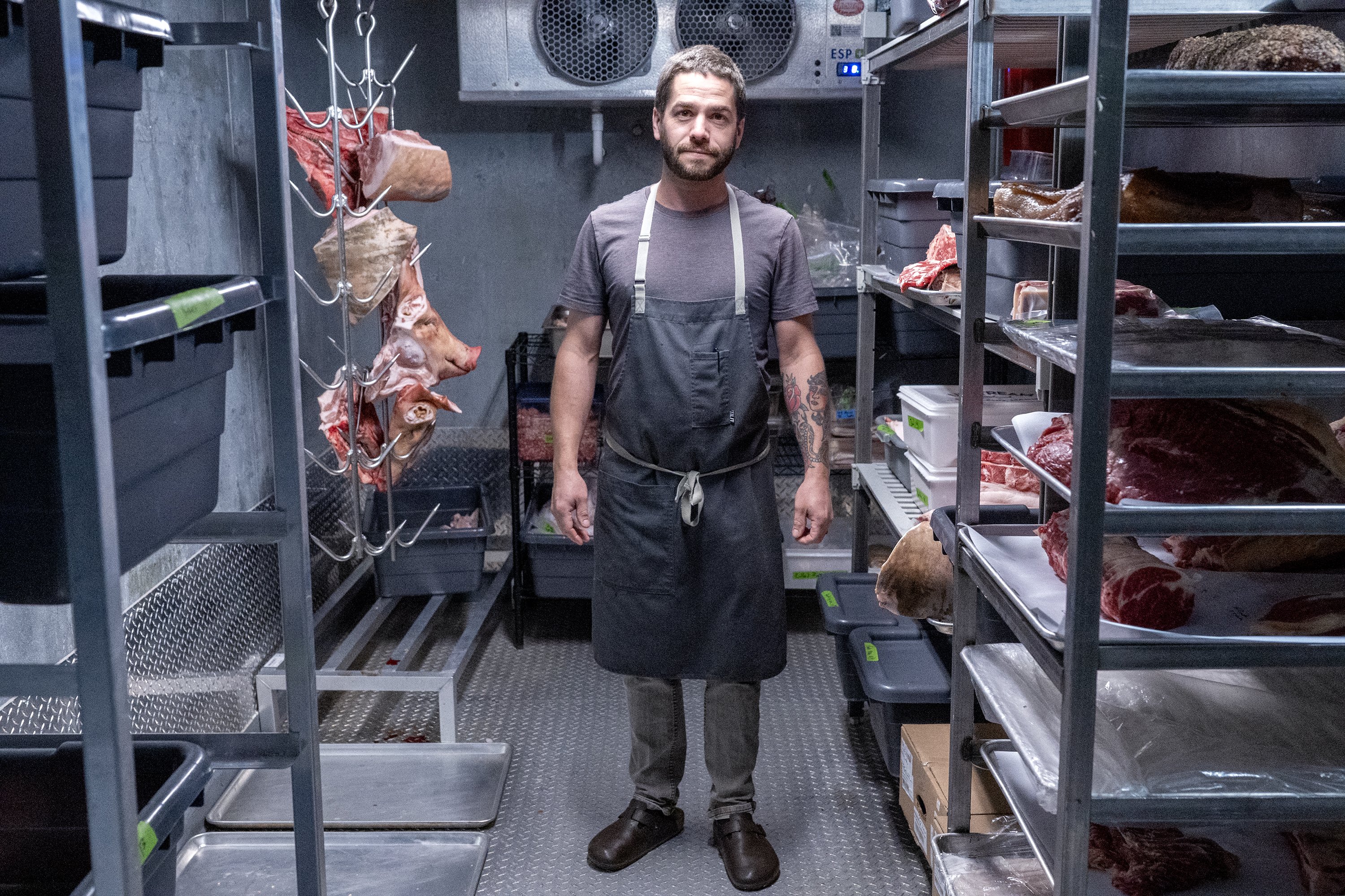
Chris Wilcox stands in the cooler at Sawyer’s Butcher & Delicatessen, the whole-animal butcher shop he owns on Cotton Street in Portland. Sawyer’s sells pasture-raised, hormone- and antibiotic-free meats from local farms. (Daryn Slover/Staff Photographer) Purchase this image
The whole-animal butcher model works well for the farmers, who don’t have to butcher and package the animals themselves. “If there were more of those types of shops in the state of Maine, I could make it,” Caldwell said.
Willcox has already had to raise his prices even though his store has only been open since August. “We want this meat to be as accessible as it possibly can, and it already costs more than the stuff at the grocery store, so it’s a really tough decision,” he said. “But at the same time, things costs what they cost.”
Advertisement
“We’re trying to support our farmers and give them a fair price,” said Jarrod Spangler, butcher and co-owner of the whole-animal butcher shop Maine MEat in Kittery, where non-premium cuts of New England-raised beef sell for $12-$15 a pound. “So in the end, we have to turn around and up our prices a little bit just to make sure everyone’s being taken care of.”
A SUPERIOR PRODUCT
Local meat is far too pricey for many Mainers. But those who can swing it say the value is clear.
Matt Reece of Portland shops exclusively at Sawyer’s for his meat, about twice a week, citing how well the livestock is raised. “I want to trust the source, and I’m willing to pay to have that trust, and to help out the local farmers who are also facing price pressures.
“I can trust that the animal has been raised well, and at each stage it’s been treated with care,” Reece added. “You can really taste how much better it is when it’s local, even compared to the premium products I’ve bought at supermarkets.”
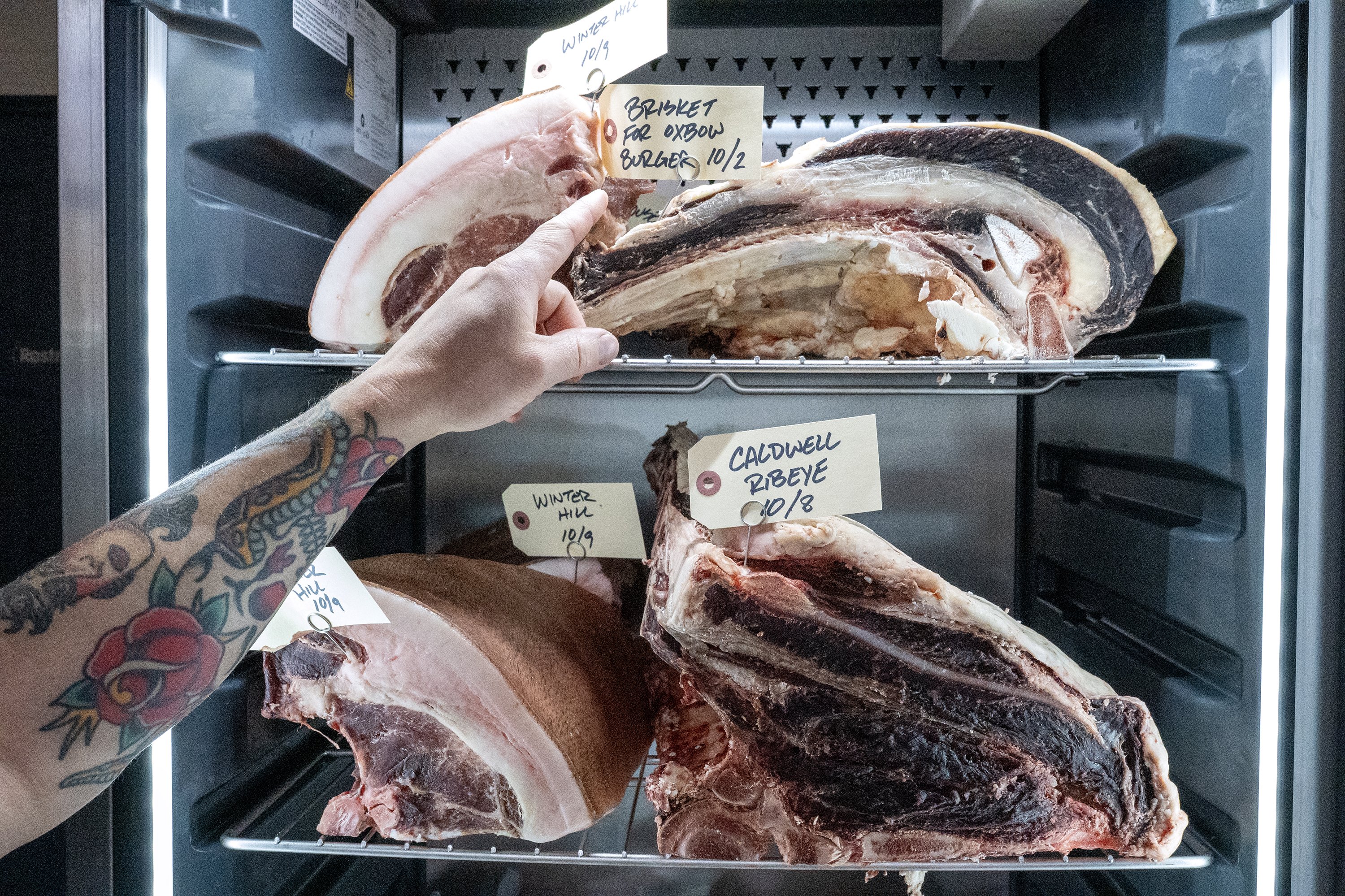
Sawyer’s Butcher & Delicatessen owner Chris Wilcox talks with a customer about the shop’s dry-aged pork and beef. Sawyer’s sources its beef from Caldwell Family Farm in Turner, and pork from Garden Spot Farm in Leeds, Milkhouse Farm in Monmouth and Winter Hill Farm in Freeport. (Daryn Slover/Staff Photographer) Purchase this image
Chef Stephanie Brown said the quality of Caldwell’s ground beef makes her burgers at North 43 Bistro shine.
“It’s perfection, to me,” Brown said. “(Caldwell’s) prices for her meats are well-justified, because she’s offering an organic, high-quality product. Sometimes in the back office, I encourage her, like, ‘Look, if you need to charge more, charge more. You can’t take the hit.'”
Advertisement
“Stephanie told me, ‘You’ve got to put a fuel surcharge on. If you go out of business because you can’t buy gas to get me your product, that doesn’t do me any good either,’ ” Caldwell said. She now has a fuel surcharge of $8 per stop on her delivery route.
“But every single business is doing that to them,” Caldwell continued. “I feel bad that the economy is in such a way that there’s no break anywhere.”
Brown said that for the past few years, she’s been reckoning with substantial increases in meat costs, regardless of whether it’s local. Meat producers nationwide are affected by the same issues local farmers face. Beef prices in particular have been compounded by a cattle shortage stemming from 2023 snowstorms that wiped out much of the herd in the western United States.
It creates a budget and pricing quandary for Brown and other chefs. “Do you still want to serve the 12-ounce sirloin and charge them more, or do you want to give them a 10-ounce sirloin and charge them less?”
‘MAKE YOUR WORLD SMALL’
Dan Sullivan raises poultry and heritage-breed pigs on Broad Arrow Farm in Bristol. He saw his client list of restaurants and markets dwindle over the years because of price increases he needed to make.
So he shifted his business model. With a few exceptions, Broad Arrow no longer sells to restaurants, butchers and markets. They now turn two-thirds of the pork they produce into value-added products like dry-cured meats, which they sell — along with their fresh meat — direct to consumers through their farm store, at farmers’ markets and online.
Advertisement
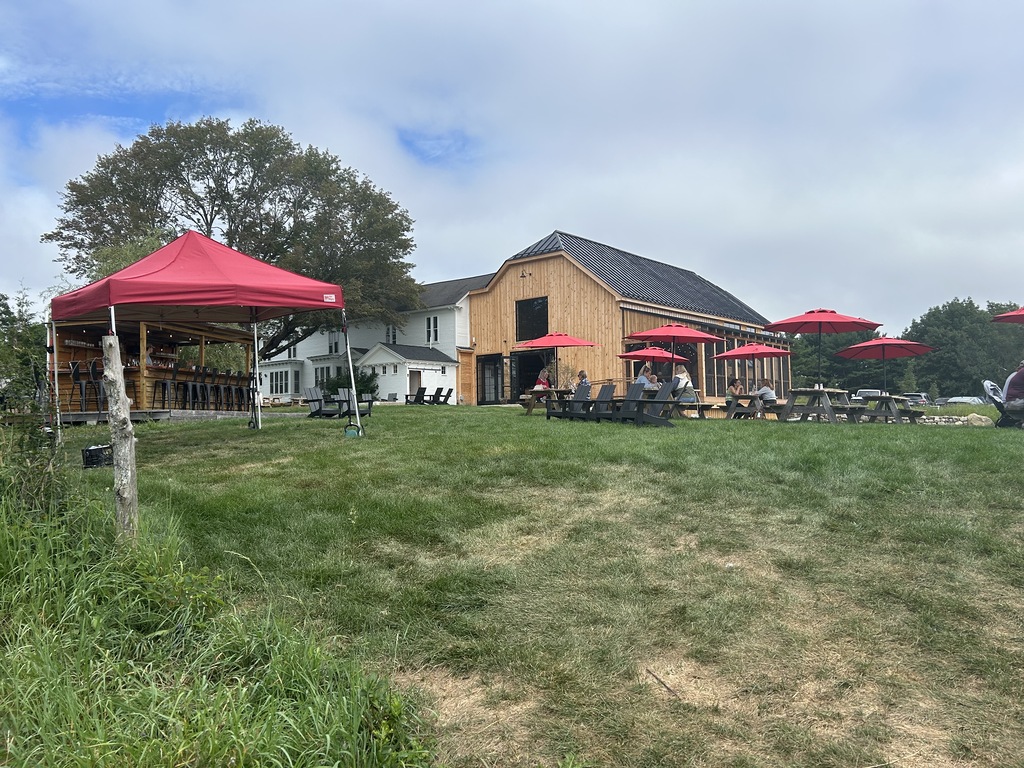
The Rooting Pig at Broad Arrow Farm in Bristol. (Leslie Bridgers/Staff Writer)
Four years ago, Broad Arrow also opened The Rooting Pig restaurant on their property. The venue puts all the farm’s cured and fresh meats to use in various ways, including a top-selling charcuterie board.
“If you want to insulate yourself from how the global commodity markets are moving, make your world small,” Sullivan said. “Be hyperlocal, hyperseasonal, and that’s what we are.”
Sullivan and other farmers and purveyors said the state could use more meat slaughterhouses to prevent processing bottlenecks and keep farmers from having to travel long distances to get their meat processed.

Related
Maine meat producers frustrated by slaughterhouse backlogs
Caldwell acknowledges that some of her high costs are voluntary. She said the wood shavings she uses for cattle bedding have become “astronomically” more expensive in the past couple of years. While she’s not required by law to do so, she insists on having clean, dry spaces for her cattle to rest.
‘NOT PAYING FOR ITSELF ANYMORE’
Quality of life for the farmers themselves is hard to come by these days.
“There’s a lot of suicide in the farming industry,” Caldwell said. “When you work 80 to 100 hours a week, and at the end of the week, you’ve got to figure out what bill you can pay, that wears on them over time.” Her father took his own life four years ago this month.
Advertisement
In the past couple of years, just to stay afloat, Caldwell has had to sell house lots from her land for the first time since her grandfather started the farm in 1944. Still, she tries to focus on the nonmaterial ways her farm pays off.
“If the weather’s good, I can see Mount Washington from where we are. There’s some pay in that. We have amazing sunsets. There’s pay in that.
“I’m very blessed to be where I am,” Caldwell said, her voice breaking as she choked back tears. “But it’s not paying for itself anymore, and we don’t have a lot of equity left to chew off. The next two years or less are make or break.”
Copy the Story Link
Tagged: farming, featured, maine food, maine restaurants

Tim Cebula has been a food writer and editor for more than two decades. He was most recently senior editor at Cooking Light magazine, where he worked for 13 years. His work has appeared in Time, Health,. More by Tim Cebula