

Group restoring Casco Bay’s eelgrass meadows one seed at a time


Hazel Johnson adds eelgrass to a crate after diving in Casco Bay Thursday. (Shawn Patrick Ouellette/Staff Photographer)
CASCO BAY — Underneath the water’s surface between Haskell and Great Mark islands lives a vibrant meadow of eelgrass that captures carbon and serves as a nursery for juvenile fish and other marine species.
But elsewhere in Casco Bay, these vital habitats are disappearing. A combination of factors — including climate change and destructive invasive species like the green crab — have wiped out more than half of the bay’s eelgrass population in recent years.
A team led by the Collaborative for Bioregional Action Learning and Transformation, or COBALT, along with students and staff at Bowdoin College’s Schiller Coastal Studies Center and other local partners, are working to understand and potentially combat the decline — by transplanting eelgrass seeds from healthy meadows to unhealthy ones.

Related
Diving into Maine’s eelgrass restoration push
Thursday morning, scuba divers from “Team Zostera” (named for the genus of eelgrass) suited up and headed out from the Schiller Center into Casco Bay to collect the eelgrass shoots that will hopefully help establish new meadows.
The divers — three Bowdoin students, a Scarborough High School student and Glenn Page, the executive director of COBALT — left bubbles and buoys in their wake as they descended about 20 feet to the thriving Haskell Island meadow. Tethered to one another, the divers plucked green shoots from the seafloor and stored them in bags, keeping track of their haul with golf counters.
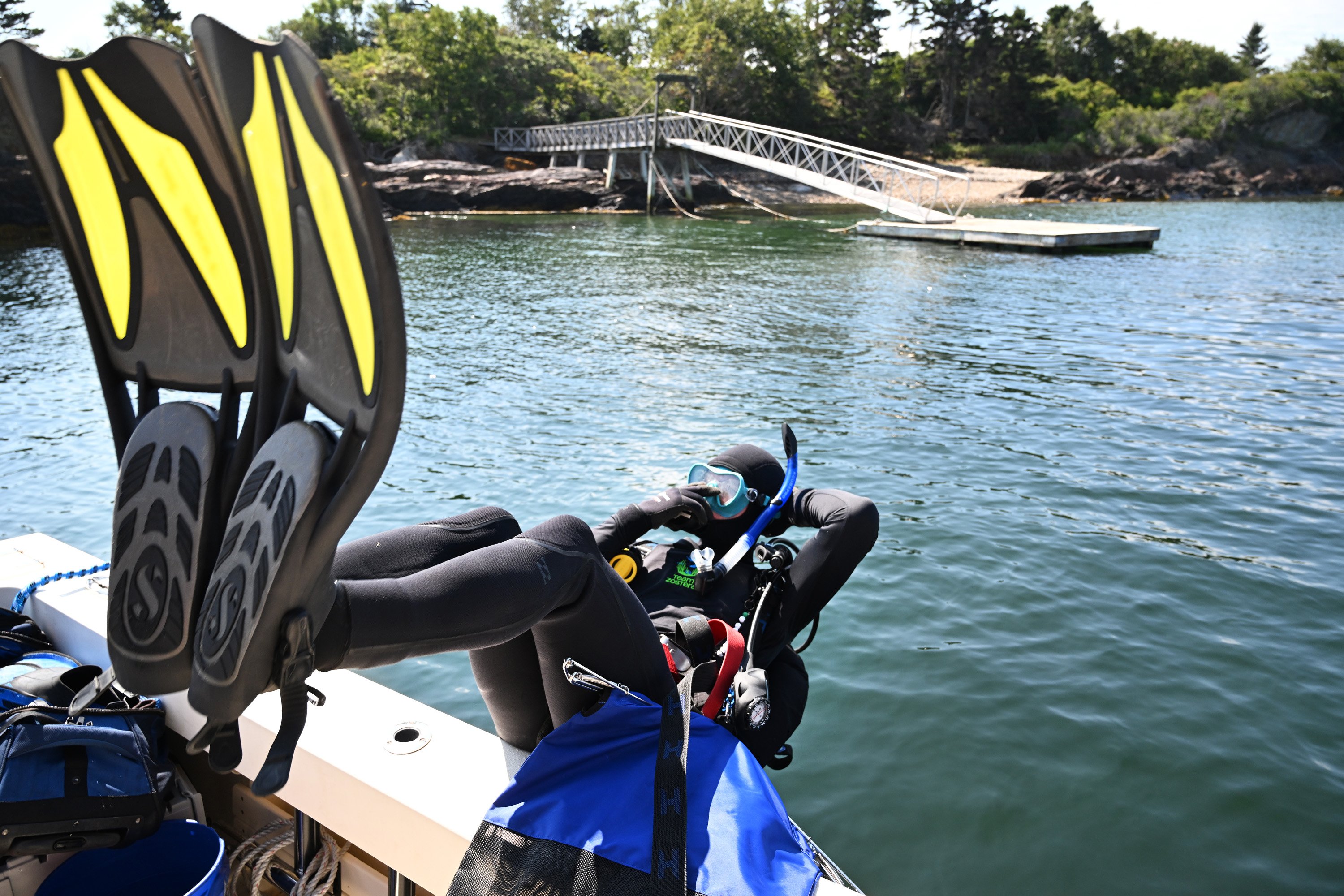
Bowdoin student Matthew Servin enters the water to gather eelgrass Thursday. In the background is Great Mark Island in Harpswell. (Shawn Patrick Ouellette/Staff Photographer)
They surfaced about an hour later with more than 2,000 individual plants.
Advertisement
“It’s astounding how many juvenile fish we saw out in the meadow; juvenile lobsters were just everywhere. If we lose the seagrass meadows, we can pretty much kiss the lobster industry goodbye,” Page said after his dive. “(Eelgrass) are the superheroes of the coastal ecosystem.”
The “Seeds of Hope” project was funded through an Environmental Protection Agency Restore America’s Estuaries grant. Six Bowdoin students worked as coastal research assistants on the project this summer; some received scientific diving training, and others worked with Schiller Center staff to monitor the water quality, light, sediment and other factors at the meadow sites.
In addition to going out on dives, junior biology student Ella Kennedy has been doing research into the microbiome of eelgrass.
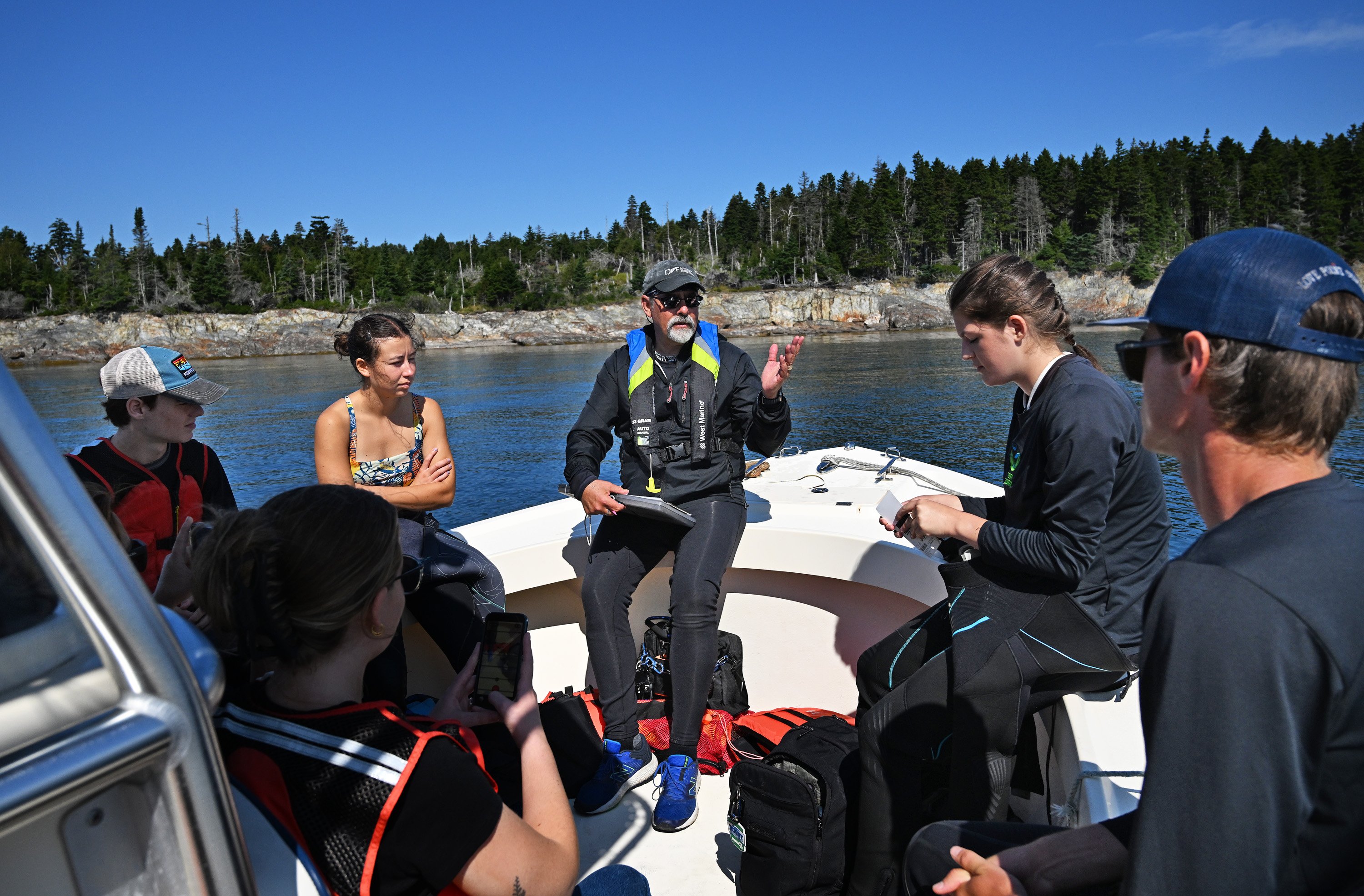
Team Zostera Executive Director Glenn Page, center, talks with his team before diving in Casco Bay Thursday. (Shawn Patrick Ouellette/Staff Photographer)
“Part of this project is to harvest reproductive shoots and then to hold them in a holding tank until October and then outplant them, and so we’re trying to figure out whether or not the microbiome of the seedlings is different from the rest of the plants, and how can we promote it so they have a better chance of surviving,” Kennedy said.
Kennedy, who has been diving since she was 12, said the summer experience has combined her interests in biology and scuba diving.
“I always wanted to do diving as part of my job once I graduated,” she said. “But having the opportunity to do it as an undergrad was really cool.”
Advertisement

Related
A Valentine’s Day celebration of vital, overlooked eelgrass
Bowdoin sophomore Kate Rice and senior Greta Ahlefeld have been looking into how water quality affects eelgrass decline and constructing the holding tank systems in the lab.
“(We’re) trying to figure out why it’s declining, as well as where it is, and laying the foundation for the making of long-term data sets that will help us track the decline in eelgrass, and maybe the restoration as well,” Rice said.
THE PLUCK
When the eelgrass is brought back to the Schiller Center on Orr’s Island in Harpswell, Team Zostera needs many hands to make light work.
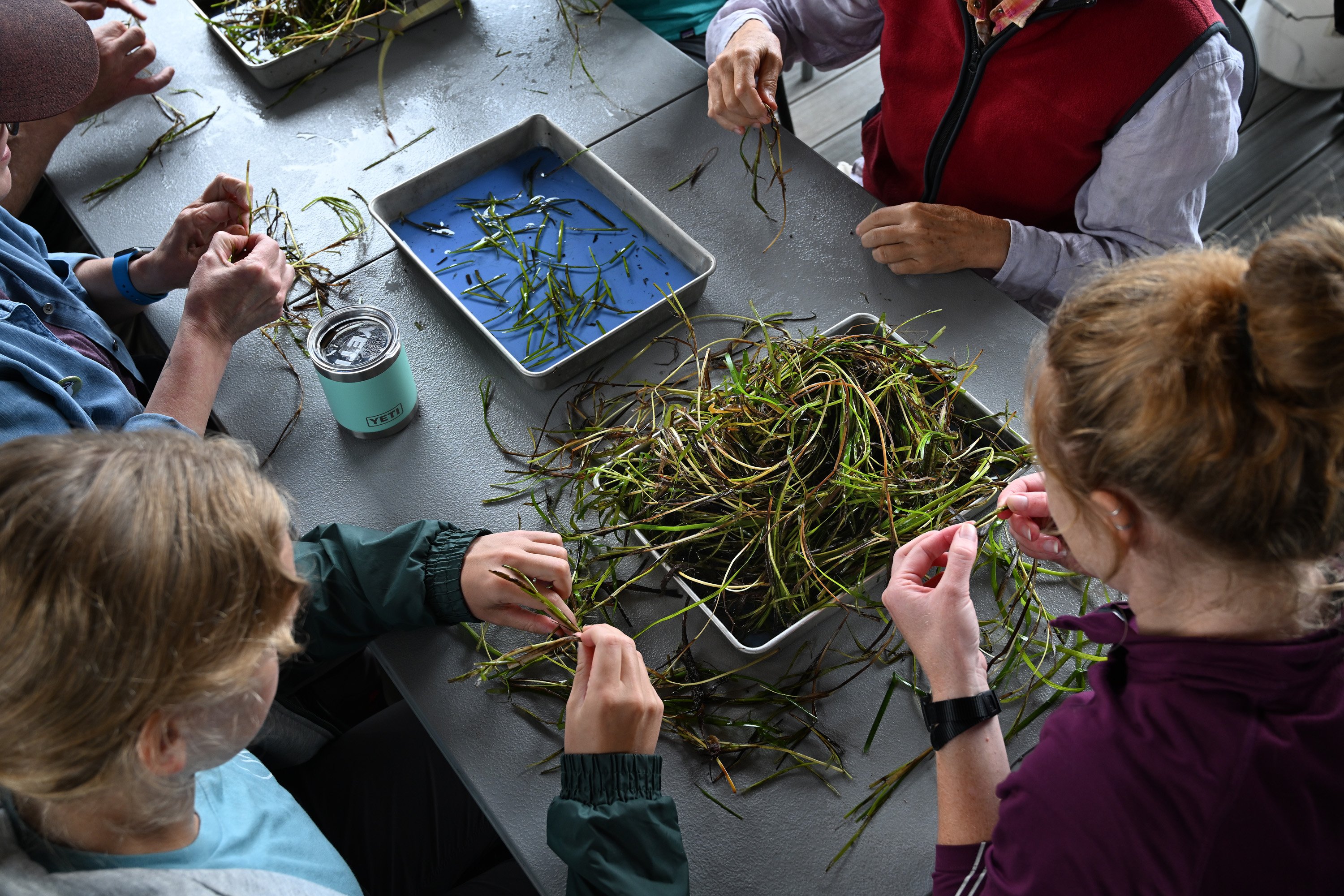
Volunteers with Team Zostera seed-plucking eelgrass at the Schiller Center in Harpswell on Thursday. (Shawn Patrick Ouellette/Staff Photographer)
On land Thursday, Schiller Center students deposited wet green spaghetti-looking blobs onto tables, where volunteers from the Harpswell Land Trust sat ready to learn about the eelgrass restoration work — and lend a hand.
This summer, the scientists have enlisted the help of several community organizations, who volunteered to spend hours plucking the reproductive spathes from the eelgrass shoots harvested by the diving team.
Kind of like a big quilting bee, the meditative plucking process takes “a moment to learn, but a lifetime to master,” Page said. It’s also great for team building, said Matt Newberg, executive director of the Harpswell Heritage Land Trust.
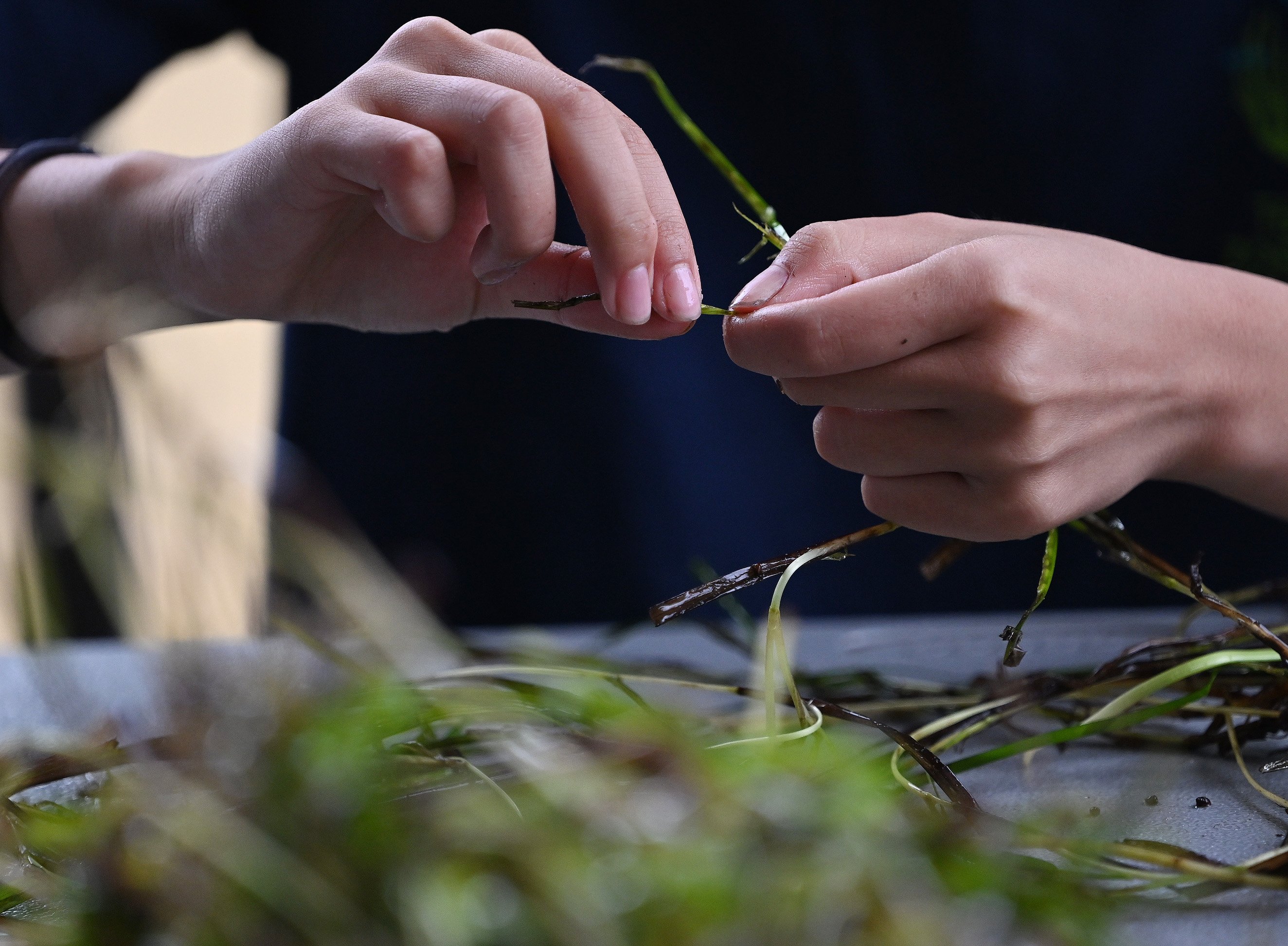
Volunteers with Team Zostera seed plucking eelgrass at the Schiller Center in Harpswell Thursday. (Shawn Patrick Ouellette/Staff Photographer)
“I love learning about the science,” he said.
After the pluck-a-thon, the spathes are stored in special containers at the Schiller Center’s wet lab while they mature and release their seeds. In the fall, the team will plant roughly 300,000-500,000 seeds in degrading meadows — and cross their fingers that they germinate into new plants.
“We’re in a race to try to understand if we can, indeed, possibly stop the loss, possibly hold the line — and maybe, maybe, maybe — even add to the restoration of the seagrass meadows around Casco Bay and around the Gulf of Maine,” Page said.

**The Times Record Sustaining Sponsor
**We believe a community must be informed to thrive. bowdoin.edu
Copy the Story Link
Tagged: bowdoin college, Casco Bay, environment, marine industry, Times Record, Times Record News

Katie covers Brunswick, Bath and Freeport for the Times Record. She was previously the weekend reporter at the Portland Press Herald and is originally from the Hudson Valley region of upstate New York. More by Katie Langley