

Federal report: Water poured on Searsmont fire likely contributed to deadly explosion


A group of bystanders watches the flames and smoke on May 15 in Searsmont. (Ethan Horton/Staff Writer)
Federal investigators have determined that the response to a blaze at Robbins Lumber on May 15 likely inadvertently contributed to the subsequent explosion that has killed three people and severely injured more.
They found the Searsmont lumber mill’s owners had inadequately planned for the hazard posed by the dust and didn’t post warnings for firefighters — most of whom were volunteers — about the dangers of using water on an “oxygen-limiting” silo.
The report, released by the National Institute of Occupational Safety and Health (part of the Centers for Disease Control and Prevention), is likely the first of several reviews of the incident. The report notes it’s meant to help fire departments and researchers learn for the future and is not intended to place blame, though it provides the first official assessment of the conditions of the explosion.
The fire started accidentally at the base of a silo containing wood shavings. Employees sprayed water into a room under the silo and called 911. Six fire agencies responded, and within 40 minutes it appeared to be contained, investigators said.
The agency found that those six departments had responded to several silo fires at Robbins Lumber over the past 20 years, but in each of those cases, the silo was vented at the top.

Related
Inside the Searsmont lumber mill fire and explosion
This time, the silo was “oxygen-limiting,” which meant that when firefighters added water in a way that had been effective in the past, they accidentally added fuel, the agency said.
Advertisement
Investigators obtained the manufacturer’s published silo emergency procedures. Under fire department instructions, the document states “DANGER: Do not fight fire by adding water or foam to the structure.”
The result was an explosion of dust that launched the silo and a large plume of fire into the air.
Investigators said Robbins Lumber employees were unaware that the silo’s contents — wood shavings and sawdust — constituted a combustible dust hazard. Subsequently, responding firefighters were not notified of any combustible dust hazards before or during the incident.
The facility had hosted walk-throughs for firefighters, the report said, but there was no “pre-incident plan” with site-specific strategies. The company also did not post labels about the specific danger of using water for fire suppression in a sealed silo.
NIOSH line-of-duty death report by Maine Trust For Local News
The fire and explosion have devastated the firefighting community in Maine and the Robbins family. Morrill firefighter Andrew Cross died on the scene from heat-related injuries and smoke inhalation. Searsmont Assistant Fire Chief Wayne Woodbury died at the hospital four weeks later due to burn injuries, and company co-owner Alden Robbins died in the hospital in July.
Advertisement
Searsmont EMS Chief Sarah Tompkins and two members of the Robbins family are still in the hospital. Massachusetts General Hospital, where Lily and Jim Robbins are believed to be, confirmed to the Portland Press Herald this week that it has two patients from Searsmont, and that one is in critical condition and one is in fair condition.
Midcoast communities and fire departments across the state have celebrated the return home of several other first responders, including Jacob Spaulding and Katherine Paige. Several of them spent weeks in the hospital and are expecting to need years to recover from their injuries.
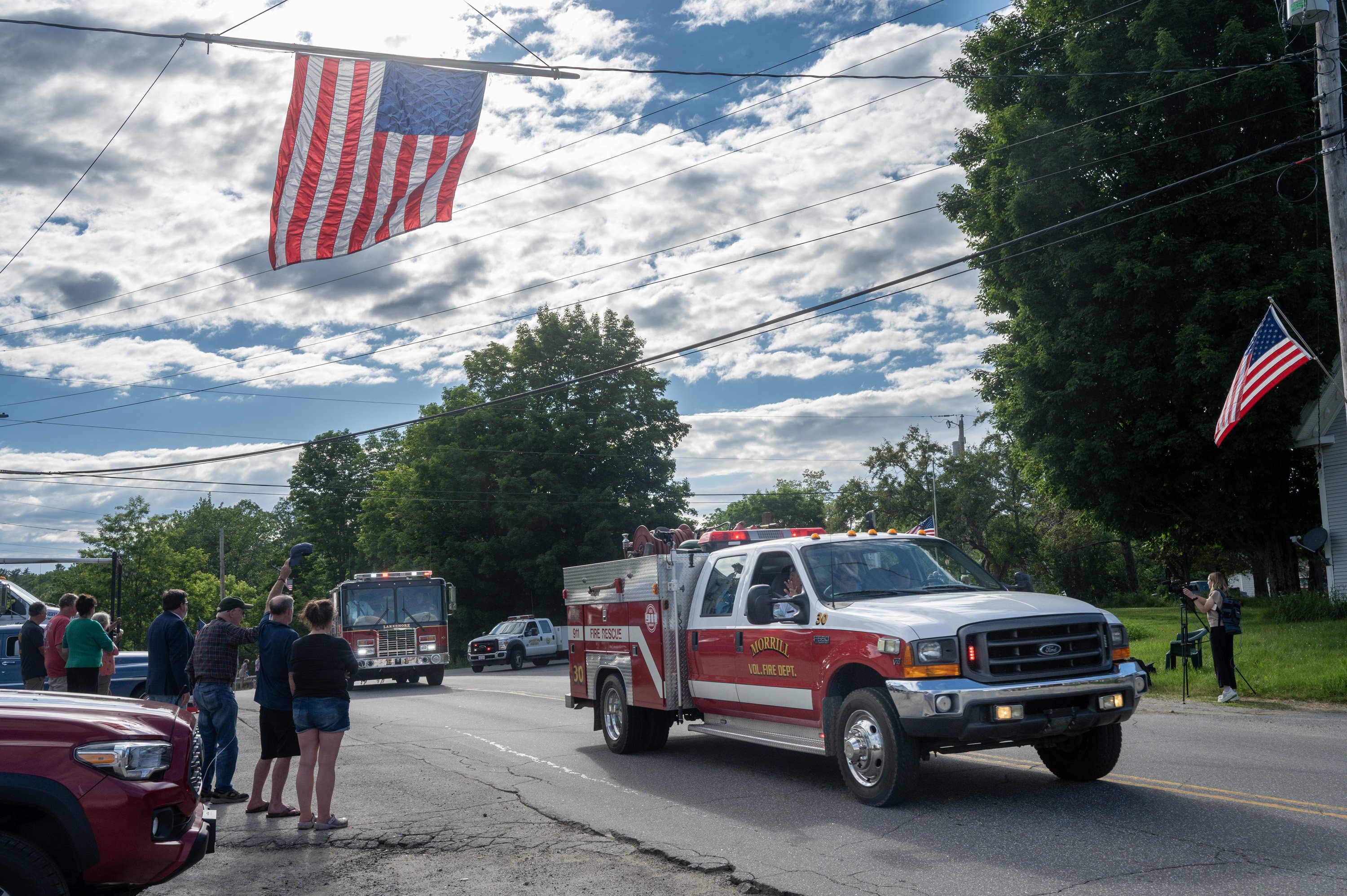
A procession accompanying the remains of Searsmont Assistant Fire Chief Wayne Woodbury, 76, passes under a large flag held up by a crane in Searsmont on June 15. (Joe Phelan/Staff Photographer) Purchase this image
The report includes descriptions of the scene immediately after the explosion. “Many of the firefighters assisting others were critically injured themselves but attempted to provide assistance amidst the chaos,” it said.
Robbins Lumber posted a statement on its website Friday that said the National Institute of Occupational Safety and Health’s report cannot “lessen the tremendous loss suffered by so many.”

Related
Read all our coverage of the Searsmont explosion
The report is intended to identify lessons for the future, the company said.
“We are committed to carefully reviewing its findings and recommendations and working collaboratively with the fire service, industry organizations, safety professionals, and regulatory agencies to improve safety wherever possible,” the statement said.
Advertisement
The report said the best practice for an oxygen-limiting silo is to allow it to smother itself by not opening the top or bottom hatches for several weeks.
It said one of the most dangerous hazards that silos present is a combustible dust explosion, and since 1980, there have been over 200 combustible dust incidents at industrial facilities that have led to the deaths and injuries of workers.
In the Maine explosion, the silo had signs warning people not to enter the confined space, but nothing warning firefighters that using water would cause a massive blast. The report explains that these signs are a critical last line of defense for rescuers who have to make split-second decisions.

Related
Searsmont and Robbins Lumber have been entwined for decades. Will tragedy bring them closer?
The agency has investigated “multiple cases” over the past 40 years where firefighters put water into an oxygen-limiting silo, unaware of the risk, and the dust exploded.
The report called for policy changes. It said current law doesn’t require these containers to have labels warning about combustible dust, even though this has been a known danger for 40 years.
To save lives, investigators want new rules requiring bold signs that say: “DANGER — Sealed Silo — Water Contributes to Explosion” on facilities including silos, bins, tanks and hoppers.
Advertisement
Robbins Lumber said its focus has been on supporting the victims and their families, caring for employees, cooperating with investigations and strengthening its safety programs.
“We are working closely with recognized industry experts as we are rebuilding our facilities,” it said.
In a Facebook post, Liberty Fire & Rescue asked that people not assign blame based on the new federal report.
“We cannot change what happened that day. We cannot undo the injuries. We cannot bring back those who were lost. But we can learn from it,” it said in part. “Please don’t forget the people behind the report.”
Fire officials were not immediately available for comment Friday.
The report listed measures fire departments took in Searsmont that may have prevented further injuries or deaths. It commended their periodic trainings on how to work together, as well as the annual walk-throughs at Robbins Lumber to familiarize firefighters with the layout and hazards.
Advertisement
However, the report recommended generally that fire departments go further in the future to formally plan for structures in their area that pose elevated or unusual risks. In the case of the Robbins Lumber silo, investigators said “strategy and tactics were dictated by individual knowledge and memory of responding firefighters who had been to the facility.”
The agency also took issue with the command on the ground during the response to the initial fire. “Facility owners and employees were around the silo to answer questions from individual firefighters but were not part of a unified command structure,” the report said, adding that employees’ and owners’ knowledge of the facility may have helped inform decision-making.
However, the agency also said employees at Robbins Lumber pointed out a plexiglass panel at the base of the silo, which led firefighters to direct water there — something that the silo’s manufacturer explicitly warned against.
They also said that while there was some accounting of where everyone was during the response**,** it was not sufficient. Cross was discovered to be missing two hours after the explosion, at which point leaders on the ground launched a search and previously told the Press Herald they found him within 20 minutes.
Copy the Story Link
Tagged: firefighters, Searsmont explosion

Rachel Estabrook is an accountability reporter at the Portland Press Herald. Before joining the Press Herald in 2026, Rachel worked in the newsroom at Colorado Public Radio for 12 years. She's originally. More by Rachel Estabrook

Penny is excited to be the Portland Press Herald’s first climate reporter. Since joining the paper in 2016, she has written about Maine’s lobster and cannabis industries, covered state politics and. More by Penelope Overton