

Extreme heat in South Portland: Planning ahead for heatwaves | Our Sustainable City

The all-too-familiar short, dark days between November and March. Unrelenting snow and ice. Despite the often long and harsh winters, extreme heat presents dire health concerns for people living in Maine. Last week, the summer solstice signaled the formal shift of the seasons. South Portland teems with signs of summer: fresh strawberries, lush native habitat gardens, swimmers at Willard Beach, long lines at Reds, and bikers gliding along the Greenbelt. Yet, the ethereal summer days come with heat-related health risks.
Historically, Maine’s high northerly latitude has meant that extreme heat events have not been frequent occurrences. As a result, the state is not as well adapted to high heat as other parts of the country. For example, when the temperatures inch above 80 degrees, Maine’s residents are less acclimated and more likely to get sick from the heat. Due to Maine’s traditionally cold climate, air conditioning is not as prevalent in homes, public spaces, and businesses. In Maine, only 60% of people live in a home with air conditioning, compared to almost 90% in the rest of the Northeast. Further, urban areas tend to be warmer than neighboring rural areas, particularly at night, known as the “urban heat island effect.”
Over the past 30 years in the U.S., more people have died from exposure to extreme heat than from all other weather events combined. Maine CDC data shows that there is an approximate 10% increase in both all-cause emergency room visits and all-cause deaths in our state on days with a heat index of 95 F or higher. Extended high heat can also elevate levels of ground-level ozone, which can trigger poor air quality that negatively affects people with asthma or other respiratory issues. Therefore, extreme heat isn’t just an inconvenience, it’s a major health risk and warrants targeted action to minimize the risks it poses to residents.
As stated in One Climate Future, South Portland is expecting to see more unseasonably hot days and extended heat waves with climate change, posing an immense risk to people whose bodies are less acclimated to the warmer weather (C.R. 218). Between 2000 and 2050, the number of days with a heat index of 95 degrees F or more is predicted to increase by two- to four-fold. Heat-related illnesses occur when your body cannot cool itself. Some heat illnesses are mild, like heat rash, sunburn, and heat cramps. Others like heat exhaustion, dehydration, and heat stroke can be severe or even life-threatening. It is essential to understand the signs of heat illness to care for yourself and your neighbors as we experience more extreme temperatures in South Portland.
BUILDING EXTREME HEAT RESILIENCE IN SOUTH PORTLAND
How can we build resilience to ensure we are prepared to respond to extreme heat?
At a city-wide scale, tactics to expand our “cooling capacity” range from preserving and expanding open space, public parks, greenspace, and tree cover to increasing access to cooling centers and improving energy efficiency in indoor spaces. Surfaces like asphalt, steel, and brick, absorb and retain more heat than natural and living surfaces such as grass and trees. As stated in One Climate Future, there is a need to improve the resilience of both our indoor spaces, through energy-efficient building upgrades, along with our outdoor spaces, by increasing trees and shrubs to reduce paved surfaces (C.R. 218).
Advertisement
HOW CAN YOU PREPARE FOR EXTREME HEAT THIS SUMMER?
Know your local cooling centers. The city of South Portland has designated the following locations as cooling centers:
• City Hall, Council Chambers, 25 Cottage Road
• Redbank Community Center, 105 Macarthur Circle West (only when there is CMP power)
• Main library, 482 Broadway (only when there is CMP power)
Stay Hydrated
• Drink a cup of water every 20 minutes, even if you don’t feel thirsty.
Advertisement
• Avoid sugary, caffeinated, and alcoholic drinks.
• Check your urine color — dark yellow means you need to drink more water.
Stay Cool
• Spend time in air-conditioned places.
• If your home is too hot, go to a library or cooling center.
• Being in the shade outside might be cooler than staying in a home without air conditioning.
Advertisement
• Take cool showers or baths.
Stay Connected
• Talk to your doctor about ways to stay safe. Heat can be more dangerous if you’re pregnant, have a health condition or take certain medications.
• Sign up for free local emergency alerts.
• Check on your friends and neighbors. Remind them to stay hydrated and cool.
Know who is at risk: extreme heat is dangerous for anyone, but some people are more at risk of getting sick, including:
Advertisement
• People without air conditioning, experiencing homelessness, or living alone
• Older adults
• Babies and young children
• Pregnant people
• People with chronic conditions or who take certain medications
• People with disabilities
Advertisement
• People using drugs or alcohol
• Athletes and outdoor workers
For more information, go to redcross.org/heatcheck.
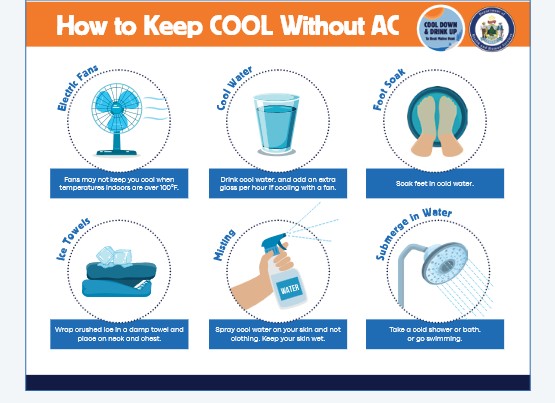
Information about keeping cool in high temperatures from the Maine DHHS extreme temperature resilience and response guidebook. (Courtesy of Robyn Landes)
COFFEE AND CLIMATE
Grab a coffee and join us virtually on Friday, July 9, from 9 to 10 a.m., where the One Climate Future Team will be joined by CJ Miles, environmental health pogram coordinator at the Maine CDC. CJ will talk about Maine CDC’s recently released “Extreme Temperature Response and Resilience: A Guidebook for Maine Communities” and other extreme temperature initiatives like a communications campaign for outdoor workers. The guidebook is a new, first-of-its-kind resource to help Maine towns and organizations prepare for, respond to, and plan long-term for dangerous heat and cold events that threaten community health. Sign up through this Zoom registration link.
Robyn Landes is an AmeriCorps Resilience Fellow with the South Portland Sustainability Department.
Copy the Story Link