

Be on the lookout for these 4 insects, plus 1 spider


The monarch is beloved because of its large size and showy appearance. (Photo courtesy Maine Audubon)
The dog days are here, in more ways than one. While the August heat can feel a bit oppressive to humans, it can make for ideal conditions for some insects. When you are cold-blooded, these warm days are great for being active, plus having many plants in bloom means there is plenty of food for our pollinators. Here are five common invertebrates — four insects and a spider — that you should keep an eye out for this month:
Starting off with one of the more charismatic of our insects, we have the monarch (Danaus plexippus). Their large size and showy appearance makes them a fan favorite, and the ones we are seeing flying in Maine right now have an amazing journey ahead of them. Their great-great-grandparents were in Maine at this time last year, and flew all the way to Mexico to overwinter. This spring, they would’ve moved north, mostly around the Gulf states, and would have laid their eggs on milkweed to produce what we call the first generation (the great grandparents of the ones we are seeing now). They move a bit farther north, and the life cycle repeats. Second generation caterpillars are usually out in June, then as adults, they’ll fly north again. Most of the adult Monarchs we’ve seen over the past month would’ve been the third generation, and those are the ones that will lay eggs that will hatch into caterpillars, then form chrysalises, and over the next month hatch into the monarchs that will make the long migration south again.
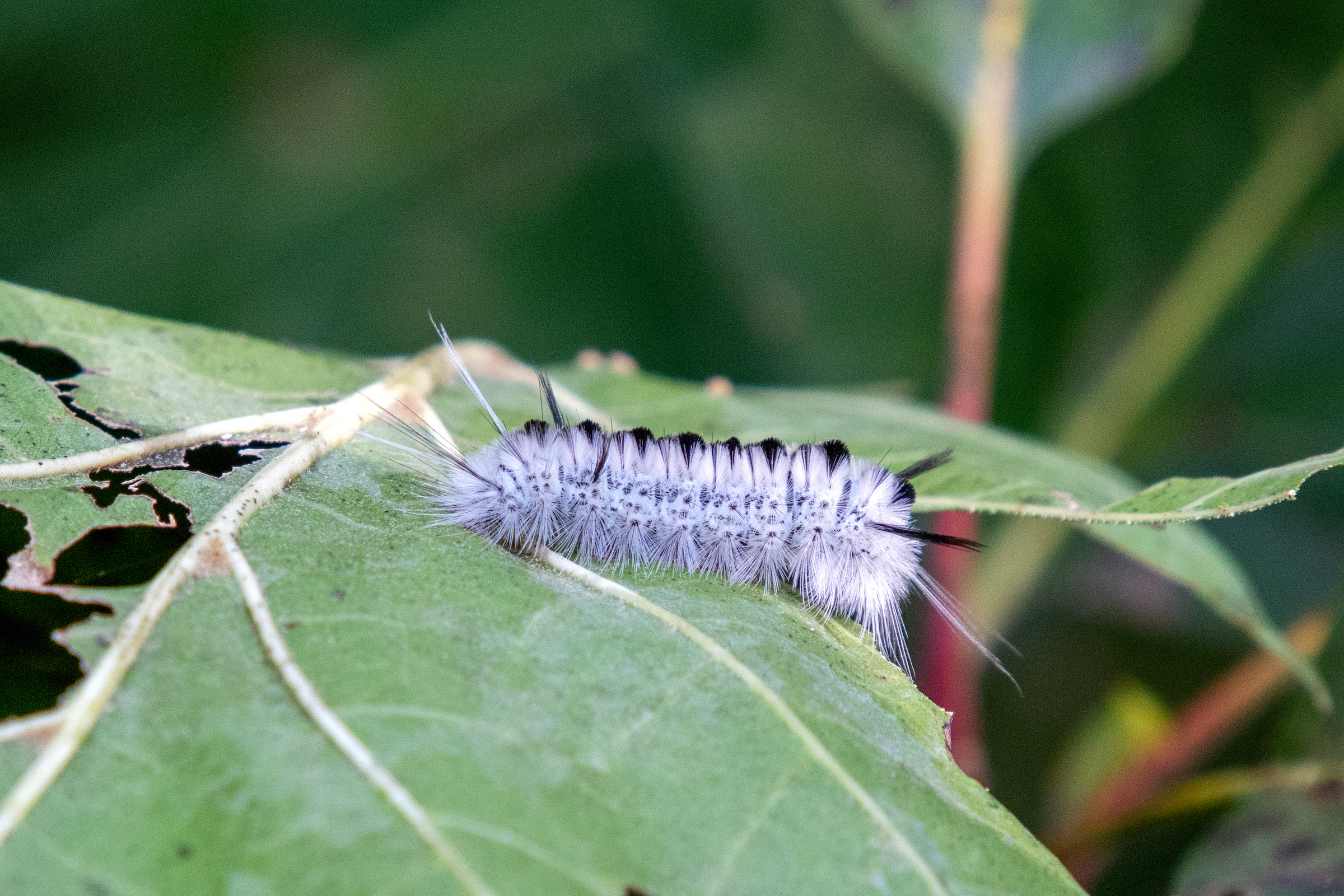
The hickory tussock moth, in its caterpillar stage, can be spotted because of its dark medial stripe and a series of four dark “pencils.” (Photo courtesy Maine Audubon)
While monarch caterpillars are well known, one less known but still frequently seen caterpillar is that of the hickory tussock moth (Lophocampa caryae). In their larval stage, the caterpillars are mostly white with a dark medial stripe, and a series of four dark pencils. In entomology, “pencils” are the little tufts (also known as setae) used in defense or communication. The hairs on a hickory tussock moth are meant to deter predators and can cause rashes in some humans, though typically not as bad as those from invasive browntail moths (Euproctis chrysorrhoea). As with all wildlife, just don’t touch them. These fuzzy guys are on the move as they seek out leaf litter where they will make a cocoon to overwinter in. So in a couple of months when we are recommending that you “leave the leaves” remember these as a species attempting to survive there.
Now is also a great time to look for tricolored bumble bees (Bombus ternarius) , one of the more colorful bees in Maine. As the name suggests, along with the usual black and yellow, tricoloreds also have a couple of orange segments on their abdomens, which is where they also get the alternative common name “orange-belted bumble bee.” Common in Maine, they should be easy to spot on flowering goldenrods. These are often mistaken for the federally endangered rusty-patched bumble bee (Bombus affinis), which has a smaller rusty-orange patch on just one segment of the abdomen. There hasn’t been a confirmed sighting of a rusty-patched bumble bee in Maine since 2009, but if you think you see one, snap a photo and upload it to iNaturalist for experts to see.
One species you are more likely to hear than see this month is the northern dog-day cicada (Neotibicen canicularis). Another appropriately named species, these common cicadas emerge as adults during the “dog days of summer” and quickly climb trees where they make their loud iconic noise. The males use a sound-producing organ called a tymbal, located on the sides of the abdomen, which are flexed hundreds of times per second to produce their iconic loud mating buzz.
The last invertebrate I want to mention is not an insect, but one of our more stunning spiders, the yellow garden spider (Argiope aurantia). These mostly black and yellow spiders can be quite large, spanning 3 inches when you include the legs. They are harmless to humans, and as long as you don’t have arachnophobia, I recommend looking for these in a grassy field. Their large webs, made for snagging aerial insects like flies or mosquitoes, are easy to spot on cool early mornings before the dew evaporates.
Days are already getting shorter, so make the most of the summer while it is here. This is a fun month for hanging out by a goldenrod patch and seeing which pollinators come by. Look for showy butterflies or colorful bumble bees, and contribute your sightings to projects like iNaturalist. I know I’ll be spending more time in the meadows at Gilsland Farm to see which insects (and arachnids) are taking advantage of the heat.
Have you got a nature or wildlife question? It doesn’t have to be about birds! Email questions to [email protected] and visit www.maineaudubon.org to learn more about birding, native plants, and programs and events focusing on Maine wildlife and habitat. Maine Audubon Staff Naturalist Doug Hitchcox and other naturalists lead free bird walks on Thursday mornings starting at 8 am, at Maine Audubon’s Gilsland Farm Audubon Sanctuary in Falmouth.
Copy the Story Link