

Artists take advantage of Maine’s long woodworking traditions

Steve Bartlett came to his medium through welding metal sculptures. Ben Boothby’s path to the same material led him through painting first. In the case of Sam Giberson, a two-week course at Haystack Mountain School of Craft proved transformational. Duncan Hewitt came at the medium through sculpture and the physicality involved in manipulating it. Jamie Johnston’s love initially arose through furniture making. Lin Lisberger started with ceramics. And Tony Machowski’s affection began later in life, after retiring from a career as an architect.
All these artists produce work that is extremely different one from the other. But they are unified by their love of wood. Most of them, too, were seduced by it; they did not set out to work with that wood but were lured to it and captivated by its expressive possibilities. Maine, of course, has a long tradition of woodworking. But except for occasional artists such as Bernard Langlais and Dan Miller, it has been concentrated in the applied arts (or materials-based craft) fields. Except for Johnston and Lisberger — who made furniture — their first forays into wood were not based in function and a craft sensibility. Rather, it was sculptural form they were after.
“I love what wood does,” says Lisberger. “I like to carve, construct and color it. You can do all that with wood.” Here is a selection of artists working in wood today in Maine.
Inspired by dance and the San Francisco club scene of the 1980s, Bartlett started off constructing abstract sculptures that clearly referenced figures in motion. Essentially self-taught, he welded stainless steel sheets into curvaceous forms that vogued, shimmied and spun.

Steve Bartlett, “The Overpass,” 2018, birch, epoxy, paint, varnish. (Image courtesy of the artist)
His decision to switch to wood, he explains, “was a practical thing. I like that it’s nontoxic and soft.” It was, however, an adjustment. Metal could be cut, shaped, bent, hammered and welded into whatever Bartlett desired. But, he says, “There are things I could do with metal that I can’t do with wood. It is a living, breathing material that expands and contracts, and there are certain ways it can bend. I have to respect that.”
Nevertheless, Bartlett did carry over aspects of his metal work. “I like curves, but I didn’t want to carve,” he says, or even steam-bend it into rounded shapes. “I like to see the planes,” so forms can appear faceted rather than perfectly, smoothly curved. Additionally, he says, “All the work still comes from the figure.”
Advertisement
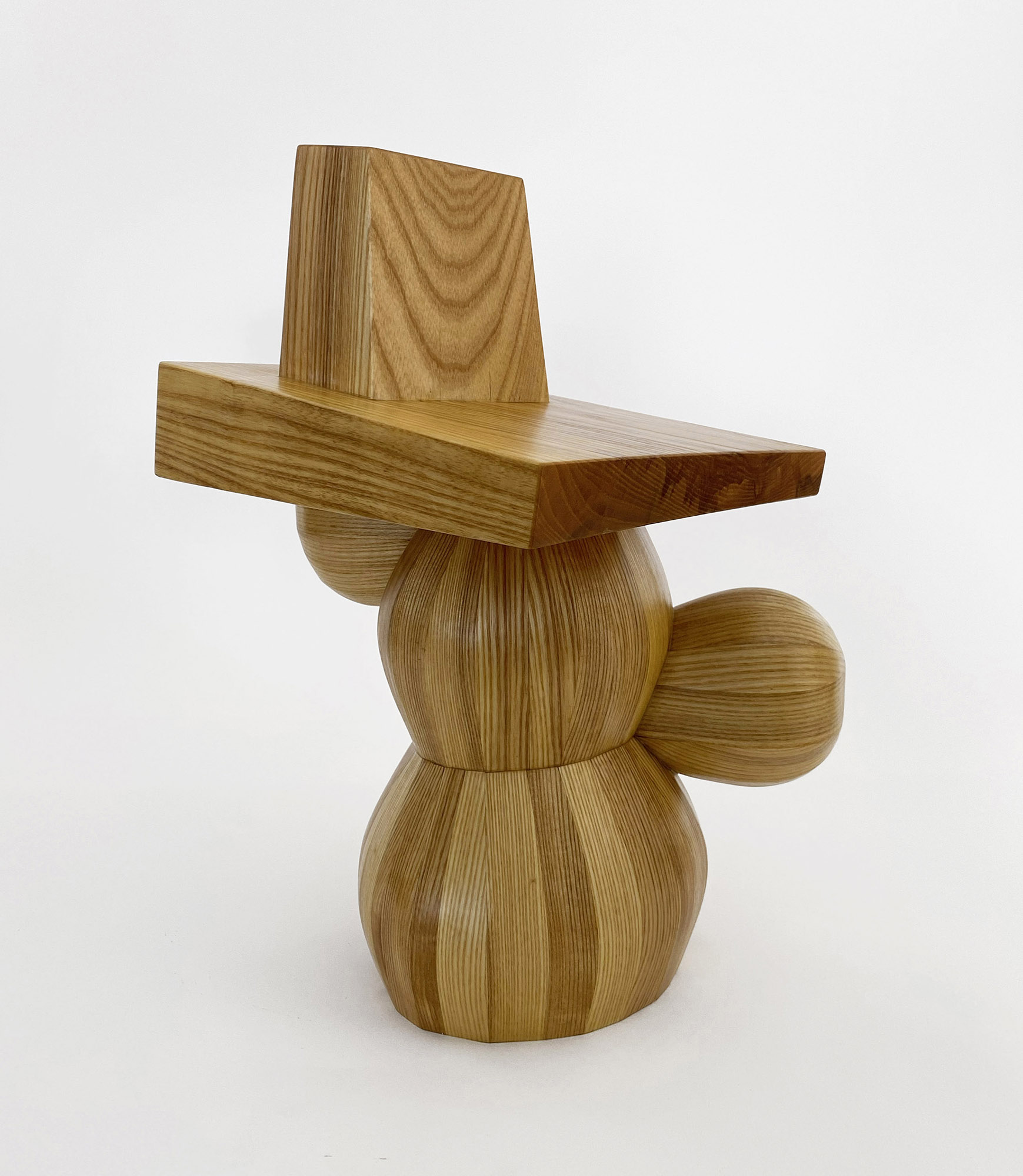
Steve Bartlett, “Casa Grande 5,” 2023, ash, stain, epoxy, wax. (Image courtesy of the artist)
Bartlett’s sculpture is emphatically not conceptual. “I don’t feel I’m trying to make a point or say something,” he concedes. But he does hope “they project a feeling.” Indeed, whereas his metal sculpture exuded energy and movement, Bartlett’s wood sculptures project a profound stillness. They can appear like sentinels or ancient boulders or heads. But, he says, “I try not to think about it too much. I know it when I see it.”
For more, go to s_tevebartlett.net_
“I’ve been on a journey to reinvent the substrate,” says Boothby, “to not be rectangular.” Boothby works with veneers, though painting remains a big part of what he does. He is interested in architecture and, specifically, the way it holds memory. His childhood bedroom and attic, the shed behind his grandparents’ house, the ferry he road to Fire Island, the apartments he lived in… all of these are inspirational fodder.
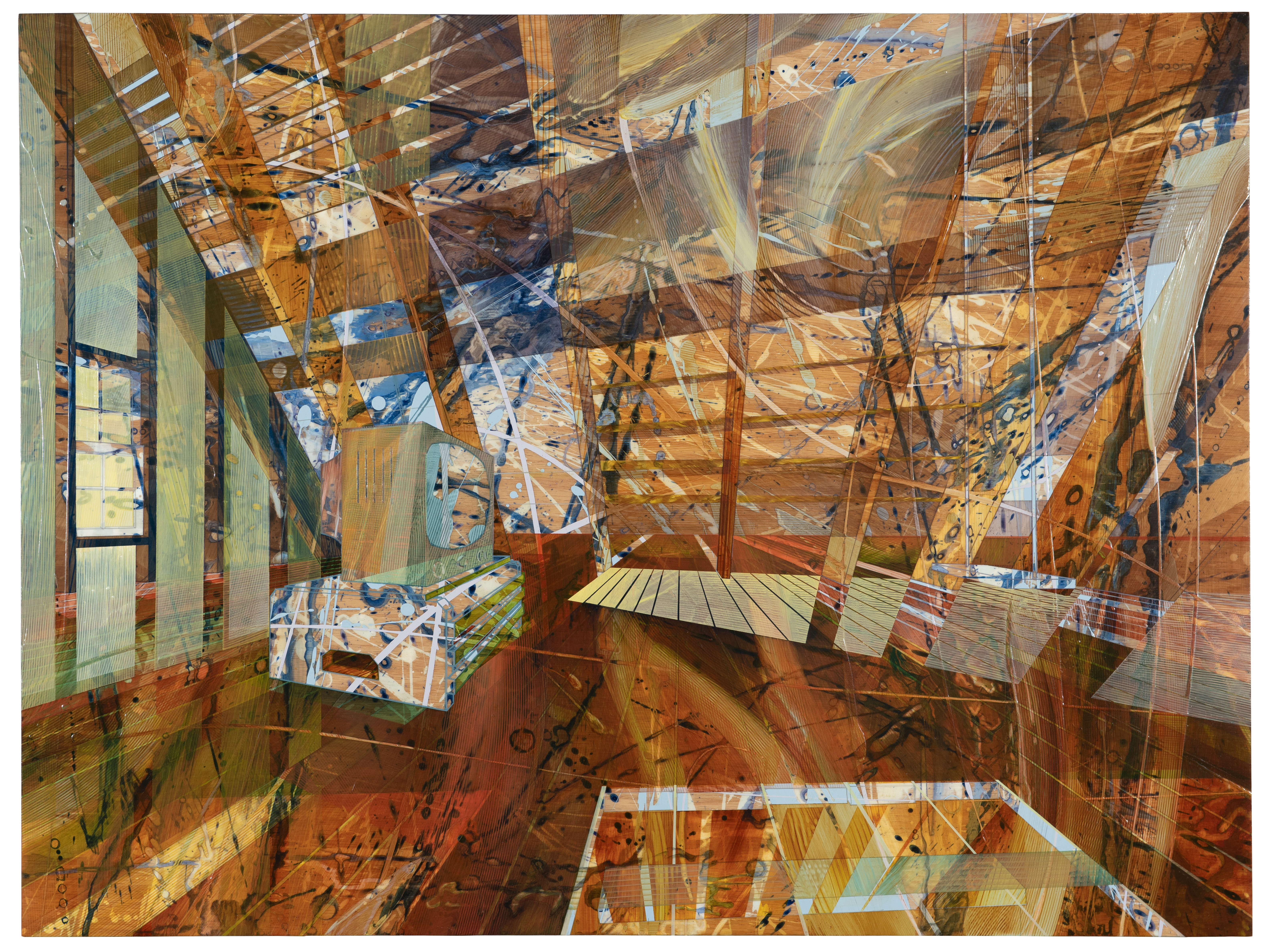
Ben Boothby, “Nylon Rope & Creaky Stairs,” acrylic and oil on oak panel. (Photo by Bret Woodard)
He begins by making a painting of a room, something he refers to as a “memoryscape.” But it is no ordinary representation of space. Instead, each seems to be viewed from many angles simultaneously, creating the illusion of depth that feels fractured and faceted into multiple dimensions, as if each section represents another angle of the room as he remembers it from different vantage points within the space. “Reality isn’t as real as you think it is,” Boothby only half-jokes. And indeed, these paintings challenge our conventional sense of what we perceive to be real.
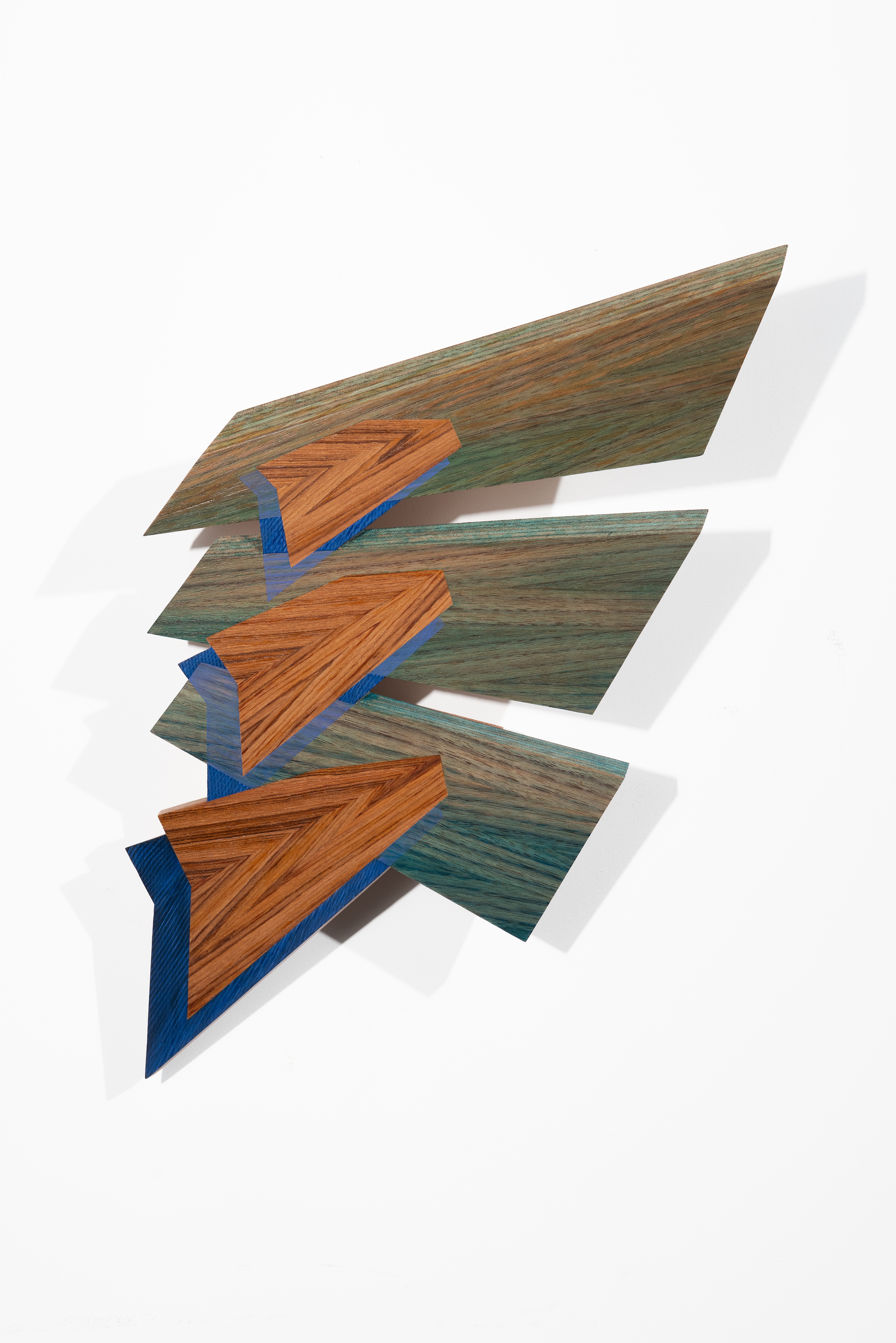
Ben Boothby, “Cantilever Iteration,” oil on veneer marquetry. (Photo by Bret Woodard)
From these, Boothby will extrapolate a certain form and then employ veneers — walnut, oak, maple, ebony, cherry, teak, etc. — to “paint” that form in two dimensions. Veneers are laid onto board in a composition, then Boothby cuts away the voids to reveal the composition’s dynamic form. “It’s aggressively analog,” he says, “just me with an X-acto knife for hours and hours.”
Finally, on these veneer paintings, he will apply patterns of color, the choices of which, he says, “are deeply personal and emotional.”
Advertisement
For more, go to benboothby.com
Giberson’s original motive in taking a woodworking course at Haystack was to take a break from his web design business by learning to make furniture. But he quickly realized that “So many people have ideas about what fine furniture should be. It’s often about who is doing the coolest joinery. There’s much more freedom in art.”
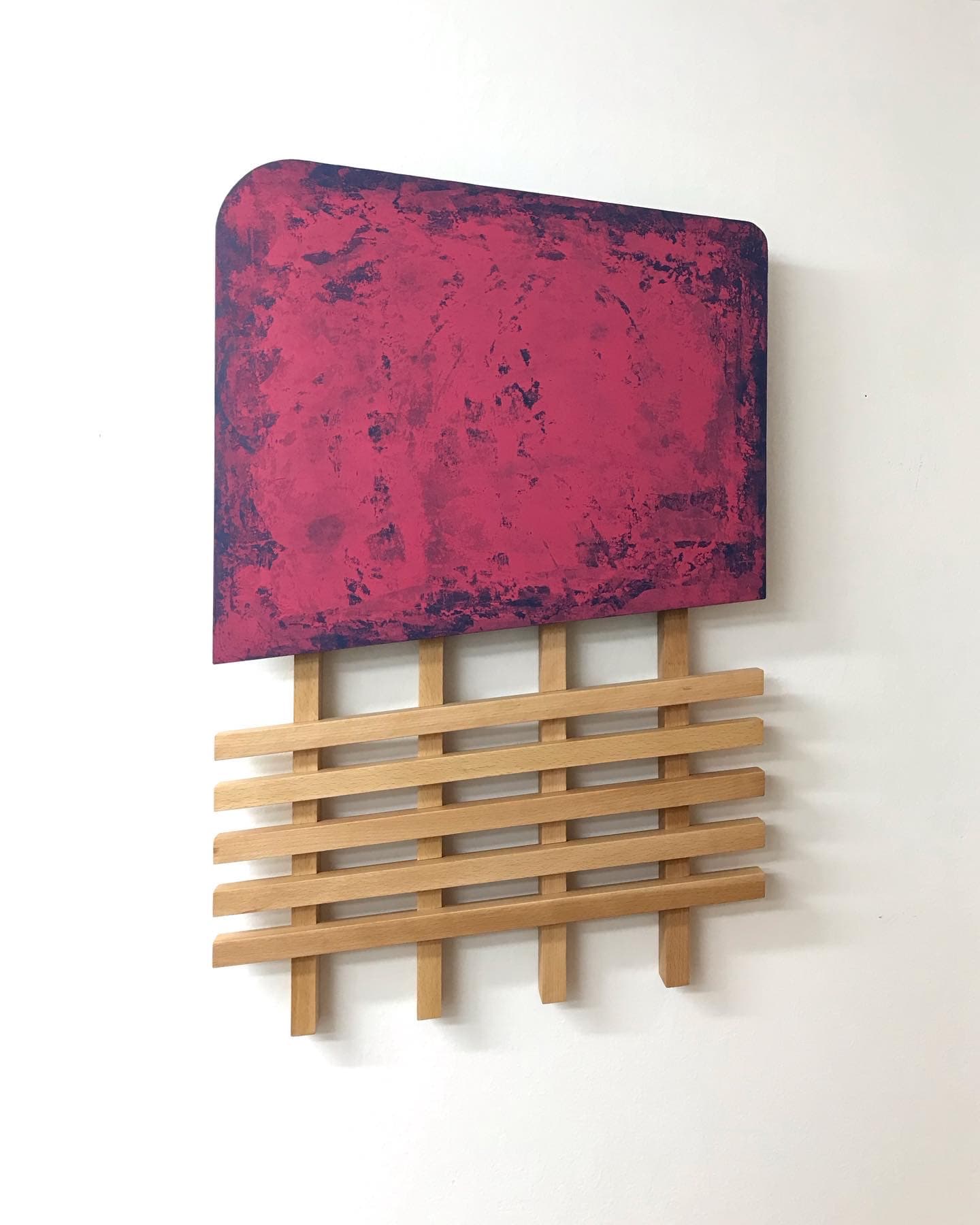
Sam Giberson, “No, I’ve Been Here A While,” 2023, beech, MDF, acrylic paint. (Image courtesy of the artist)
In the throes of the pandemic, he began informally dabbling in collage and assemblage and decided to use wood as a material for these art forms. He became enthralled with wood’s ability, when cut into shapes, to create spatial relationships, texture and shadow. He colored them and set them elevated from the substrate, hovering above it. The work is often inspired by architecture (it is often set within a box, as if it were a constructed environment).
Each wood element of the sculpture is then treated a different way — hand-gouged, colored with paints into which Giberson has mixed sand or some other way of distinguishing individual components of a piece and placing them in compositional relation to each other. The resulting tactility, he observes, “creates a play of light and shadow and asks to be touched.”
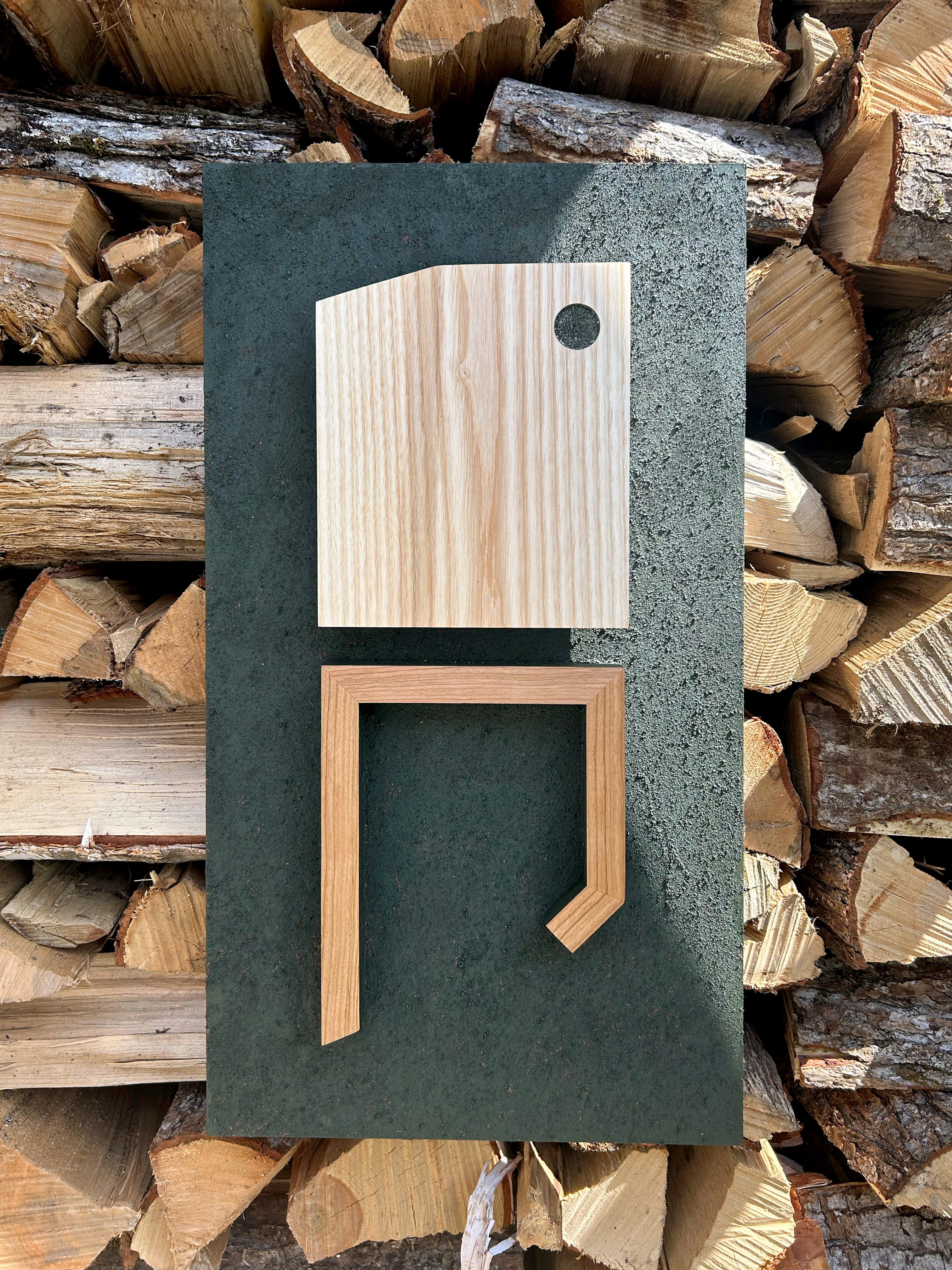
Sam Giberson, “In the Garden 3,” 2025, ash, cherry, plywood, acrylic paint, sand. (Image courtesy of the artist)
That tactility and color conspire to create dynamic planar assemblages. “Textures can imply layers of history and decay,” he also observes, “but that’s not a main narrative driving force.” Instead, forms such as trapezoids, keyhole shapes and broken lines jostle within the frame in a kind of dance. “I’m coming at it from a place of play,” Giberson says, “and with the intention to build things I haven’t seen.”
For more, go to territorysixteen.com
Advertisement
DUNCAN HEWITT
Hewitt creates sculptures that, he says, “are deeply familiar and at the same time out there. I don’t want them to be put on a shelf. I want them to be alive.” So, we can look at his work and recognize a glove, an ice skate, a cardboard box or a curtain. But unlike practitioners like Wendell Castle, who depicted objects such as coats and hats on a coat hanger, illusion is the farthest thing from Hewitt’s mind.
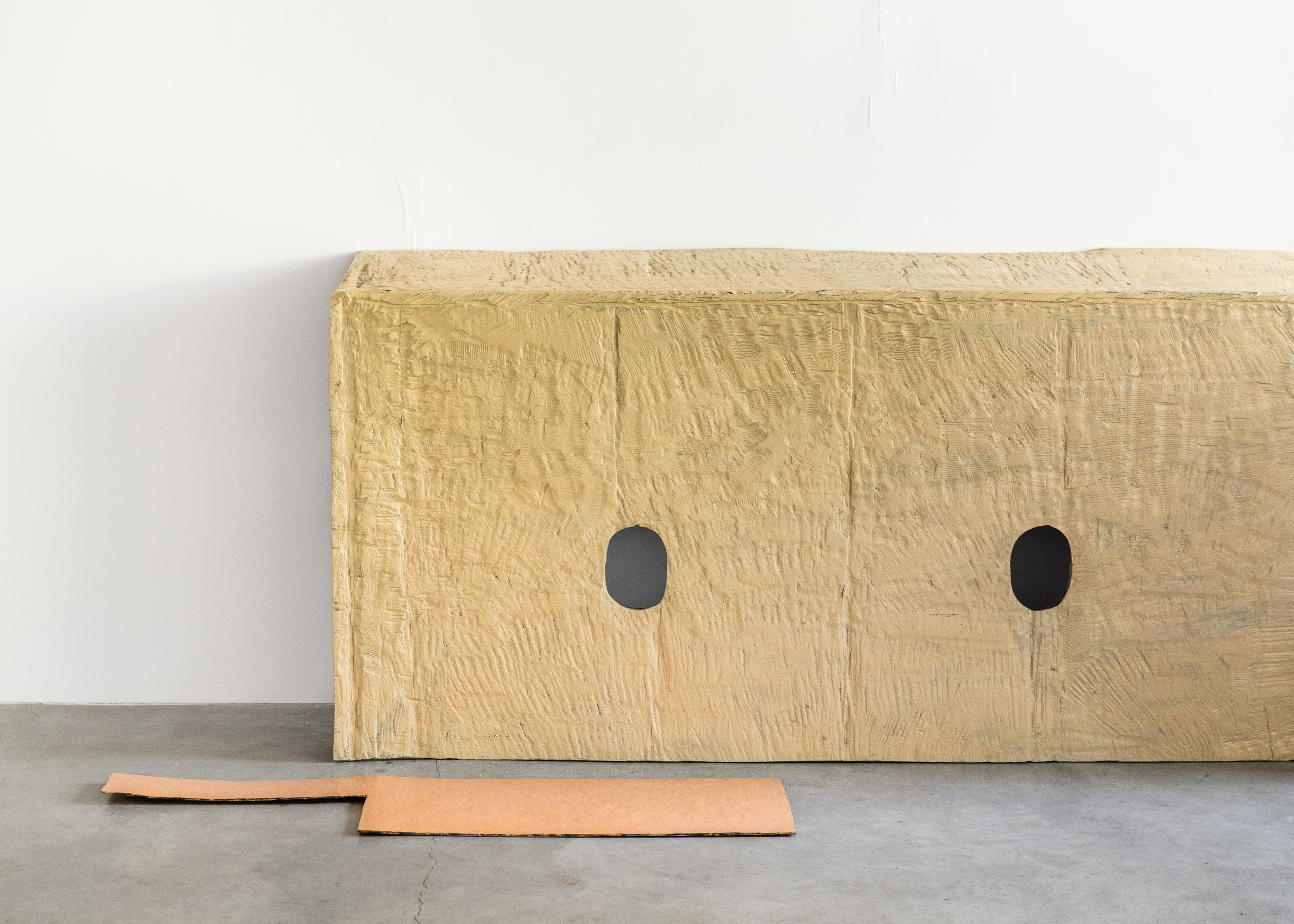
Duncan Hewitt, “Detail Carton Fragments,” 2021, carved and painted wood. (Photo by Joel Tsui)
“For me, carving can be incredibly rough at the first stage, then incredibly tender. I’m willing to move my aesthetic according to what is moving in me.” It is a physical process for Hewitt. “I like moving the material,” he says, which evokes “a physical range of emotions.”
This is an artist who wants us to question the very nature of an object. “What, exactly is that sweater in front of you?” he wants us to ask. “It has no cultural reference. But it has its own life. It isn’t just a sweater. How do you get into that weird space?” Hewitt’s sculptures often reside in a sense of ambivalence, even, at times, about his material. “My job is to have the feeling live right in the material. I’ve gotten screwed staying within the limits of that material. Wood wants to work with a long grain. But I try to be particular to the source object,” meaning the glove or the skate or the curtain, no matter what the material wants to dictate.
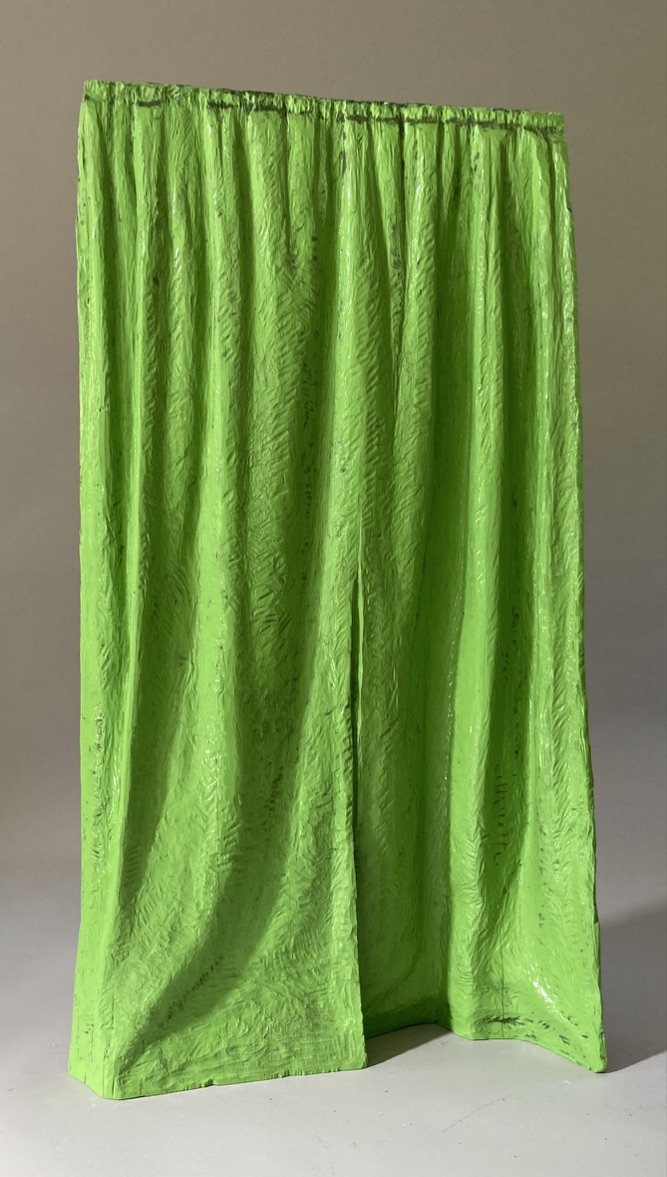
Duncan Hewitt, “The Floridian,” 2023, carved and painted wood. (Photo by the artist)
“I collaborate with things”— that is, material and subject matter —“so there’s a third thing. That is my power, to make something that’s way beyond you. This is what I do. This is my identity.”
For more, go to duncanhewitt.net
Johnston taught himself to make furniture, first by engaging with his father’s avocational woodworking, then through the 1960s-’70s counterculture magazine Whole Earth Catalog. But, he says, “With furniture, you have to learn to do the thing you have to do before making the thing you want to make.”
Advertisement
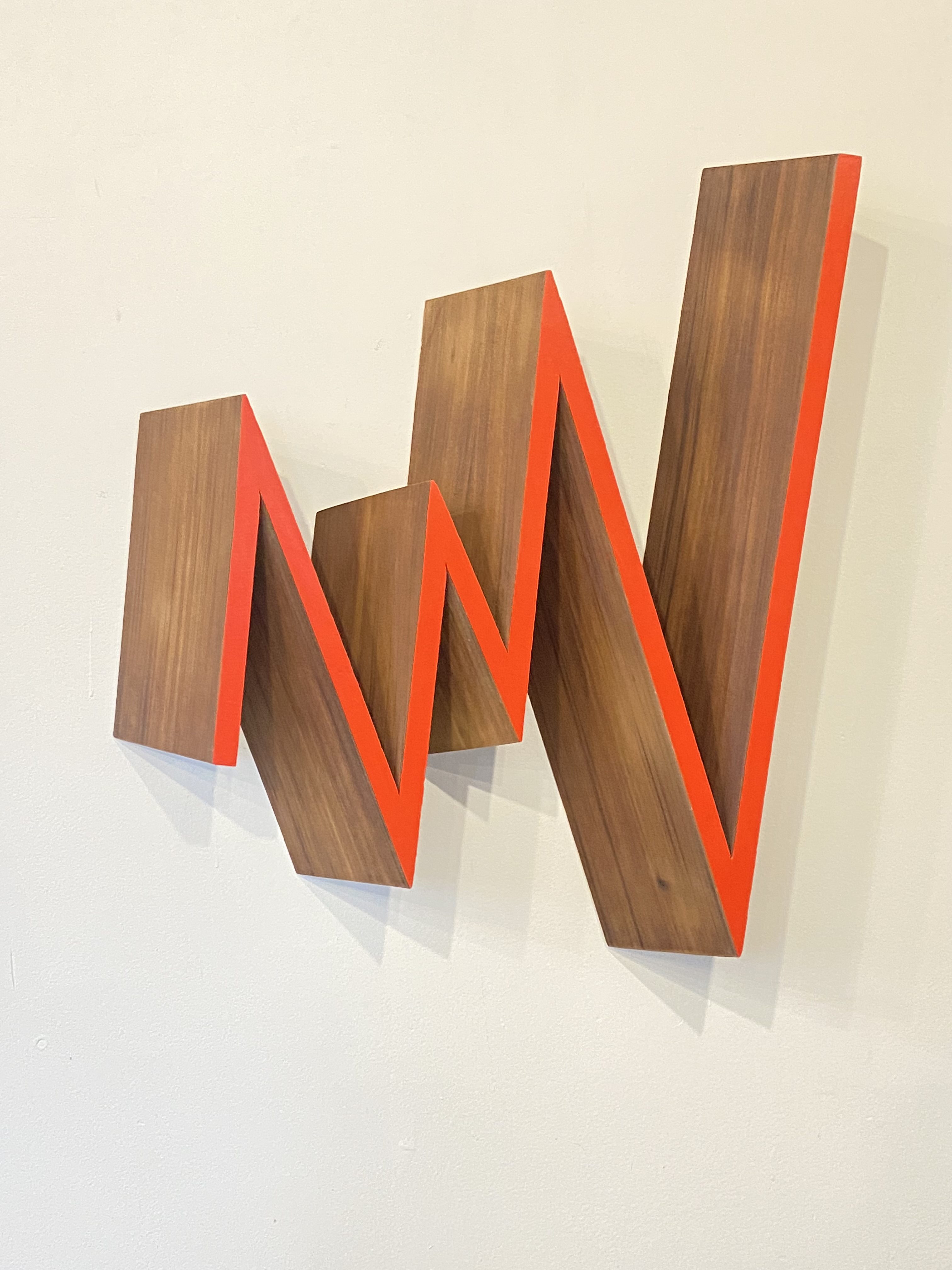
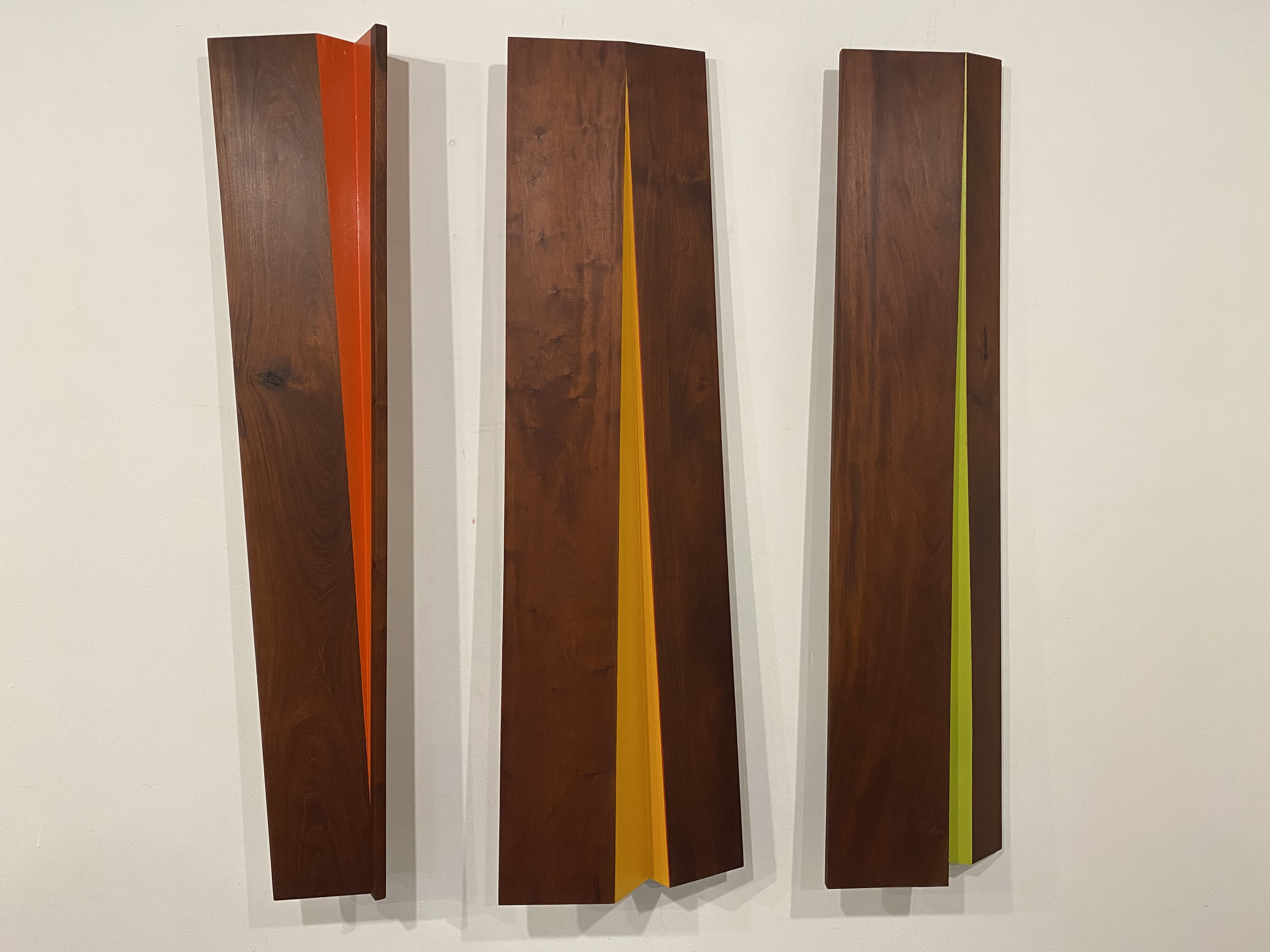
Jamie Johnston, “Red Zephyr,” wood and paint, 2023. (Image courtesy of the artist)
Nevertheless, he built furniture for about two decades and taught. Eventually, he recalls, “I started reacting to exposed joints or people saying ‘How did you get this so smooth?’ So, I started painting my furniture. I felt wood was a material for making things rather than a preciousness of material.” Paint was a way, he says, of shifting the emphasis away from the refinement of craft. Much like Giberson, he pivoted, using his acquired skills to produce sculpture.
“(Sculpture) gave me a way to think sequentially, to provide an order to how I thought of things,” Johnston says. Instead of making drawings, he could just work with multiple modules to think through a design process, placing them the way one might put down lines on paper. At some point, he began carving letter-like forms that were not really legible, essentially translating the idea of mark making into three dimensions.
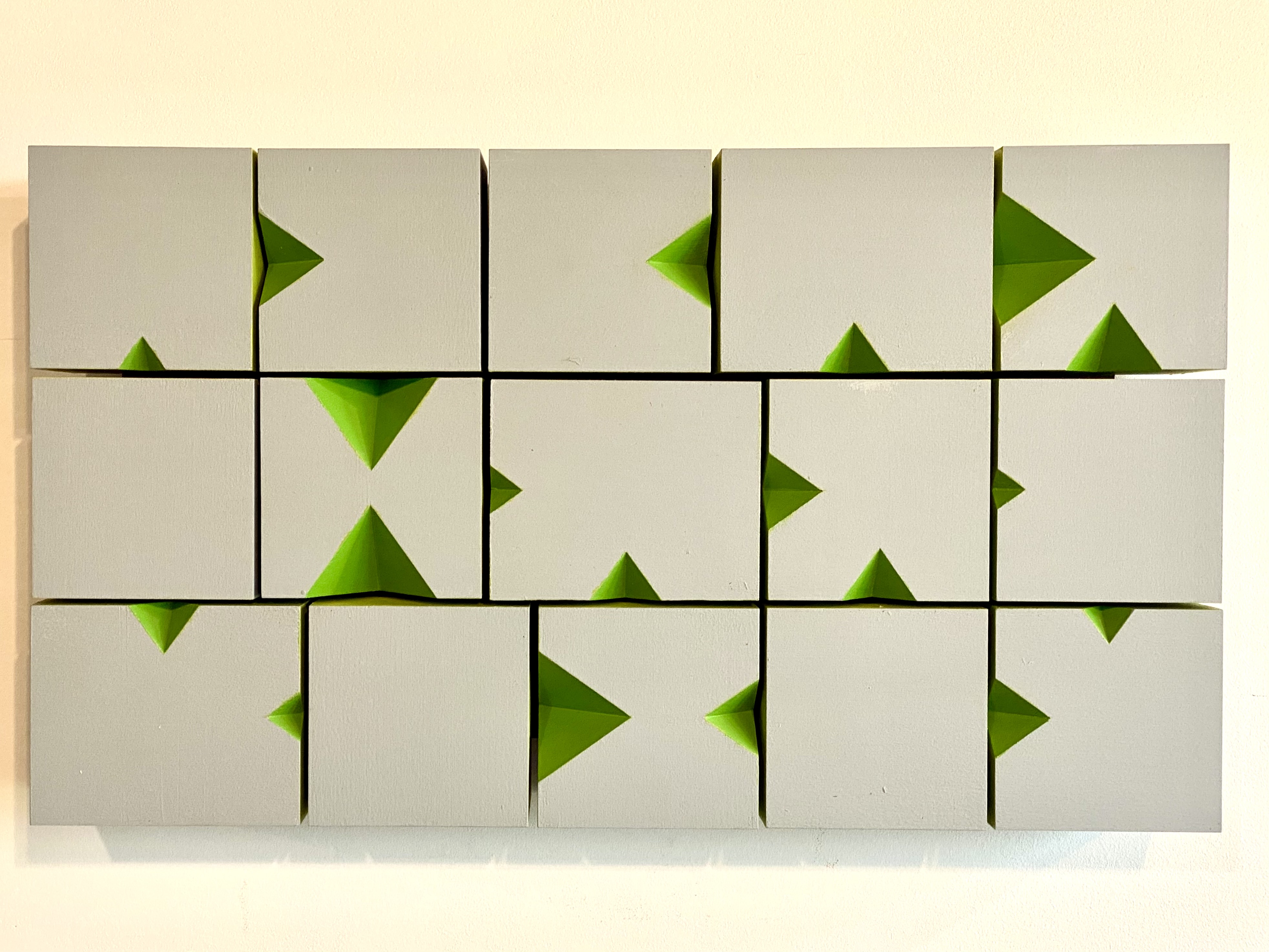
Jamie Johnston, “you, me and the other,” 2024, wood and paint. (Image courtesy of the artist)
Other forms followed — book-like shapes referenced a flirtation he had with being a writer, for example. There were accordion pleat forms and fan forms too. But there was never an intentional plan. “It originates with me in the manipulation of materials.” Through this manipulation and his use of color, Johnston’s works convey a kinetic quality. Not only do they feel as though they are moving, but as one strolls past them, they seem to morph like the images in a flip book. “You have to walk by them to understand them, really see them,” Johnston says.
Jamie Johnston, “Early May,” 2025, wood and paint. (Image courtesy of the artist)
For more, go to jamiejohnston.me
Lisberger started carving wood in her undergraduate years. “What kept me at it,” she remembers, “is that wood was so forgiving. If a piece broke off, you could glue it back or change it. If a stone breaks, on the other hand, you have to start over.” It was also, she felt, “a spectacular gift from Mother Nature that is plentiful,” with varied grains, colors and characters (i.e.: “Fruitwoods holds an edge because it is denser, and when I want something faster, I use softer woods”).
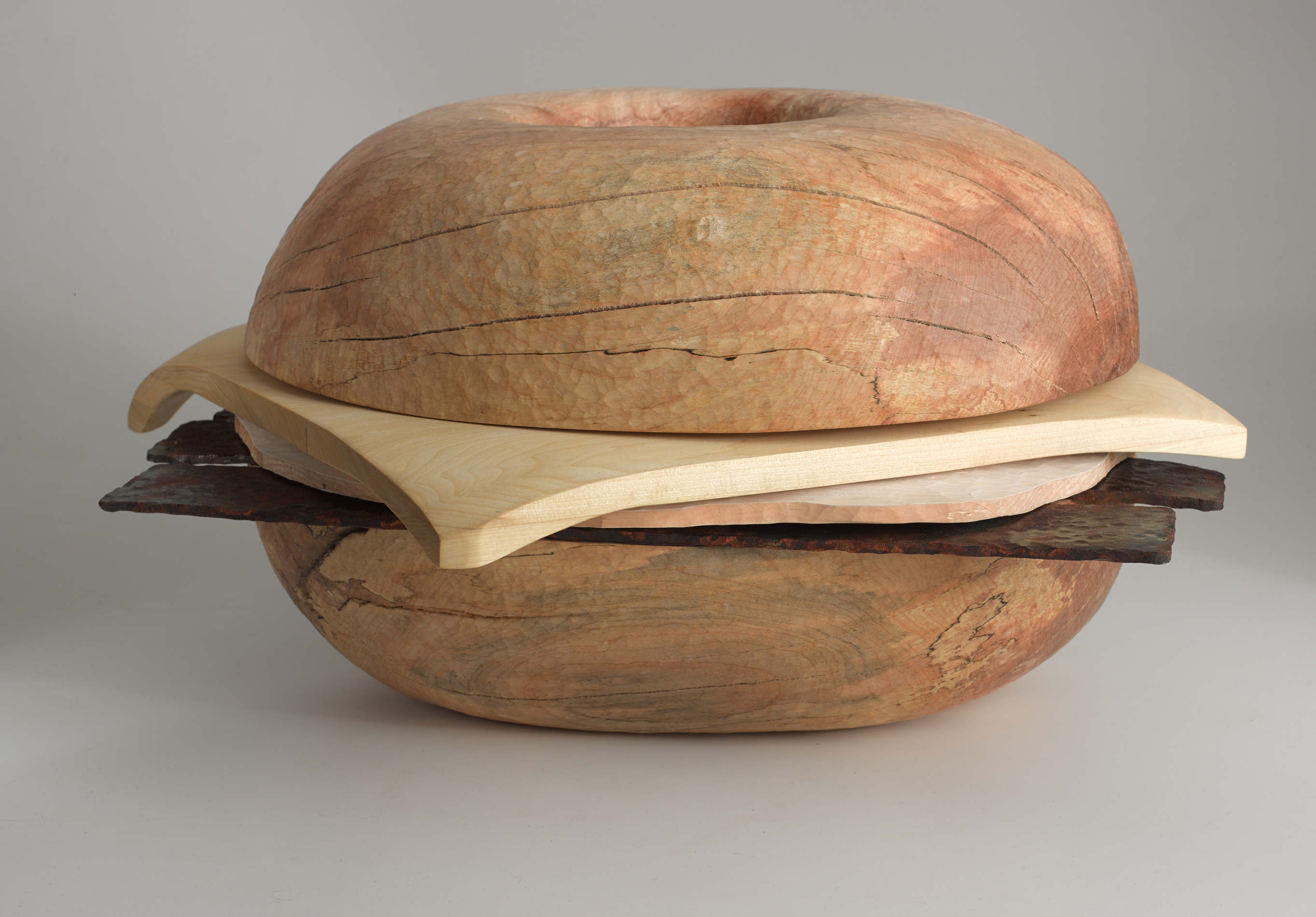
Lin Lisberger, “Bagel Breakfast Sandwich.” (Photo by Luc Demers)
Wood was also ideal for her sculptural interests and intentions. “My work tells stories,” Lisberger explains. “I wanted something consistent within those stories, and that was material and method.” Implicit to those stories is the evidence of the hand. “I like the marks that my tools make.” Too much refinement would lose this essential aspect of her work and make it less alive.
Advertisement
The stories she tells are culinary (whimsical food sculptures like bagels and hotdogs), natural (knot sculptures), quotidian (a shopping cart made from castoffs of other work, clown shoes, balloons), poetic (metaphorical bridges and ladders, or a pile of wood bones sitting on what looks like the shadow of a raptor that is based on Mary Oliver’s rumination on death, “White Owl Flies Into and Out of the Field”).
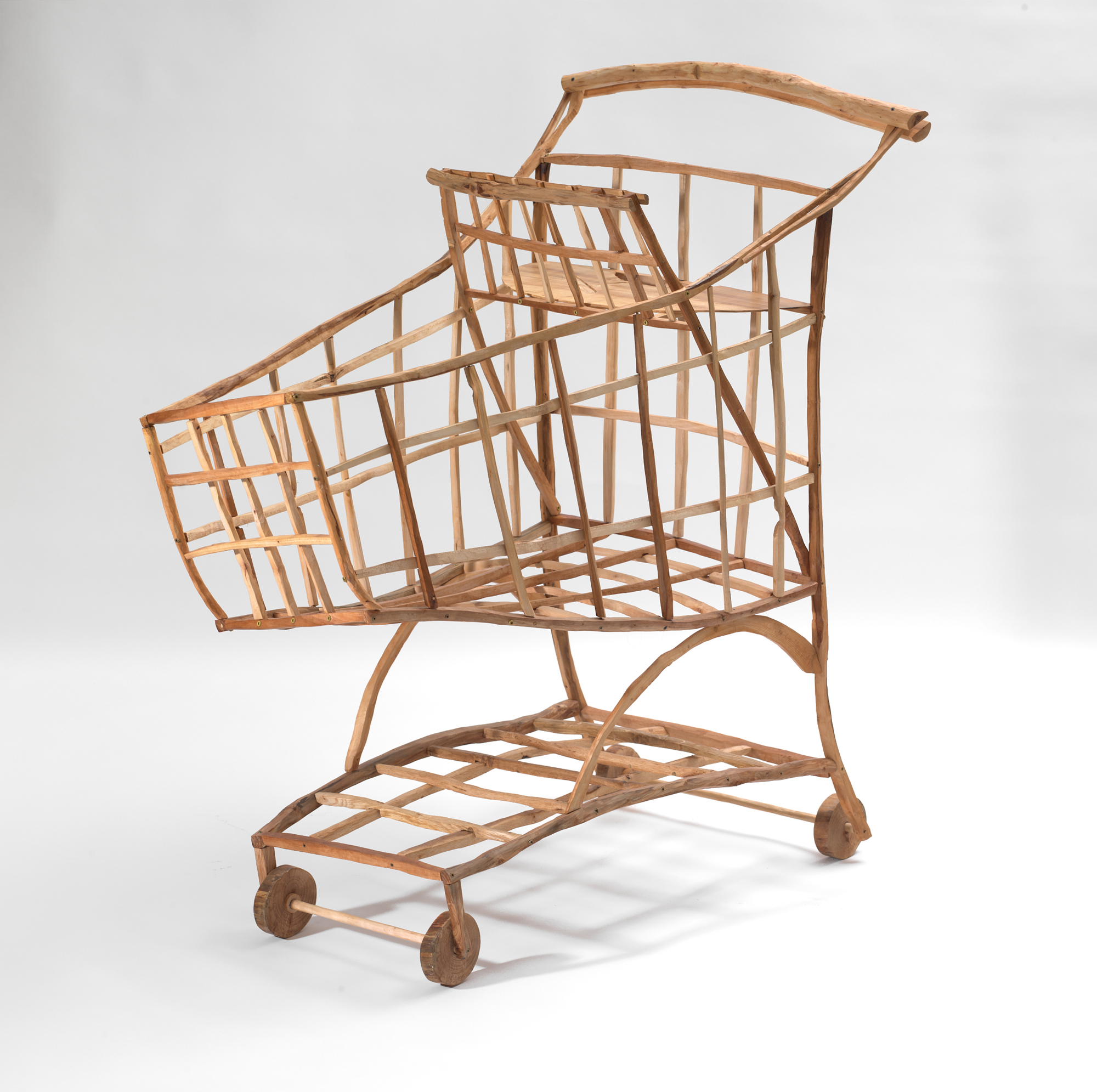
Lin Lisberger, “Shopping Cart.” (Photo by Luc Demers)
“I’ve always talked about my work as abstracted narrative,” she says. And yes, the stories are implicit in everything she makes. But it is the fealty to the material and the evidence of the making that make them evocative and stirring.
For more, go to linlisberger.com
Machowski took up carving after retiring from a career as a commercial, institutional and research lab architect. He converted an outbuilding on his Baltimore property into a studio and began experimenting with found wood. “I had a good arborist friend who would throw me anything he couldn’t make into spoons,” he recalls (he also works with wagon wheel hubs).
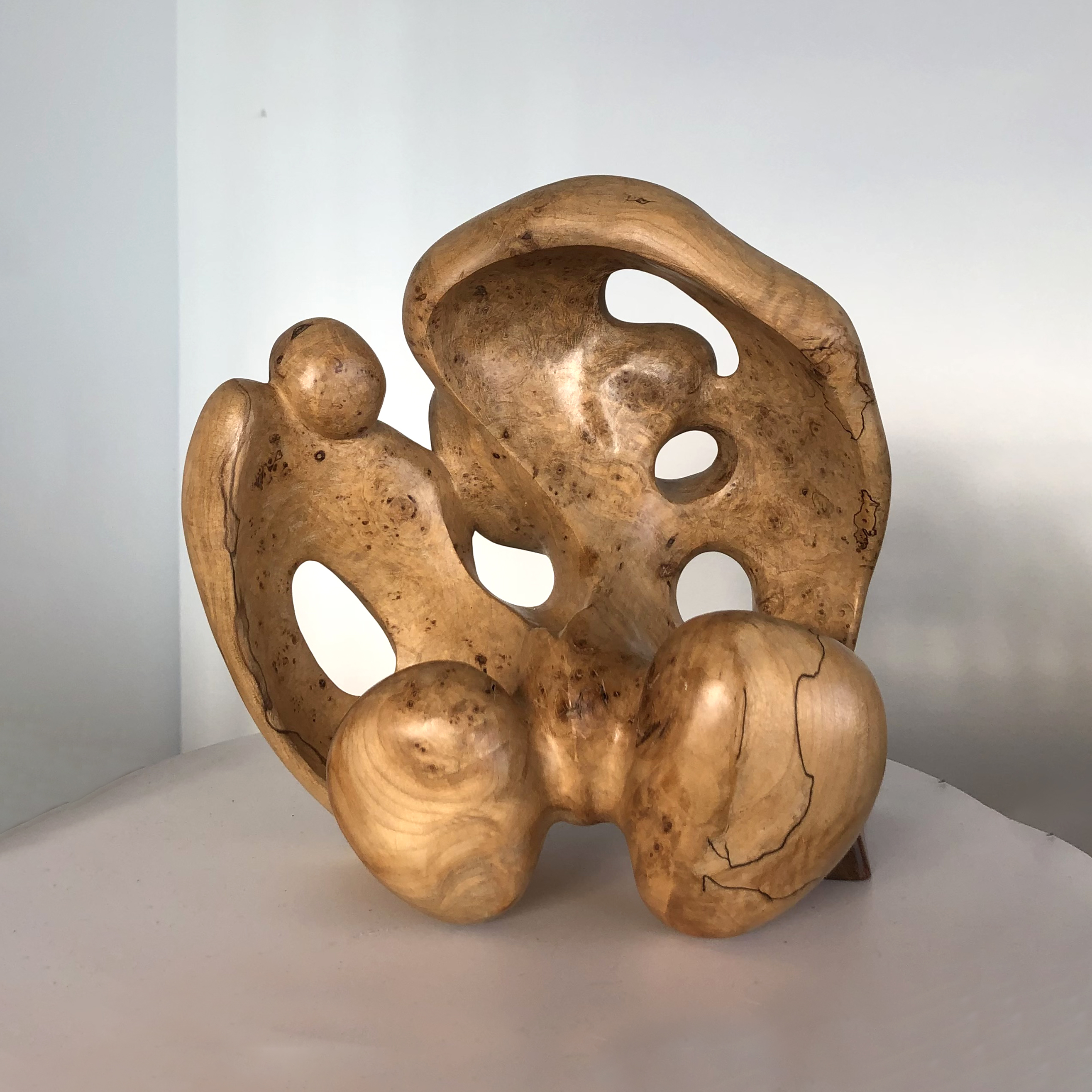
Tony Machowski, “Waiting for an Angel,” burl. (Image courtesy of the artist and Triangle Gallery)
Essentially, his process is subtractive, as much carving is. But it took a leap of faith to get there, he admits. “I was reticent about the subtraction process because I didn’t want to make a mistake.” But through conversations with his painter wife, Kathryn Shagas, about the creative process, and through a local sculptor’s group in Belfast, he slowly gained confidence, creating abstracted figurative works that feel at once voluptuous in volume and form, yet also airy and open.
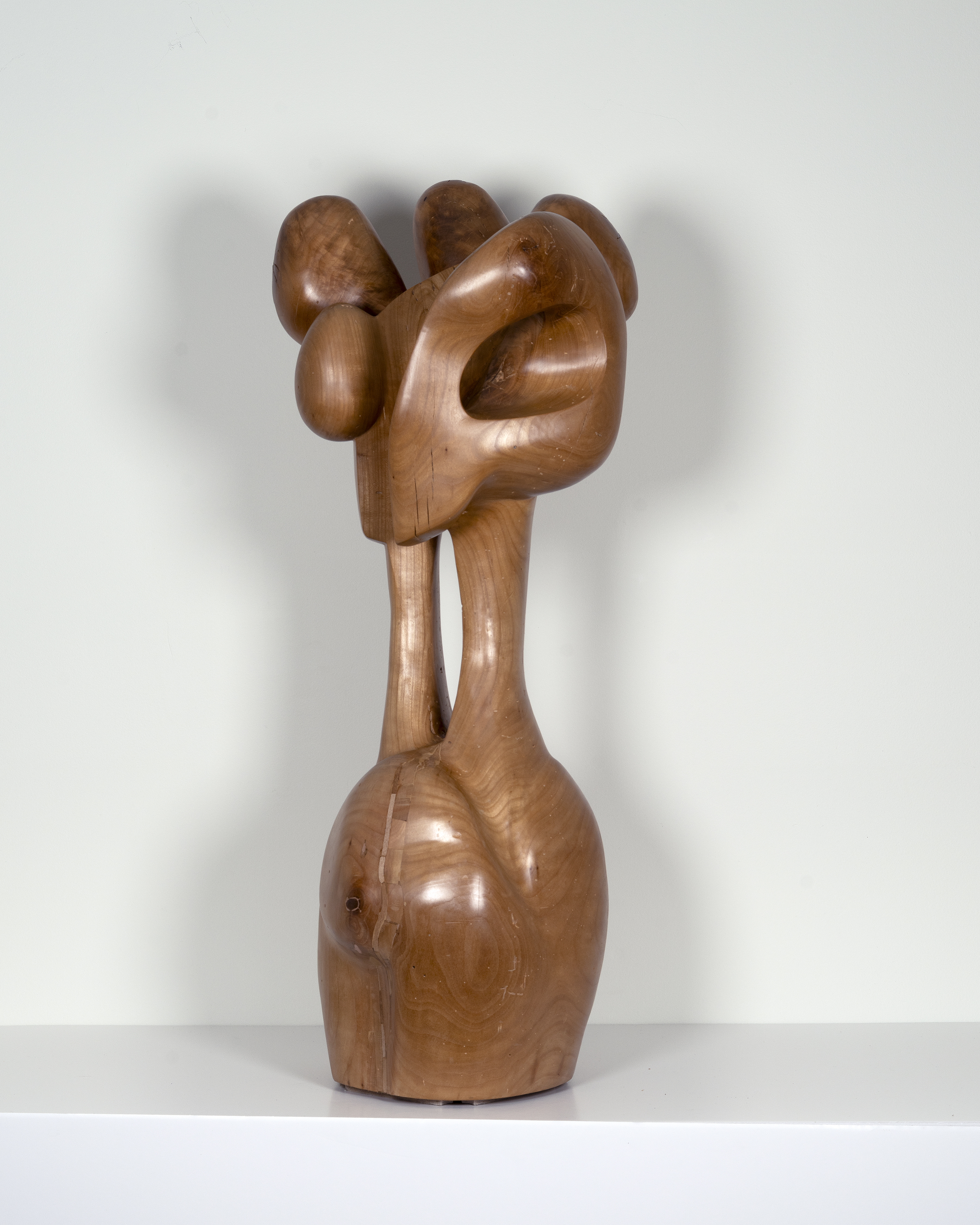
Tony Machowski, “Queen Mother,” cherry crotch wood. (Photo by Digital Printmaker/Courtesy of Triangle Gallery)
Machowski approaches each with no specific idea in mind and lets the wood lead his process. “Shape has a whole lot to do with where you start,” he says. “Some woods are obvious; others aren’t. I spend time with it and try to see it through different eyes.” Then comes the first chiseled mark.
Frequently, the process keeps unfolding an evolving over time. “The process can change over months and years,” he admits. “Sometimes I’ll have a piece for a long time and one day I walk by it and something niggles.” So he picks up his tools and goes at it again. “There’s always a way out.”
For more, go to trianglegallery8elm.com/artists
Jorge S. Arango has written about art, design and architecture for over 35 years. He lives in Portland and can be reached at [email protected]. This column is free to access through support by The Dorothea and Leo Rabkin Foundation.
Copy the Story Link
Tagged: artists, featured, Maine art, maine artists