
Anything is possible: My experience at the Maine Ironman triathlon


Press Herald intern Charley DiAdamo is seen at the finish line of the Ironman 70.3 Maine, where she participated in a relay as the runner on Sunday, July 26 in Augusta. (Libby Kamrowski Kenny/Staff Photographer)
“It doesn’t hurt,” I sobbed, referring to my unnaturally bent left arm.
Actually, it did hurt. A lot. But that wasn’t why I was crying in an urgent care center three days after moving into my Portland apartment, the same day I started my summer internship at the Portland Press Herald, and about fifty-six minutes after I bought my new bike.
I was crying because I was seeing four months of training, and well over a year of dreaming, go down the drain. Because I was scared and in urgent care with a roommate I had met two days prior. Because I was seeing my perfect Maine summer disappear before my eyes as they put the soft cast around my elbow.
I played competitive sports from a young age through prep school at home in Massachusetts. They were a defining part of my life. When I started at Colby College three years ago, I needed something to fill the hole, so I just kept training.
I ran my first marathon this spring but decided that wasn’t enough. Ironman 70.3 Maine, in Augusta, was four months after the marathon. A 1.2-mile swim, followed by a 56-mile bike ride, followed by a 13.1-mile run through the Kennebec Valley. I signed up.
I started training in the winter, amidst classes and working as a freelancer, hoping the mystery issues of the last two years — constant exhaustion, dizziness, shaking — would disappear if I ignored them. I was in pain all the time.
Advertisement
Dozens of doctors appointments left me frustrated and confused. I eventually learned I’d had both mono and Lyme Disease, both untreated and undiagnosed. I then found out I had a form of dysautonomia, a chronic disorder of the autonomic nervous system that affects involuntary body functions like heart rate and blood pressure.
I dealt with this, too, largely by ignoring it.
I knew my bike would not survive a 56-mile ride so I began looking at resale sites. When my parents helped me move into my Portland apartment, we went to a bike store. I finally found a slightly used road bike in my size. It was purple. I named her Barney.
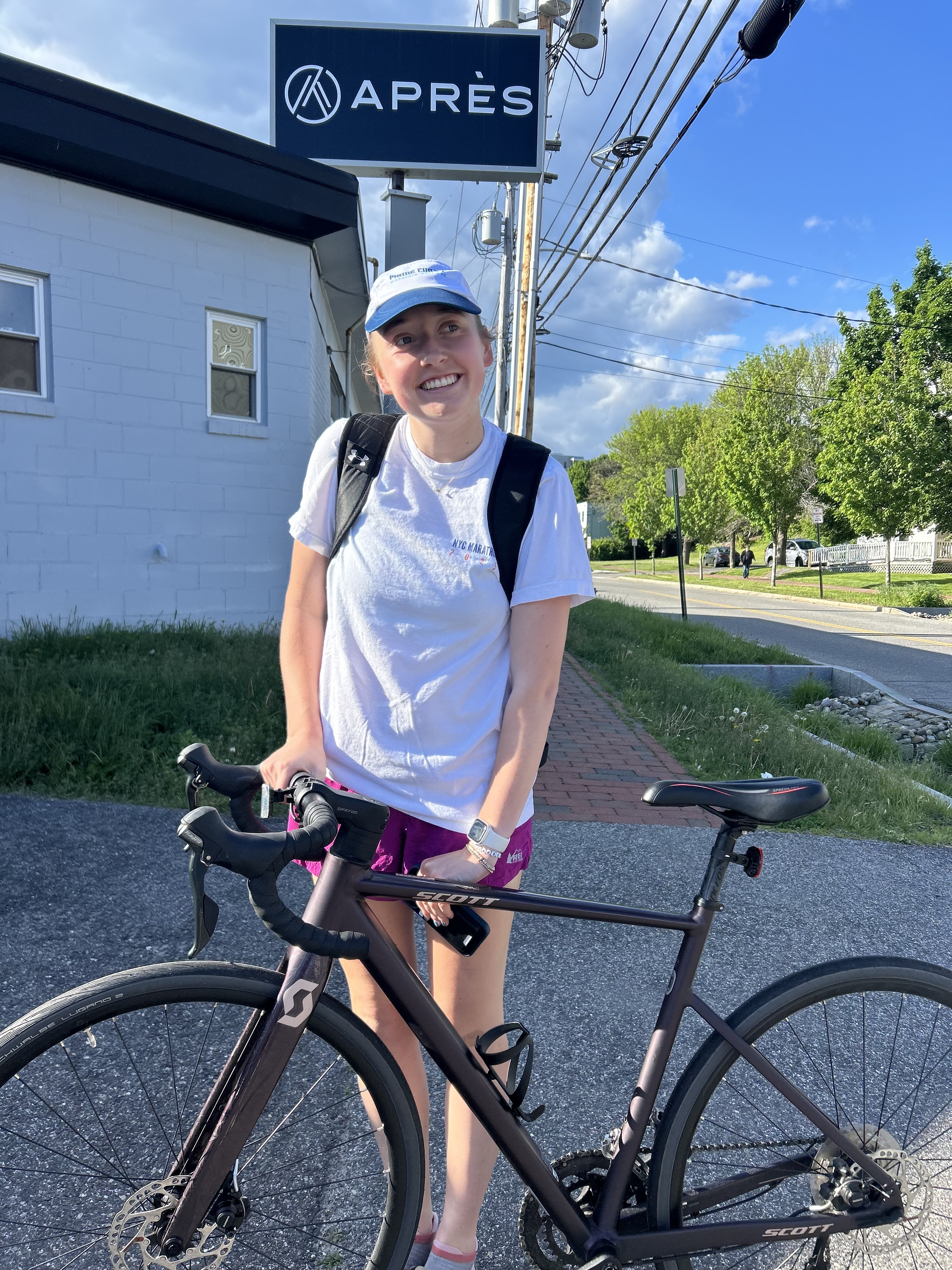
Portland Press Herald intern Charley DiAdamo with her bike, Barney. (Photo by Megan Blonigen)
I attempted to clip-in for the first time not-stationary on a completely new kind of bike, after months of only riding inside, alone in a parking lot. I have never been known for my patience.
I fell several times, on the grass and on the pavement. A couple passing by expressed concern but I waved them away. I was getting the hang of it, or so I thought.
I rode in a large circle and slowed down, trying to pull out my clipped-in cleat, but I wasn’t fast enough. I tipped over. Ignoring everything I’ve been taught about falling, I stuck out my arm.
Advertisement
I heard it crack.
I was stuck under the bike, one foot still clipped in, one arm bent unnaturally. I managed to untangle myself and walk home, holding my arm up. My roommate drove me to urgent care. Turns out I hadn’t broken my arm. I had broken my elbow. In two places. Surgery was a possibility.
I was supposed to do a Half Ironman in eight weeks, I said. I had been training for this for months, planning it for nearly a year. She laughed when I asked if I would still be able to race. She thought I was kidding.
I was not.
I was inconsolable, thinking about the race, then about all the hikes and surfing and exploring I had planned for the summer. Then everything else, like putting my hair up, or cooking, or my first-day-of-work clothes sitting on my hamper that I now couldn’t fold.
The next day, more x-rays confirmed the break. I again asked about competing. This doctor said there was a chance. I joined a gym with stationary bikes.
Advertisement
The first story I was assigned when I started my internship was about a man who was finishing a cross country bike ride in Portland. When my editor pitched it to me, I thought he was kidding. I met the man and his wife with my arm in a sling.
He was completing his journey after 50 years. On his first attempt, he was hit by a car and unable to continue. Now, in retirement, he was finally finishing what he started. His wife was relieved it was ending. Biking was dangerous, she said. We both held our breath as he rode down the final hill.

Related
Cyclist finished coast-to-coast ride in Maine 50 years after he started
I went back to the doctor three weeks before the race; I had decided I would do it no matter how little I had been able to train. The doctor asked, incredulous, if I meant a triathlon as in swimming and biking. “How do you think you’re doing that with an arm that won’t straighten and can’t hold your body weight?”
There was a chance I could switch to a relay team and still run.
Initially, I was opposed. If I couldn’t do it “right,” I didn’t want to do it. I would still go and support my two friends who were competing, but I couldn’t decide what would be less painful: just watching or participating in a different way that I originally intended.
I agonized, and cried some more, but decided to race.
Advertisement
I found a relay member, a guy I knew from middle school who had done the race the year before. We hadn’t talked in years but he was happy to help.
I kept training. I was angry at myself for not being in the same shape I was during the marathon, three months and one broken bone prior. And the heat was making the dysautonomia symptoms worse, some days I had to cut workouts in half, walking the rest of the way home.
I talked to my editor about doing a feature story about the event, a small way for me to commemorate it even if I couldn’t participate the way I wanted.
As the deadline approached, I still hadn’t heard back from the race coordinators. I was afraid the story wouldn’t come together in time. I felt like I’d lost a part of the race all over again.
Finally, I heard back. As I scrolled through a list of human interest stories, I came across my own name. The description mentioned my arm break and dysautonomia diagnosis. I was embarrassed about being listed next to newly postpartum mothers and people who had survived open heart surgery and brain procedures. I was ashamed of all my complaining.
I spent the next morning interviewing athletes. One of them, Zach Norman, had raced the same marathon as me that spring. He finished exactly one second behind me, so our names were right next to each other in the results.
Advertisement
Another, Andrew Emig, had brain surgery and competed as part of a relay team five months later. I interviewed six people, teary eyed in the office listening to all their stories.
I’ve learned that most people who choose the voluntary suffering that comes with any kind of endurance race have often dealt with some sort of involuntary suffering. There is a lesson in learning to live with the discomfort, and not letting it stop you.

Related
For many participants, Ironman just another obstacle to overcome
It was race week. My friends who were also competing called me, nervous about the race, but I didn’t want to hear it. “When you’re struggling on that bike,” I said, “remember how much I would kill to be out there.”
I drove up with my friend, and we met up with my relay partner. I met Zach and gave him a copy of the paper with the story I had written. I thought about the other people I spoke to, and the many more I didn’t.
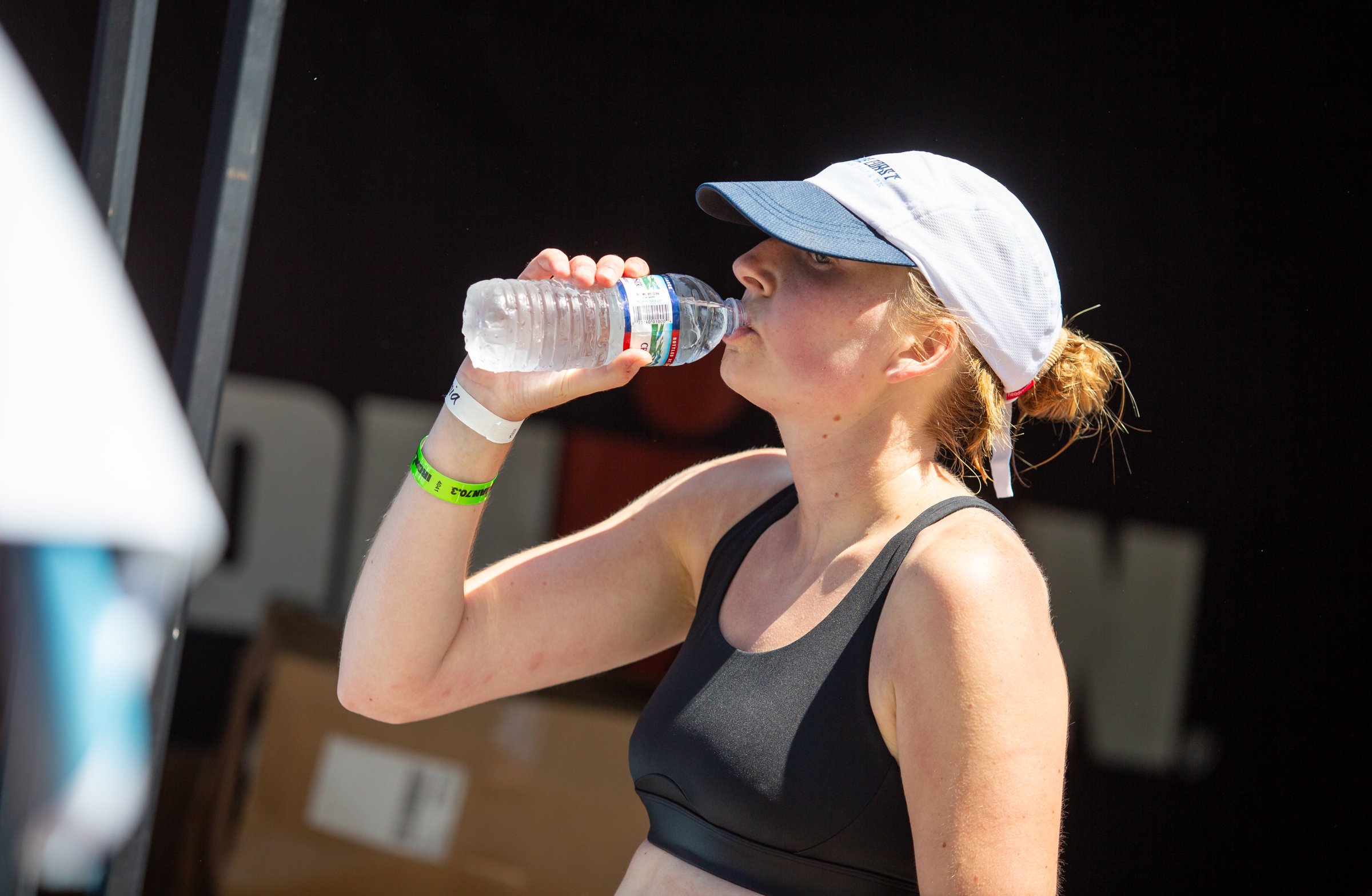
Press Herald intern Charley DiAdamo is seen at the finish line of the Ironman 70.3 Maine, where she participated in a relay as the runner on Sunday, July 26, 2026 in Augusta. (Libby Kamrowski Kenny/Staff Photographer)
After the 3:30 wake up on race morning, I watched everyone setting up their transition areas, some with headlamps strapped on. I walked the mile to the swim start with my friends, giving them final hugs as they went into the corral. I heard the cannon go off and the elite swimmers plunge in at 6:00 a.m.
I tracked them, along with Andrew’s team and Zach, on my phone, growing increasingly antsy as I waited to run. I chatted nervously with other women in the transition area. We wished each other luck.
Advertisement
When it was my time to run, I noticed most of the women I passed on the course nodded at me. One older woman watching the race by herself caught my eye. “You got this. Keep going,” she said. I put my head down and kept running.
The run was hard. It was hot. Because of my partner’s pace on the first two legs, I was running with people who were much faster than me, and my first mile split was unsustainable. I passed my parents, who were cheering, and my friend Sarah, who held a sign that read “Iron will > broken elbow.”
I kept reminding myself that most of the people around me had already done the 56-mile bike and 1.2 mile swim that morning. People had asked me what my goal time was. I wasn’t going for any personal record, but in my head, I wanted to get under two hours. My whole life in sport had been about a different kind of endurance and speed, and I had accepted I would never be a particularly fast runner. And I knew the broken arm wouldn’t help.
But as I came up the last hill, I glanced at my watch. There was a chance. Someone yelled my name – a male voice I didn’t recognize. I found out later it was Andrew.
I finished with a time of 1:59:56. Four seconds under.
I stood by the finish, cheering as other athletes crossed. One woman cried as she approached the finish line. I realized I was crying, too.
Nothing had gone according to plan. But it all worked out.
Copy the Story Link

Charley DiAdamo, from North Andover, Massachusetts, is a rising senior at Colby College. She writes a food and humor column for The Colby Echo and is a freelance contributor to The Maine Monitor. She is. More by Charley DiAdamo