An acclaimed architect revisits his Maine roots

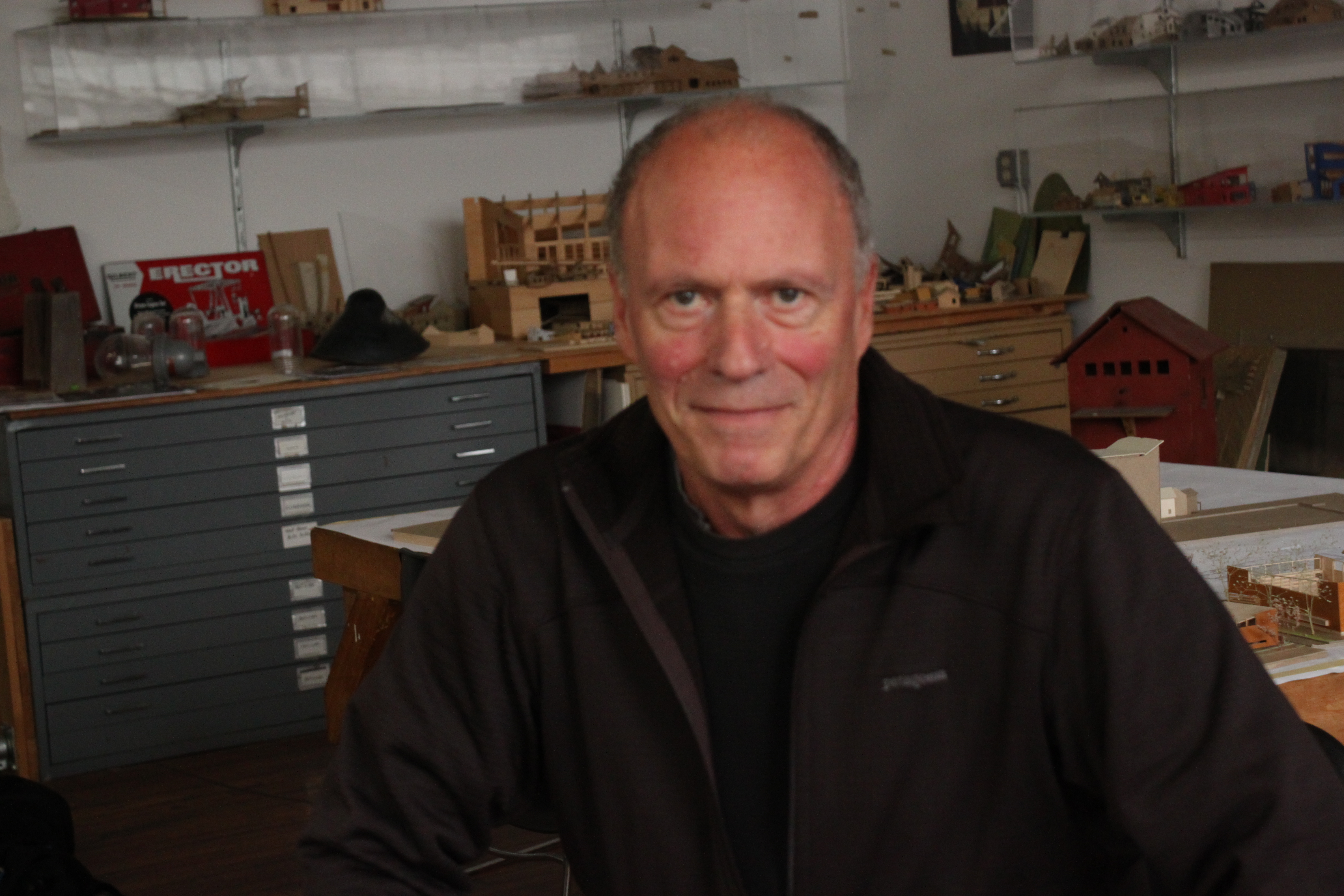
Author Turner Brooks. (Photo courtesy of the author)
Over the course of his long career in architecture, Turner Brooks has designed buildings ranging from distinctive homes that harmonize with the landscape to a campus designed for residents with autism spectrum disorders. In his new book “Spatial Memories and Preoccupations of an Architect,” Brooks shares his thoughts on space and revisits some of the projects that helped clarify his aesthetics — all the while tracing the role Maine played in his artistic evolution.
Brooks’ childhood memories of visiting his grandparents in Maine provide one of the keys to his philosophy of space. Their home — and the bedroom where he slept, “suspended over the front porch of the house and centered directly above the front door” — left a formidable impression on him through its combination of indoors and outdoors, light and shadow. Elsewhere, he revisits a moment of traveling foggy waters around Seal Island and perceiving “a miraculous little circle of clarity” around the boat — another key to his conception of space.
We spoke with Brooks about the genesis of his book, his philosophy of architecture and design, and the importance of bats.
Was there any one specific impetus that led to you writing an overview of your career?
I don’t know if there was one incident. I’d say it was a series of incidents. One came from teaching and feeling that there wasn’t much discussion about what space actually was about. Mostly it was a description of form and things like that: Details and colors. The actual issue of how to talk about space, which to me is the most important part of architecture, was somewhat ignored.
I was given a project when I was a student that was very important to me. I keep invoking it, and as a teacher I’ve given this project to my own students for years and years. It’s called the dominant void, and it was given to us by the guy who the book is dedicated to, Kent Bloomer. It was really our first project in architecture school: To define a space that was more palpably present than whatever was around it. It sounds like an insane paradox. I’ve called it the quest for the Holy Grail, though there are very few Galahads — more sweating Lancelots struggling to do it.
For the student project, these spaces seemed to be very inhabitable to me, and they were designed around the movement of the body. You would feel happily encapsulated in these spaces, because they had an atmosphere of its own that was different from the landscape outside of it. The inspiration was about making spaces that contain the body in a comfortable way.
Advertisement

Turner Brooks’ “Dancing Void.”
Another element that inspired the book was my memories of spaces I inhabited as a child, like that little bedroom in Maine. It had these wonderful windows that looked out at the road to the landscape and also down the stairs into the living room, so it was embedded in that cozy atmosphere of the larger landscape of the house, as well as the larger landscape.
There was not one moment when I thought, “I’m going to write a book.” But I’ve been working on it for 20-something years, off and on. I didn’t think of it as writing a book, but just writing memories of space. Then it became clear what I was doing. That’s also in part due to my friend Cynthia Zarin, who edited a lot of the initial writing.
For readers who aren’t familiar with your work, are there any spaces that you could point them toward to get a sense of how these spaces and absences work in practice?
In the book, I wrote about buildings in Rome designed by Francesco Borromini. Those spaces feel incredibly, wonderfully active, like there are overlapping vibrating ripples that are moving around. The funny thing is, I’ve always wanted to release a thousand bats into those spaces, because bats are the most amazing space definers. If you had a cloud of bats flying around, they would define the shape of the space and, in an amazing way, demonstrate that it’s full of some sort of atmosphere.
The Sant’Ivo alla Sapienza and San Carlo alle Quattro Fontane would be two spaces where I think you would get a really clear idea of what the whole book is about, in terms of palpable space.
Buildings aren’t the only thing you cite as an inspiration in your book. You also mention a few paintings, including work by René Magritte.
There are several paintings that are cited, like Edward Hopper’s “Rooms by the Sea_._” That’s an amazing painting: You have the open door that looks out at the horizon of the ocean at a far distance and in the center two-thirds of the painting, which is so radical, is just a blank wall with a light coming down diagonally over it. The shaft of light leads you to a little open door on the left side of the painting which reveals a cozy domestic space with furniture. “It’s like the house in Maine, an interior space which relates to the vast space of where the horizon meets the ocean. It illustrates everything I’m trying to talk about in the book.”
Besides the house you spent time in while growing up, are there any other spaces in Maine that have had a significant influence on your aesthetic sensibility?
I love the streets of Kennebunkport, and the great houses all over the place. But in Maine, it’s about the landscape. In Biddeford Pool, you go from The Gut into the vast ocean, and that’s also part of what the book is about: The coziness of the pool and then that little transitional liminal zone of The Gut and then the ocean beyond it, which opens up to the rest of the hemisphere. The landscape there was very influential on me — the harbor in Biddeford Pool and the transition out into the ocean and the islands.
Advertisement
In writing about your work as an architect, you discuss a lot of community-oriented spaces and housing designed for working people. Given that affordability has been in the news a lot lately, do you feel vindicated about some of the stances you’ve taken over the years?
I’m actually quite proud of the fact that I’ve never done a house for a yuppie. When I started in Vermont, I was paid in pots for my design fee for the first house I designed, because it was for a potter. I made four dollars an hour as a carpenter; this was in 1972.
A few more recent clients have been fairly wealthy, but nobody’s been super wealthy — most of them have been not very wealthy. And then the other projects I’ve done frequently are schools, which is satisfying too because they’re places for learning. I believe in affordable, humble things that are not grand and expensive.
Having taught architecture, have you seen any of the concepts you’ve taught making their way into the world from your students in ways you would not have expected?
I’m 83. I’ve been retired for a couple of years. It’s an interesting question, because there have been so many fluctuations since I graduated. When I was a student, we did what’s called at Yale a building project. For the first building project, we were revolting against fancy sorts of corporate architecture. We had a wonderful dean named Charles Moore who also was revolting against those things and we designed and built a community center down in New Zion, Kentucky, in Appalachia.
There was an emphasis on smaller and affordable things, and then it all changed with the sort of fancy post-modernist material that erupted later. I’m not saying it has anything to do with my influence, but I feel now that students are much more involved in socially relevant projects and are not so interested in the corporate stuff. I find that very refreshing. There are more studios now at Yale that are devoted to affordable housing and socially relevant projects, which I think is a good change.
Fifteen years ago, there was a lecture by a developer. He showed this hill of beautiful vernacular villages that were falling apart. And then he showed how they were all destroyed by his company, which built all these fancy high-rises. There was no discussion of what happened to the people who lived in the original village. That would never happen now. There’s more awareness of social issues now, which is very much like the attitude of that period when I was in school.
New York City resident Tobias Carroll is the author of five books, most recently the novel “In the Sight.” He has reviewed books for The New York Times, Bookforum, the Star Tribune and elsewhere.
Copy the Story Link
Tagged: books, Maine authors