

After Lowe’s Failed to Get His Case Thrown Out, Its Lawyers Turn Their Attention to the Man Suing Them
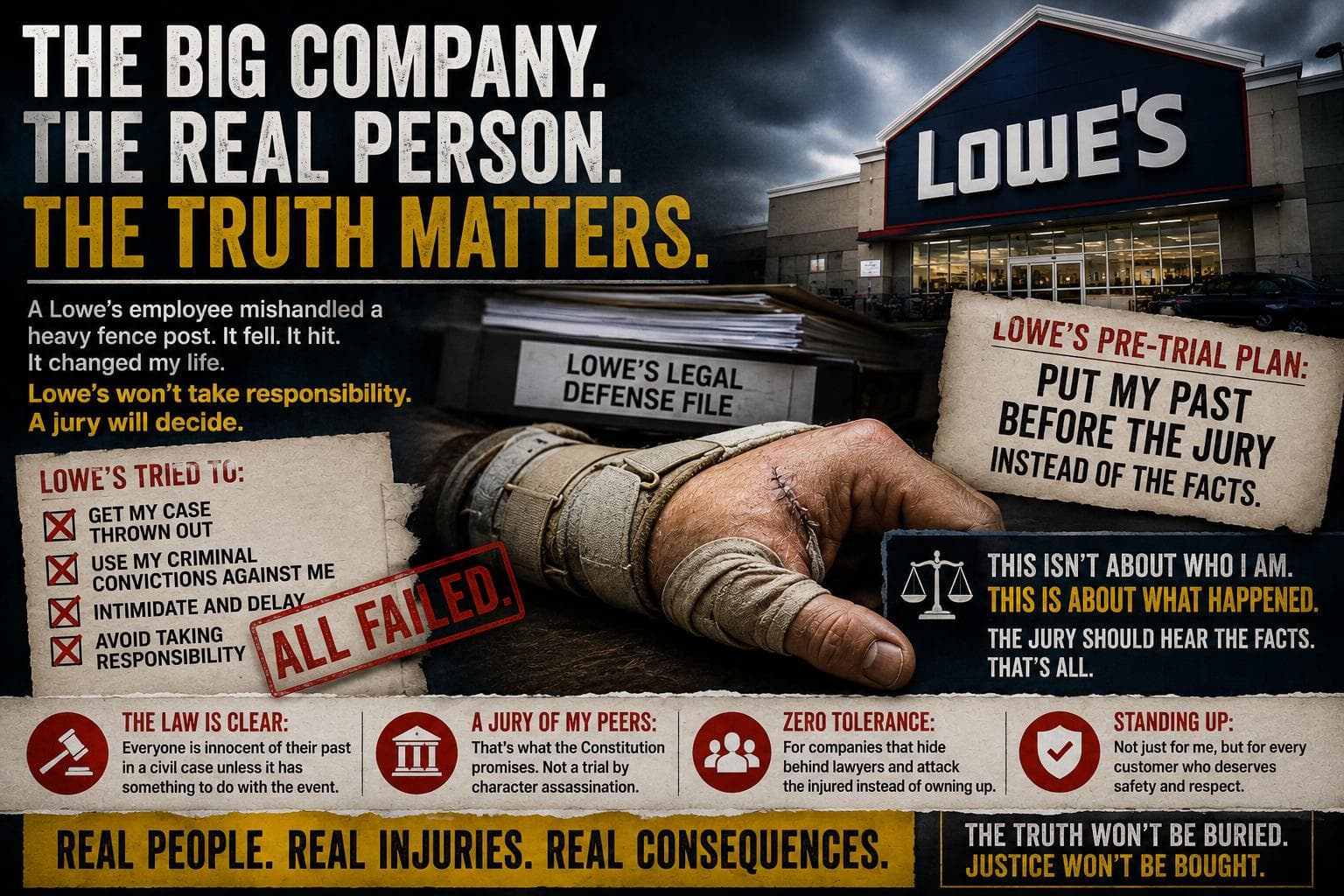
A Maine man representing himself in federal court has survived Lowe’s attempt to end his personal-injury lawsuit before trial. Now, as the case moves toward a jury, Lowe’s is signaling that it intends to bring something very different into the courtroom: his criminal history.
Nathan Reardon alleges that he was injured at the Lowe’s store in Brewer in December 2019 when a cashier mishandled a wooden fence post, causing it to fall toward him. Reardon says he instinctively reached to protect himself and the post struck his thumb, ultimately leaving him with lasting problems.
The incident itself was captured on Lowe’s surveillance video, according to the company’s own September 1 pretrial filing.
Reardon is representing himself. Lowe’s is represented by attorneys from Morrison Mahoney LLP.
That disparity has not stopped Reardon from getting his case to the courthouse door.
Lowe’s Tried to End the Case Before a Jury Could Hear It
Lowe’s moved for summary judgment, arguing in significant part that Reardon could not prove the necessary medical causation because he had not disclosed his own medical expert.
The effort did not end the lawsuit.
On July 28, U.S. District Judge John A. Woodcock Jr. denied Lowe’s motion for summary judgment and concluded that a jury could find that Reardon suffered at least some injury from the incident.
The court drew an important distinction between complicated questions about whether the incident caused Reardon’s later surgery and the more straightforward question of whether being struck in the thumb caused an immediate injury.
The court stated that a factfinder could determine that when the Lowe’s employee fumbled the post and it struck and damaged Reardon’s thumb, Reardon sustained an injury through Lowe’s negligence for which he could be entitled to compensation. The judge left the ultimate questions for trial rather than eliminating Reardon’s case before a jury could hear it.
Now Lowe’s Wants the Jury to Hear About Reardon’s Criminal Record
With summary judgment unsuccessful and trial approaching, Lowe’s September 1 Pre-Trial Memorandum reveals another part of its strategy.
Among the witnesses Lowe’s identifies are “any and all persons necessary to authenticate Plaintiff’s prior criminal convictions for impeachment purposes pursuant to Fed. R. Evid. 609.” Lowe’s similarly lists copies of Reardon’s prior criminal convictions among its potential trial exhibits.
The convictions have nothing to do with how the fence post was handled at the Brewer Lowe’s store. They do not determine whether the post hit Reardon’s thumb. And they do not establish whether a Lowe’s employee acted negligently.
Lowe’s apparently intends to offer conviction evidence for the legally distinct purpose of attacking Reardon’s credibility under Federal Rule of Evidence 609. Whether, and to what extent, the judge will permit that evidence remains a question for the court.
Simply putting convictions on a pretrial exhibit list does not mean a jury will necessarily be allowed to hear them. Federal evidence rules impose requirements on the use of convictions for impeachment, and Reardon is asking the court to exclude or sharply limit the evidence.
One Man Without a Lawyer Against a Major Corporation
The case presents an unusual courtroom contrast.
On one side is Lowe’s Home Centers, part of one of America’s largest home-improvement retailers, represented by experienced outside counsel. On the other is Reardon, appearing without an attorney.
Yet Lowe’s efforts have not prevented the case from reaching the trial stage. Its summary-judgment motion failed. The court determined that there was enough for a factfinder to consider whether the Lowe’s incident caused Reardon an injury.
Lowe’s subsequently sought to postpone the October trial period because its attorney had another trial scheduled in Massachusetts. Its motion acknowledged that Reardon objected to the delay.
Now the company’s pretrial strategy includes not merely disputing what happened to Reardon’s thumb, but potentially putting his criminal record before the jury.
The Jury Should Decide the Lowe’s Case on the Lowe’s Case
Lowe’s has every right to defend itself vigorously. Reardon likewise has the right to insist that the jury decide this lawsuit on admissible evidence concerning what happened inside Lowe’s and the injuries that followed.
Lowe’s denies negligence and disputes the causal relationship between the incident and Reardon’s claimed injuries and damages. It intends to call orthopedic surgeon Bruce M. Leslie, M.D., and emphasizes that Reardon did not seek medical treatment until February 4, 2020. Those are substantive issues the company can put before a jury.
But Reardon’s unrelated history presents a fundamentally different question.
A jury deciding whether a Lowe’s employee injured a customer should not be encouraged to decide whether it likes that customer.
The federal judge—not Lowe’s—will ultimately determine what evidence the jury is permitted to hear.
And despite the resources lined up against a self-represented litigant, one fact is now difficult to overlook: Lowe’s tried to end Reardon’s case before trial. The court refused. Now a jury may get to decide it.


