

A Maine man’s complicated homecoming after 7 months in ICE detention


Alessia Gaspar-Da Silva of Bridgton embraces her husband Marcos Gaspar-Da Silva, who was picked up by Immigration and Customs Enforcement in late January and held for 7 months. He was released this month. (Derek Davis/Staff Photographer)
BRIDGTON — Marcos Gaspar-Da Silva has been out of immigration detention and back in Maine for a little more than a week.
Everything feels new, he says. In good ways and bad.
He’s home and has gotten to spend time with his wife and daughter after being apart for months.
But he’s restless. He can’t stay too long in the same place. In a crowd, he starts to feel nauseous.
“When I was in the jail, that’s our dream, everybody’s: to get released, take our stuff, feel happy,” Gaspar-Da Silva said. “Right now, I feel I’m another guy. I’m very emotional, but right now, I’m not. It’s weird.”
Gaspar-Da Silva and his wife, Alessia Gaspar-Da Silva, a U.S. citizen, spoke with the Portland Press Herald this week from the community center in Bridgton, where they live. Alessia held his hand as he talked about his initial detention in January as part of U.S. Immigration and Customs Enforcement’s enhanced operation in Maine, about the conditions of the facility where he was held and his complicated feelings about what it’s been like to return.
Advertisement
His story, and others like it, have become common over the last year and a half as President Donald Trump has made immigration enforcement a top priority. Although the administration has defended its aggressive actions as needed to target what it often calls the “worst of the worst,” many of the people caught up in these actions have been like Gaspar-Da Silva: immigrants with no criminal history who fled violence in their home country to seek a better life.
CREDIBLE FEAR
Gaspar-Da Silva, 33, grew up in Brazil in the city of Pontes e Lacerda, near the border with Bolivia. He worked as a civil attorney, and in 2019 took a case representing a farm owner who said his land had been illegally occupied by a local city councilman and retired police officer.
He didn’t know how dangerous it would be. The men occupying the farm had a history of brutal violence and corruption, he said, and began to threaten Gaspar-Da Silva. He tried to find another lawyer to take the case but none would.
“I feared that they would finally carry out their threats and kill me,” he wrote in a sworn affidavit for his asylum application.
When he left for the U.S. border in 2021, Gaspar-Da Silva gave his car to a cousin to sell. Shortly after, a man went to the cousin’s salon, believing he would find Gaspar-Da Silva, and shot another family member in the face. Although the man survived, Gaspar-Da Silva knew he would never again be safe in Brazil. Later, when Gaspar-Da Silva asked a family member back home to track down some information about the men who had threatened him for his asylum case, the family member was shot to death, he wrote.
He told all of this to a U.S. immigration official for a credible fear review, an interview with an asylum officer where an immigrant can explain that they would face persecution or torture in their home country. The officer agreed Gaspar-Da Silva had reason to believe he would be in danger in Brazil, according to federal court filings, and he was released into the U.S. on parole.
Advertisement
He came to the East Coast to be close to his daughter from a previous relationship, who lives in Massachusetts with her mother, and has been working as a contractor.
Gaspar-Da Silva and Alessia met on Facebook Dating, and went out for the first time at a Starbucks in Auburn, where they talked until the cafe closed. They got married in 2023, and submitted an application for a green card in 2024.
MOVED AROUND
That application was still being processed in January when masked agents pulled over his truck under a Portland overpass. Gaspar-Da Silva had just picked up a day laborer, also an immigrant, to help on a worksite. In court filings, ICE does not say why it targeted Gaspar-Da Silva, only that it “encountered and detained” him.
He said the agents first took him to the Lowe’s parking lot in Portland, put him in a van to another parking lot in the city, then brought him to one in Scarborough, where he was put on a bus with several other people and driven to Massachusetts.
The agency took Gaspar-Da Silva to a facility in Burlington, and then to one in Plymouth. A federal judge ordered that ICE not move him out of Massachusetts.
They moved him anyway, to Louisiana, then to Mesa, Arizona, where he said he spent a week at a staging facility sleeping on the floor, unable to take a shower. Eventually, he was transferred to the Central Arizona Florence Correctional Center, between Phoenix and Tucson, where he spent the remainder of his time in detention.
Advertisement
Related
Wife of detainee questions morality of ICE enforcement in Maine
An attorney for the government said in a court filing that all of those transfers were, “conducted as part of standard ICE operations to advance the agency’s mission and optimize bedspace management.” Alessia believes they were designed to keep his family, and lawyers, from contacting him.
Florence wasn’t as bad as the temporary sites, Gaspar-Da Silva said, but there was still limited food and substandard care. He lost 26 pounds, then gained it back once Alessia was able to get him money to get ramen and rice from the commissary. He developed a tooth infection, and had to make repeated requests to get a dentist. The showers were all cold, and the water wasn’t drinkable. First he was put in a room with 13 other men, then later in a smaller double room in an area for longer-term detainees.

Marcos Gaspar-Da Silva, a Bridgton resident from Brazil, walks with his wife, Alessia, on a covered bridge in town. Gaspar-Da Silva was picked up by Immigration and Customs Enforcement in late January and held for seven months. (Derek Davis/Staff Photographer)
All the while, Alessia made hundreds of calls to find him as he disappeared from and reappeared in the agency’s online tracker. Once he was moved permanently to Florence, she got in touch with Democratic congressional candidate Elizabeth Lee, who visited Gaspar-Da Silva at the facility, hand-delivered forms he needed to sign in person and kept an eye on his health.
Related
Families, lawyers work to locate Maine immigrants moved out of state
Alessia’s application to sponsor him for a green card was approved in June; a habeas corpus petition filed in Massachusetts federal court is ongoing. On Aug. 12, an immigration judge in Arizona approved an adjustment of status, making Marcos a lawful permanent resident.
He was released the following day and flew to Portland on Aug. 16.
‘I’M HAPPY, BUT I DON’T FEEL HAPPY’
After returning to Maine, Gaspar-Da Silva had a meal at a restaurant in Windham. He got to sleep in his own bed, and be reunited with his 11-year-old daughter.
Advertisement
But none of it has felt exactly how he thought it would.
When Gaspar-Da Silva had his first coffee, something he longed for during his months in detention, he stayed awake for 24 hours straight. His body had lost its caffeine tolerance. When he tried to call his mom and sister to tell them he’d been released, looking at a phone screen made him ill.
He expected to cry at the airport when he saw Alessia. He thought he’d cry when he saw his daughter, too. But he didn’t.
“I was waiting for some emotions, but I don’t have emotions,” he said. “I’m happy, but I don’t feel happy.”
Some things have gotten better. He can keep down food now. He found a Portuguese-speaking therapist that he meets over Zoom, so he doesn’t have to translate his feelings.
Related
Some US citizens in Maine are carrying passports, fearing ICE detention
This week, Gaspar-Da Silva and his wife visited the U.S. Citizenship and Immigration Services office in South Portland so Marcos could get his photo and fingerprints taken for a green card. It’s been nearly two years since they first applied.
Advertisement
For now, all he has to prove his right to be in the country is a four-page paper with a judge’s signature. Alessia is on high alert until he gets his official card — she’s seen that immigration agents aren’t always reading paperwork.
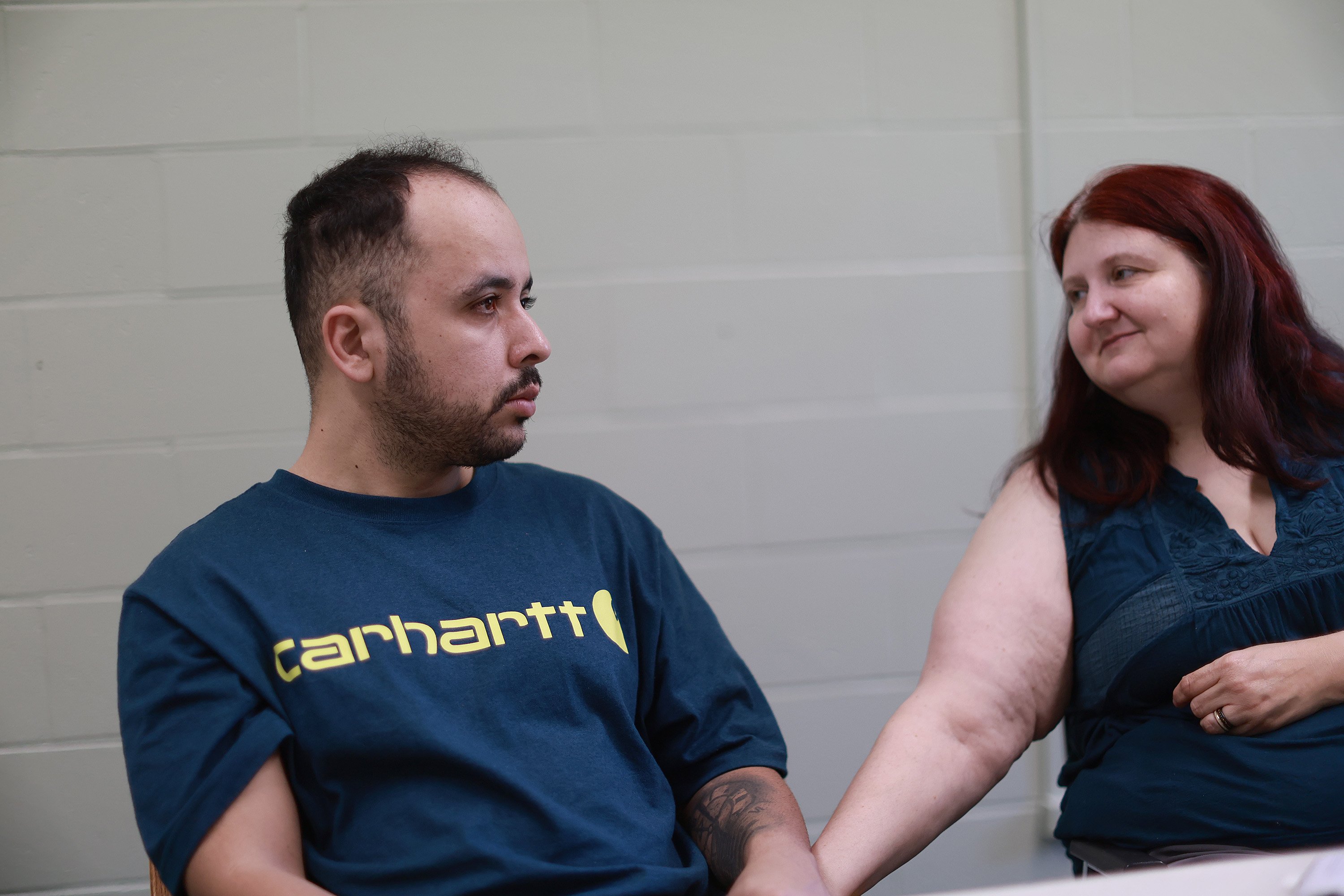
Alessia Gaspar-Da Silva of Bridgton smiles at her husband, Marcos, who was picked up by Immigration and Customs Enforcement in late January and held for seven months. Marcos was in the U.S. with a pending asylum case and a processing green card petition while living in Bridgton. (Derek Davis/Staff Photographer)
“So it’s worrying. Do you have your paper on you?” she turned to ask him, anxiously. “You’d better.”
“Yes,” Marcos said, patting his pocket.
They both laughed in relief.
Copy the Story Link
Tagged: immigration, Immigration and Customs Enforcement, public service

Riley covers education for the Press Herald. Before moving to Portland, she spent two years in Kenai, Alaska, reporting on local government, schools and natural resources for the public radio station KDLL. More by Riley Board